Maharashtra Board Class 11 Political Science Important Questions Chapter 1 The State

Balbharti Maharashtra State Board Class 11 Political Science Important Questions Chapter 1 The State Important Questions and Answers.

Maharashtra State Board 11th Political Science Important Questions Chapter 1 The State

1A. Choose the appropriate alternative and complete the following statements.

Questions 1.
___________ is the agency of the state through which its will is formulated, expressed, and realized. (Jurisdiction, Government, Sovereignty, Legitimacy)
Answer:
Government

Question 2.
The principle of ‘self-determination of nations’ was advocated by ___________ (Woodrow Wilson, Pandit Nehru, Aristotle, Jean Bodin)
Answer:
Woodrow Wilson

Maharashtra Board Class 11 Political Science Important Questions Chapter 1 The State

Question 3.
___________ type of nationalism is reflected in liberation struggles. (Aggressive, Regressive, Progressive, Expansionist)
Answer:
Progressive

1B. Identify the incorrect pair in every set, correct it and rewrite.

Question 1.
(a) Liberal Nationalism – French Revolution
(b) Expansionist Nationalism – British Imperialism
(c) Anticolonial Nationalism – Indian Freedom Struggle
(d) Conservative Nationalism – Anti-Apartheid Struggle
Answer:
(d) Conservative Nationalism – Israeli Nationalism.

1C. State the appropriate concept for the given statements.

Question 1.
A politically organized society within a definite territory.
Answer:
State

Question 2.
A spirit of a common consciousness that binds a community together.
Answer:
Nationalism

Question 3.
The right of a section of people having unity to decide what type of government they prefer.
Answer:
Self-determination

Maharashtra Board Class 11 Political Science Important Questions Chapter 1 The State

Question 4.
Type of nationalism that promotes imperialism and colonialism.
Answer:
Expansionist Nationalism

Question 5.
A people organized for law within a definite territory.
Answer:
State

Question 6.
Authority of the government to take decisions in the public interest.
Answer:
Legitimacy

1D. Answer in one sentence only.

Question 1.
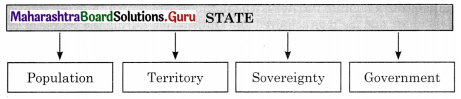
Name the four elements of a State.
Answer:
The four elements of a State are population, territory, government, and sovereignty.

Question 2.
Name the three organs of a government.
Answer:
The three organs of a government are Legislature, Executive, and Judiciary.

Maharashtra Board Class 11 Political Science Important Questions Chapter 1 The State

Question 3.
When does a ‘nation’ become a state?
Answer:
A ‘nation’ becomes a state when it has a specific territory, population, sovereignty, and an independent government.

Question 4.
What does the territory of a state include?
Answer:
Territory includes land area, the airspace over it, and the territorial waters along the coastline.

Question 5.
Name some nationalities that were part of the Soviet Union.
Answer:
Russian, Ukrainian, Latvian, and Estonian.

Question 6.
Write some factors that promote nationalism.
Answer:
Some factors that promote nationalism are common race, religion, language, etc.

Question 7.
What is the main premise of liberal nationalism?
Answer:
The main premise of liberal nationalism is that every nation has the right to freedom and self-determination.

Maharashtra Board Class 11 Political Science Important Questions Chapter 1 The State

Question 8.
What does ‘nationalism’ refer to?
Answer:
Nationalism is a force that holds the people to a sense of political loyalty to the country.

1E. Complete the following sentences by using the appropriate reasons.

Question 1.
In political terms, Maharashtra cannot be called a State because
(a) it lacks a stable government.
(b) it is under the control of the Union Government.
(c) it is a State within Indian territory but not a Sovereign unit.
Answer:
(c) it is a State within Indian territory but not a Sovereign unit.

Question 2.
After the First World War, liberal nationalism was noticed in many countries because
(a) the collapse of many empires led to demand for self-determination.
(b) these countries became colonial.
(c) these nations did not want another World War to happen.
Answer:
(a) the collapse of many empires led to a demand for self-determination.

1F. Find the odd word in the given set.

Question 1.
Executive, Legislature, Judiciary, Nation-State.
Answer:
Nation-State (not an organ of government)

Question 2.
Palestine, Sri Lanka, Canada, Israel.
Answer:
Palestine (not a State)

Maharashtra Board Class 11 Political Science Important Questions Chapter 1 The State

Question 3.
Population, Territory, Community, Sovereignty.
Answer:
Community (not an element of State)

2A. State whether the following statements are true or false with reasons.

Question 1.
Powers of the government are delegated.
Answer:
This statement is True.

  • The government is the agency through which the will of the State is formulated and expressed.
  • Thus the government is an element of the state and only has powers given to it by the state.

Question 2.
India is a member of the SAARC. Hence, it is not sovereign.
Answer:
This statement is False.

  • India has voluntarily accepted membership of the SAARC – a regional organization.
  • This membership in no way encroaches on any aspect of India’s sovereignty.

Question 3.
Nomadic tribes cannot be called a state.
Answer:
This statement is True.

  • The four elements of a State are population, territory, government, and sovereignty.
  • Nomadic tribes do not possess a fixed geographical area (territory) so they cannot be called a State.

Maharashtra Board Class 11 Political Science Important Questions Chapter 1 The State

Question 4.
India becomes a state in 1950.
Answer:
This statement is True.

  • India becomes politically independent in 1947 but become a sovereign state only on 26th January 1950.
  • This was when the Constitution came into force and India declared itself as the Sovereign Democratic Republic.

2B. Complete the concept maps.

Question 1.
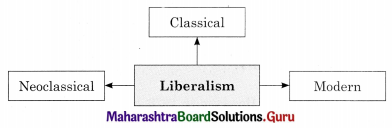
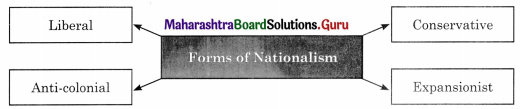
Maharashtra Board Class 11 Political Science Important Questions Chapter 1 The State 2B Q1
Answer:
Maharashtra Board Class 11 Political Science Important Questions Chapter 1 The State 2B Q1.1

Question 2.
Maharashtra Board Class 11 Political Science Important Questions Chapter 1 The State 2B Q2
Answer:
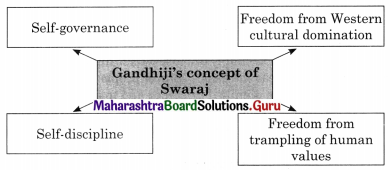
Maharashtra Board Class 11 Political Science Important Questions Chapter 1 The State 2B Q2.1

3A. Explain the correlation between the following.

Question 1.
State – Government.
Answer:
The terms State and Government are often used interchangeably. However, they are different concepts. The state is a political organization. Government is an agency of the State through which the will of the State is formulated, expressed, and realized.

Maharashtra Board Class 11 Political Science Important Questions Chapter 1 The State

Government is the main wing of the state. Its main nature is administrative. Law and order, welfare, etc. are some of the main functions of the State. These functions are performed through the government organs such as the Executive, Legislature, and Judiciary.

Powers of the government are delegated. The state is a universal, permanent institution while the Government exists in different forms for a specific period. All persons within its territory are members of the State while the number of members in the government is limited.

3B. Express your opinion of the following.

Question 1.
Nationalism is a potent force that can either unite or destroy.
Answer:
I agree with this statement.

Nationalism refers to a spirit of psychological oneness or common consciousness that binds a community together. It is an expression of emotionality.

There are many factors that promote nationalism such as culture and language, common race, religion, geographical area, history, and political aspirations. Many times, these very factors may also lead to problems among the people and hence be destructive. Indian nationalism united the people in their struggle for liberation from British colonialism. However, religious diversity and the ‘Two Nation Theory’ put forth by the Muslim League led to the partition and creation of India and West and East Pakistan in 1947.

Although religion was a unifying factor in the national spirit of Pakistan, it wasn’t enough to sustain national integration. East and West Pakistan were separated by the landmass of India and because of linguistic, cultural, and historical differences, the common consciousness dimmed. East Pakistan demanded political independence and in 1971, the State of Bangladesh was formed. Progressive nationalism can help national integration and development while aggressive nationalism is destructive in nature.

4. Answer the following questions.

Question 1.
What are the features of a Nation?
Answer:
The word ‘nation’ is derived from the Latin word ‘Nasci’ meaning ‘to be born’. Thus, the literal meaning of a nation is a people having a common race /ethnicity or cultural linkages. Earnest Barker defines a nation as a body of men, inhabiting a definite territory, who normally are drawn from different races but possess a common stock of thoughts and feelings acquired and transmitted during the course of common history.

Maharashtra Board Class 11 Political Science Important Questions Chapter 1 The State

A nation refers to a large group of people, united in common bonds of geography, race, history, religion, language, sharing common objectives.

Features of a Nation:

  • Population: A nation must have a population that has a sense of ethnic, historical, and cultural oneness.
  • Feeling of community: The emotional dimension of a nation is a perception held by the population of psychological oneness i.e., they are a community.
  • Desire to be politically separate: A feeling of unity and of being a nation is a product of the urge for ‘self-determination’. This can lead to a demand for self-governance. This signifies that people who feel united should have the right to decide the type of government that they prefer.

Question 2.
What is Nationalism? Explain its types.
Answer:
Nationalism is a force that binds the people to a sense of integrity and loyalty to their country. It is a spirit of oneness or common consciousness that binds a community together. Nationalism is a sense of political identity and emotional attachment to one’s ‘homeland’.
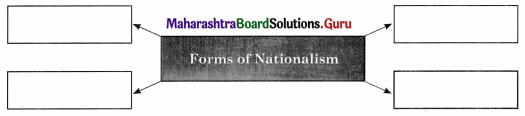
The forms of Nationalism from a political perspective are:

  • Liberal Nationalism: Its origins are in the ideals of the French Revolution. President Woodrow Wilson linked the concept of a nation to the right to self-determination and sovereignty.
  • Conservative Nationalism: It views a nation as a closely linked society with great importance to patriotism and the concept of ‘motherland’.
  • Expansionist Nationalism: It is aggressive nationalism, which leads to imperialism, conquest, and colonialism. It has been seen in European imperialism by countries like England, Italy, Spain, France, etc.
  • Anticolonial Nationalism: It refers to liberation struggles for independence from colonial rule, e.g., Indonesian freedom struggle from Dutch colonial rule.

5. Answer the following question in detail with reference to the given points.

Question 1.
Explain the following elements of the State.
(i) Sovereignty
(iii) Government
(iii) Population
(iv) Territory
Answer:
(i) Sovereignty: It signifies the supreme power of the State internally as well as externally. It means an independent nation with its own constitution.

(ii) Government: This refers to the agency through which the will of the state is expressed. Modern governments have three organs viz. legislature, executive, and judiciary. Government must be independent. Institutions of the State are ‘public’ institutions and have the legitimacy to act on behalf of the State. These institutions are responsible for making and implementing laws to promote the general welfare of the people. There are various kinds of government based on their creation or style of function for e.g., democracy or dictatorship, republic or monarchy, presidential or parliamentary system, etc.

Maharashtra Board Class 11 Political Science Important Questions Chapter 1 The State

(iii) Population: A State is an association of human beings. The progress of a State depends on the quality of the population. Some states viz. China, India, etc., have a large population while some States have a small population viz. Monaco, Belgium, etc. The population may be homogeneous e.g., Israel, or diverse e.g. erstwhile USSR comprised of many nationalities like Russians, Ukrainians, Latvians, etc. Thus a ‘State’ may comprise of many ‘nations’.

(iv) Territory: A State is recognized by its territory. This includes the land area within its boundaries, the airspace above the area, and surrounding territorial waters (up to 12 nautical miles). The area within which the State has the authority to govern is called its jurisdiction. Some states have a small territory e.g., Sri Lanka, Bhutan, Maldives, etc., while other States e.g., Brazil, Russia, India, and Australia have a large territory. Most States have compact territory e.g., India, while some states which exist as islands have scattered territory e.g., Indonesia.

6. Answer the following questions.

Question 1.
How does nationalism discourage imperialism?
Answer:
Nationalism discourages imperialism and colonialism. The resistance to any form of external occupation is one of the features of nationalism. National liberation struggles or freedom struggles across the world are a product of nationalism. It thus encourages self-determination e.g., India’s struggle for freedom from European colonialism.

Question 2.
Explain ‘legitimacy of government’.
Answer:
All citizens are members of the State. Decisions are taken in the public interest by the government of the State. This authority of the State to make decisions is called legitimacy. The State has the legitimacy to take decisions in the interest of the people.

Question 3.
Explain the ‘jurisdiction’ of a State.
Answer:
The area of the State within which it has the authority to govern is called its jurisdiction. Thus, Jurisdiction is the legal power that the State has to take decisions.

Question 4.
Describe the ‘territory’ of a State.
Answer:
The territory is an essential element of a State. It includes

  • The actual land within the national boundaries.
  • The territorial waters along the coastline. This is up to 12 nautical miles (22.2 km or 13.8 miles) along the coastline.
  • The air space above its territory (there is no international law on the height of this air space.)

Maharashtra Board Class 11 Political Science Important Questions Chapter 1 The State

Question 5.
What is a multinational state?
Answer:
States may comprise of many ‘nationalities’ living together. For example, the Soviet Union had people of many nationalities like Russians, Lithuanians, Latvians, Estonians, Ukrainians, etc. Similarly, the United Kingdom consists of England, Scotland, Wales, and Northern Ireland.

Question 6.
Do state and nation convey the same meaning?
Answer:
The terms ‘state’ and ‘nation’ appear to have the same meaning and are often used interchangeably, However, technically there is a difference. A nation has a sense of ‘oneness’ that is psychological and is born out of commonness of ethnicity and race, culture and history, religion, language, etc. The State is a politically organized society within a definite territory. It is used to describe a sovereign country having an independent government in a specific territory.

Question 7.
Write about President Wilson’s Fourteen Point speech.
Answer:
The Fourteen Point put forward by President Woodrow Wilson of the USA was a statement of principles for peace outlined in a speech on January 8, 1918. It aids an outline for stable, long-lasting peace in Europe, the Americas, and the rest of the world, following the First World War. It also visioned ‘self-determination of nations.
7. Distinguish between.

Question 1.
State and Government
Answer:

State Government
(i) State is an abstract concept. (i) Government is a concrete reality.
(ii) State is more extensive than a government. It includes all public institutions and all members of the society as citizens. (ii) Government is a part of the State.
(iii) A State is permanent in nature. (iii) A Government exists for a specific time period.
(iv) The State is an impersonal authority. It is politically neutral. (iv) The government has an ideological agenda. It wants to implement policies to achieve that agenda.
(v) The State is a sovereign entity. (v) The source of the authority of the Government is the State.

Maharashtra Board Class 11 Political Science Important Questions Chapter 1 The State

Question 2.
State and Nation
Answer:

State Nation
(i) A State is a community of persons who occupy a definite territory, have an organized government, and are independent of external control. (i) A Nation is a group of people who are united in common ties of culture, history, religion, language, etc.
(ii) A State is known by a fixed, permanent territory. (ii) A Nation does not need a territory and can be spread across many States.
(iii) State is a political-legal entity. It is a formal and objective condition in law. (iii) A Nation is a historical-cultural entity. It is a subjective, psychological condition of the spirit.
(iv) The State has coercive power and functions through its laws. (iv) A Nation has no coercive power but functions through its common ties and psychological spirit.


Maharashtra Board Class 11 History Important Questions Chapter 16 Swarajya to Empire (Maratha Period)

Balbharti Maharashtra State Board Class 11 History Important Questions Chapter 16 Swarajya to Empire (Maratha Period) Important Questions and Answers.

Maharashtra State Board 11th History Important Questions Chapter 16 Swarajya to Empire (Maratha Period)

1A. Choose the correct alternative and complete sentences.

Question 1.
___________ defeated the Yadavas of Devgiri.
(a) Alauddin Khalji
(b) Muhmmad Tughluq
(c) Hasan Gangu Bahamani
(d) Qutubuddin Aibak
Answer:
(a) Alauddin Khalji

Question 2.
After the end of Nizamshahi rule, Shahaji Raje accepted the rank of a Mansabdar in the ___________ court.
(a) Qutubshahi
(b) Imadshahi
(c) Baridshahi
(d) Adilshahi
Answer:
(d) Adilshahi

Maharashtra Board Class 11 History Important Questions Chapter 16 Swarajya to Empire (Maratha Period)

Question 3.
___________ is regarded as the visionary of Swarajya.
(a) Veermata Jeejabai
(b) Shahaji Raje
(c) Chhatrapati Shivaji Maharaj
(d) Chhatrapati Sambhaji Maharaj
Answer:
(b) Shahaji Raje

Question 4.
He took over the fort of ___________ and laid the foundation of Swarajya.
(a) Raigad
(b) Pratapgad
(c) Torana
(d) Sinhgad
Answer:
(c) Torana

Question 5.
Chhatrapati Shivaji Maharaj established the first capital of Swaraiva at the fort of ___________
(a) Rajgad
(b) Pratapgad
(c) Raj gad
(d) Vishalgad
Answer:
(a) Rajgad

1B. Find the incorrect pair from set B and write the correct ones.

Question 1.

Set ‘A’ Set ‘B’
(a) ‘Yatharthdeepika’ Vaman Pandit
(b) ‘Naladamayanti Swayamvara’ Raghunath Pandit
(c) Pandavapratapa Shridhar Pandit
(d) Translation of Mahabharata Mahipati

Answer:
(d) Translation of Mahabharata – Moropant

Question 2.

Set ‘A’ Set ‘B’
(a) ‘Gulshane-i-Ibrahimi’ History of India
(b) ‘Rajyavyavaharakosha’ A text on Maratha polity
(c) ‘Budhabhushan’ Overview of ancient texts on polity
(d) ‘Nayikabhed Text in Brij literature

Answer:
(b) ‘Rajyavyavaharakosha’ – A compilation of Sanskrit lexicon for Persian terms

Question 3.

Set ‘A’ Set ‘B’
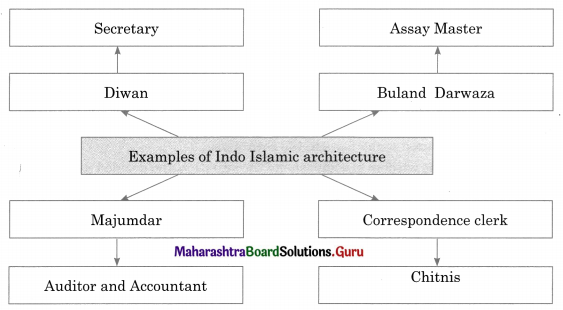
(a) Diwan Military Chief
(b) Majumdar Auditor and Accountant
(c) Phadnis Deputy Auditor
(d) Sabnis Office in-charge

Answer:
(a) Diwan – Secretary

Maharashtra Board Class 11 History Important Questions Chapter 16 Swarajya to Empire (Maratha Period)

Question 4.

Set ‘A’ Set ‘B’
(a) Karkhanis Commissary
(b) Chitnis Religious Officer
(c) Jamdar Treasurer
(d) Potdar Assay Master

Answer:
(b) Chitnis – Correspondence Clerk

1C. Find the odd one out.

Question 1.
Temples of Nashik:
(a) Mahadev
(b) Kalaram
(c) Goraram
(d) Sundarnarayan
Answer:
(a) Mahadev

Question 2.
Shahirs is known for beautiful composition:
(a) Anantafandi
(b) Prabhakar
(c) Ramjoshi
(d) Tulsidas
Answer:
(d) Tulsidas

Question 3.
Persons included in special posts of Ashtapradhans:
(a) Dhanaji
(b) Peshwa
(c) Mantri
(d) Senapati
Answer:
(a) Dhanaji

2A. Write the names of historical places, persons, and events.

Question 1.
Powerful General sent by the court of Bijapur against Chh. Shivaji Maharaj
Answer:
Afzal Khan

Question 2.
Portuguese Shipbuilders
Answer:
Rui Leitao Viegas and his son Fernao Viegas

Maharashtra Board Class 11 History Important Questions Chapter 16 Swarajya to Empire (Maratha Period)

Question 3.
Disguised himself as Chh. Shivaji Maharaj
Answer:
Shiva Kashid

Question 4.
Text ‘Nayikabhed’was written in this language
Answer:
Brij

Question 5.
Afghani Pathans are known as
Answer:
Rohillas

2B. Choose the correct reason and complete the sentence.

Question 1.
___________ was the leader of the Rohillas.
(a) Najib Khan
(b) Nizamshah
(c) Adilshah
(d) None of them
Answer:
(a) Najib Khan

Question 2.
After Chhatrapati Sambhaji Maharaj, ___________ took over the reins at Raigad.
(a) Chhatrapati Shivaji Maharaj
(b) Chhatrapati Rajaram Maharaj
(c) Chhatrapati Shahu Maharaj
(d) Shiva Maharaj
Answer:
(a) Chhatrapati Rajaram Maharaj

Maharashtra Board Class 11 History Important Questions Chapter 16 Swarajya to Empire (Maratha Period)

Question 3.
___________ defeated the Yadavas of Devgiri and the rule of Delhi Sultans began in south India.
(a) Akbar
(b) Babur
(c) Humayun
(d) Alauddin Khalji
Answer:
(d) Alauddin Khalji

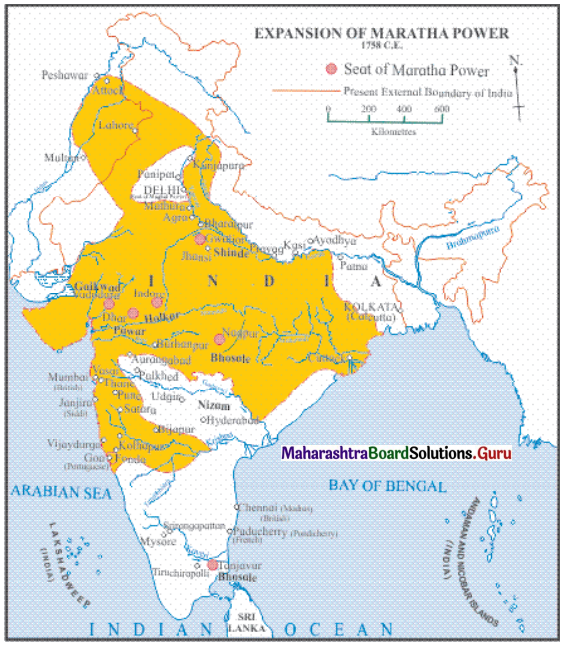
3. Observe the map on page 123 of your textbook and answer the following questions based on it.

Maharashtra Board Class 11 History Important Questions Chapter 16 Swarajya to Empire (Maratha Period) 3

Question 1.
Write the names of Seats of Maratha power.
Answer:
Gaikwads of Vadodara, Shindes of Gwalior, Bhosales of Tanjavar, Bhosales of Nagpur, Pawars of Dhar, Holkars of Indore.
Question 2.
Write the extent of Chh. Shivaji Maharaj’s Swarajya.
Answer:
The regions in Maharashtra including Nashik, Pune, Satara, Sangli, Kolhapur, Sindhudurga, Ratnagiri, Raigad; Belgaum, Karwar, Dharwad in Karnataka; some regions of Andhra, Jinji, and Vellore in Tamil Nadu comprised Swarajya.

Question 3.
Name the places in Maratha Empire that are in today’s Pakistan.
Answer:
Attock, Peshawar, Multan, Lahore.

4. Complete the concept maps.

Question 1.
Maharashtra Board Class 11 History Important Questions Chapter 16 Swarajya to Empire (Maratha Period) 4 Q1
Answer:
Maharashtra Board Class 11 History Important Questions Chapter 16 Swarajya to Empire (Maratha Period) 4 Q1.1

Maharashtra Board Class 11 History Important Questions Chapter 16 Swarajya to Empire (Maratha Period)

Question 2.
Maharashtra Board Class 11 History Important Questions Chapter 16 Swarajya to Empire (Maratha Period) 4 Q2
Answer:
Maharashtra Board Class 11 History Important Questions Chapter 16 Swarajya to Empire (Maratha Period) 4 Q2.1

Question 3.
Maharashtra Board Class 11 History Important Questions Chapter 16 Swarajya to Empire (Maratha Period) 4 Q3
Answer:
Maharashtra Board Class 11 History Important Questions Chapter 16 Swarajya to Empire (Maratha Period) 4 Q3.1

Question 4.
Maharashtra Board Class 11 History Important Questions Chapter 16 Swarajya to Empire (Maratha Period) 4 Q4
Answer:
Maharashtra Board Class 11 History Important Questions Chapter 16 Swarajya to Empire (Maratha Period) 4 Q4.1

5. Write short notes.

Question 1.
Maratha-Adilshahi Relations
Answer:

  • The inception of Swarajya- After joining the Adilshahi court, Shahaji Maharaj entrusted the administration of his Jahagirs at Pune, Shirwal, and Supe region (pargana) to Chh. Shivaji Maharaj.
  • Yet the forts located in those Jahagirs and nearby areas were in the custody of Adilshahi court. The one ‘who owns the forts owns the land’ was the ruling of the day.
  • Hence, Chh. Shivaji Maharaj began with capturing the forts in the vicinity of his Jahagirs.
  • He took over the fort of Torana and laid the foundation of Swarajya.
  • Chh. Shivaji Maharaj established the first capital of Swarajya at the fort of Rajgad.

Javali episode – Chandrarao More proved to be a hindrance in Chh. Shivaji Maharaj’s efforts to create Swarajya. Chh. Shivaji Maharaj successfully took over Javali. After this victory the activities of Chh. Shivaji Maharaj in Konkan was escalated.

Maharashtra Board Class 11 History Important Questions Chapter 16 Swarajya to Empire (Maratha Period)

Afzal Khan – Realising the danger of the increasing activities of Chh. Shivaji Maharaj, the Bijapur court sent their powerful General Afzal Khan to curb the increasing power of Chh. Shivaji Maharaj. Chh. Shivaji Maharaj had anticipated the intentions of Afzal Khan who had taken up the challenge of killing Chh. Shivaji Maharaj. He met Afzal Khan at Pratapgad. As expected, Afzal khan attempted treachery but Chh. Shivaji Maharaj was well prepared and killed Afzal khan in self-defense. Afzal Khan’s huge army was set on the run and huge booty and weapons were collected left behind by them. This made Swarajya’s treasury richer.

Siddi Jauhar – After Afzal Khan’s defeat, the Bijapur court sent Siddi Jauhar to attack Swarajya. He seized the fort of Panhala and closed all possibilities of escape for Chh. Shivaji Maharaj. In this difficult situation Shiva Kashid, a loyal servant of Swarajya, disguised himself as Chh. Shivaji Maharaj and made it easy for Chh. Shivaji Maharaj to escape.

When Siddi came to know the truth, he killed Shiva Kashid. Thus, Shiva Kashid sacrificed his life for the cause of Swarajya. Baji Prabhu took up the task of blocking Siddhi Masud’s path in Ghodkhind and stop him in his chase of Chh. Shivaji Maharaj. Baji Prabhu was successful in doing this. He fell dead only after receiving the news of Chh. Shivaji Maharaj reaching Vishalgad safely.

Question 2.
Maratha – Mughal Relations
Answer:

  • At the time of ascending the throne, Aurangzeb was aware of the ambitious plans of Chh. Shivaji Maharaj.
  • He sent his maternal uncle Shaistakhan on an expedition against Chh. Shivaji Maharaj.
  • Shaistakhan camped in Lai Mahal in Pune. Chh. Shivaji Maharaj who knew Shaistakhan’s intentions manages to enter the Lai Mahal and cut off Shaistakhan’s fingers.
  • Shaistakhan had no alternative but to hastily leave Lai Mahal. Chh. Shivaji Maharaj gained more confidence and he attacked Surat, the prosperous economic capital of Aurangzeb, and collected a large booty.
  • Enraged by this, Aurangzeb sent his powerful sardars Mirza Raje Jaising and Diler Khan to attack Swarajya. They captured many forts in the Swarajya.
  • Chh. Shivaji Maharaj had the wisdom to comprehend the situation and decided to retreat tactically by signing the ‘Treaty of Purandar’.
  • According to the treaty, Chh. Shivaji Maharaj had to present himself before Aurangzeb at Agra, along with his son Sambhaji Maharaj.
  • Aurangzeb acted treacherously and put Chh. Shivaji Maharaj is under house arrest.
  • Chh. Shivaji Maharaj very cleverly misled the guards and escaped from Agra.
  • Soon after returning to Swarajya Chh. Shivaji Maharaj conquered the forts which were held by Aurangzeb.

Maharashtra Board Class 11 History Important Questions Chapter 16 Swarajya to Empire (Maratha Period)

Question 3.
Maharani Tarabai
Answer:

  • After the death of Rajaram Maharaj (March 1700 C.E.), his wife Maharani Tarabai continued to fight against Aurangzeb.
  • Maharani Tarabai led the Swarajya movement under extremely unfavourable conditions.
  • She single-handedly took charge of the administration and fought for Swarajya for twenty-five years with the help of her sardars.
  • At times, the Marathas had to fight the Mughals on lands beyond the boundaries of Swarajya, but she did not stop them.
  • This was an indication that the scenario of the war was changing. The Maratha War of Independence was a tussle between the Mughal ambition of expanding their Empire and the desire for independence cherished by the Marathas.
  • Finally, the death of Aurangzeb put an end to this fighting. In the beginning, the Mughal rulers adopted an aggressive policy while the Maratha policy remained that of defense.
  • But by the second half of the 18th century, this condition changed. With the weakening of Mughal power, the Marathas could extend their rule almost all over India.

6. Explain the following statement with reasons.

Question 1.
Chh. Shivaji Maharaj signed the Treaty of Purandar
Answer:

  • Aurangzeb sent his powerful sardars Mirza Raje Jaising and Diler Khan to attack Swarajya.
  • They captured many forts in the Swarajya. Mirza Raje Jaising was a powerful and competent military commander.
  • He blocked Chh. Shivaji Maharaj from all sides. Lives of Chh. Shivaji Maharaj’s men were endangered.
  • Chh. Shivaji Maharaj had the wisdom to comprehend the situation and decided to retreat tactically by signing the ‘Treaty of Purandar’.
  • According to the treaty, Chh. Shivaji Maharaj had to present himself before Aurangzeb at Agra, along with his son Sambhaji Maharaj.

Question 2.
Shivaji Maharaj coronated himself.
Answer:

  • Chh. Shivaji Maharaj decides to give legitimacy to his earned kingdom.
  • To announce the sovereign and independent status of Swarajya it was necessary to make it official.
  • Realizing this Chh, Shivaji Maharaj decided to get himself coronated.
  • With his coronation as a sovereign king, the provinces under his rule assumed the status of an independent kingdom.
  • He minted new coins after the coronation. He started ‘Rajyabhishek Shaka’ i.e., a new era after the coronation.

7. State your opinion.

Question 1.
The work of Sants created a sense of self-esteem among the people of Maharashtra.
Answer:

  • The saints created a sense of belonging among people toward their native region, language, literature, and culture.
  • They gave a message of equality to people. Their teachings were based on the principles of humanity.
  • They preached harmonious community life, unity, and love. Their efforts created social awakening.
  • Their teaching helped people to survive situations like foreign invasions, draughts, or other natural calamities.
  • Their devotional songs became a source of great moral support for people.
  • Their work created a sense of self-esteem among the people of Maharashtra.

Question 2.
Veermata Jeejabai’s role was important in the creation of Swarajya.
Answer:

  • Shahaji Raje sent his son Shivajiraje and his wife, Veermata Jijabai from Bengaluru to Pune along with his loyal and capable associates.
  • Veermata Jijabai encouraged Chh. ShivajiMaharajto fulfills the dream of Shahajiraje of establishing Swarajya.
  • She was a visionary and an efficient administrator.
  • She constantly guided her son in the mission of establishing Swarajya and provided him with the excellent education necessary for the king of Swarajya.

Maharashtra Board Class 11 History Important Questions Chapter 16 Swarajya to Empire (Maratha Period)

8. Answer the following questions in detail.

Question 1.
Write in detail about Peshwa Period
Answer:

  • After Balaji Vishwanath, his son, Bajirao I was appointed as the Peshwa. He expanded the Maratha empire up to Malwa, Rajasthan, and Bundelkhand. He defeated the Nizam.
  • After Bajirao I, Balaji Bajirao alias Nanasaheb was appointed as the Peshwa. Madhavrao Peshwa tried to re-establish the Maratha power.
  • The defeat in Panipat was not just a political defeat but also lowered the morale of the Marathas greatly.
  • Madhavrao Peshwa tried to elevate the spirits of Marathas as well as re-establish the Maratha power in the north.
  • The Marathas were successful in overcoming the great defeat at Panipat and create a politically strong position for themselves in the politics of the north.
  • Malharrao was the founder of the Holkar State at Indore. He served the Maratha power for a long time.

Question 2.
Write about Maratha’s War of Independence.
Answer:

  • After the death of Chhatrapati Shivaji Maharaj, Chhatrapati Sambhaji Maharaj was coronated as the King of Swarajya.
  • During his reign, a constant conflict continued with the Mughal Emperor Aurangzeb. Aurangzeb’s rebellious son, Akbar had established friendly relations with Sambhaji Maharaj.
  • Enraged by this Aurangzeb came down to Deccan along with a huge army and able sardars, who were veterans of warfare.
  • For the next 25 years, he camped in Maharashtra and fought against the Marathas.
  • After Chhatrapati Sambhaji Maharaj, Chhatrapati Rajaram Maharaj took over the reins at Raigad.
  • Aurangzeb sent Zulfikar Khan to seize the fort of Raigad.
  • Chhatrapati Rajaram Maharaj, Maharani Tarabai, Maharani Yesubai (Queen of Chhatrapati Sambhaji Maharaj), and her son Prince Shahu were staying on Raj gad.
  • After the death of Rajaram Maharaj (March 1700 C.E.), his wife Maharani Tarabai continued to fight against Aurangzeb.
  • Maharani Tarabai led the Swarajya movement under extremely unfavourable conditions.
  • She single-handedly took charge of the administration and fought for Swarajya for twenty-five years with the help of her sardars.

9. Answer the following questions with the help of given points.

Question 1.
Write in detail about Maratha’s administration under Chh. Shivaji Maharaj.
(a) Central administration
(b) Provincial administration
(c) Village administration
Answer:
(a) Central administration:

  • Chh. Shivaji Maharaj set up an ideal administrative system for the smooth running of Swarajya’s affairs.
  • The formation of the Ashtapradhan Mandal (council of eight ministers) and its growth took place along with the expansion of the kingdom.
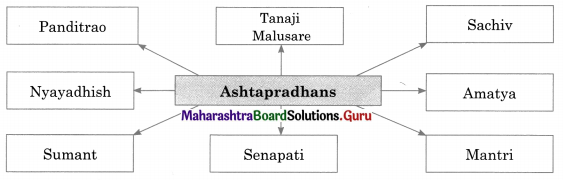
  • After the coronation, Chhatrapati Shivaji Maharaj created special posts of Ashtapradhans. It included ‘Peshwa’, ‘Amatya’, ‘Sachiv’, ‘Mantri’, ‘Senapati, ‘Sumant’, ‘Nyayadhish’ and ‘Panditrao’.
  • Chh. Shivaji Maharaj had a strong intelligence network of his own. Bahirji Naik was the Chief of this network. Before starting on any expedition, Chh. Shivaji Maharaj obtained detailed information from his spies and then planned his expedition.

Maharashtra Board Class 11 History Important Questions Chapter 16 Swarajya to Empire (Maratha Period)

(b) Provincial administration:

  • The Kingdom was divided into two parts for the sake of administration. One of them was the province that was geographically bound together and the other comprised scattered regions in the south.
  • Sarsubhedars taking care of provincial administration were known as ‘Deshadhikari’.
  • Sarsubhas in the Swarajya was meant to be the zonal division for the overall administration, while under Islamic rulers a division merely served the purpose of revenue collection.

(c) Village administration:

  • The Subhedars were assisted by ‘Deshmukhs’ and ‘Deshpandes’.
  • The main task of a Deshmukh was to collect the land revenue, develop wasteland into cultivable land and settle new villages.
  • All government officials received salaries in the form of cash instead of a land grant (watan).
  • ‘Village’ was the basic unit of the administrative system. New villages were settled.
  • The people were provided with cattle, seed money, money for daily utilities.
  • The farmer was given a period of two years, to repay the advance after a good harvest. This system was known as the ‘Batai system’.

Question 2.
Write in detail about the social conditions during the Maratha period.
(a) Art
(b) Architecture
(c) Literature
Answer:
(a) Art:

  • The development of Maratha miniature paintings is seen through illustrations on the manuscripts such as pothis, pattachitra, and patrikas. The same style is maintained in the glass paintings as well.
  • Illustrated manuscripts of Sanskrit texts such as ‘Bhagvat Gita’, ‘Devi Saptashati’, ‘Bhagvat Purana’ as well as Marathi texts such as ‘Dnyaneshwari’ (Bhavarthadipika), ‘Shivaleelamrut’, ‘Pandavapratap’ etc. are available.
  • The paintings of Dashavatara are included in them. The wooden stands of the pothis have paintings of various deities in dark red, green, and yellow colours.
  • The miniature paintings, include human portraits and themes like ragamalas, talamala, processions, etc.
  • Remarkable portraits of Bajirao I, Nanasaheb Peshwa, Pilaji Jadhavrao are available. Murals are found on the facade of the wadas as well as on the walls of reception areas (Diwankhana) and bedrooms.
  • In the temples, the mandapa wall, owri (varanda), shikhara, gabhara (sanctum sanctorum), and chat (ceiling) were also decorated with paintings. Mythological stories form the main theme of these murals.
  • They include scenes from Ramayana and Mahabharata and Puranas. The paintings of Dashavatara and Krishnaleela are found almost everywhere.
  • The subjects of contemporary social life were also popular in the paintings. The royal court, royal meetings, processions were also included in them.
  • Keertan, Bhajana, Powadas (Ballads), Lavani were popular folk songs in Maharashtra.

(b) Architecture:

  • Forts – Chh. Shivaji Maharaj gave priority to building forts. The tradition of building forts was prevalent in the Deccan in the last three centuries. This tradition proved to be of advantage to Chh. Shivaji Maharaj..
  • Temples – The Kasaba temple in Pune and Vitthal temple in Vitthalwadi were reconstructed by Veermata Jijabai. The construction of temples began on a large scale during the later Peshwa period. These temples were of three types. Examples, of the temple architecture of this period, are found at Saswad (‘Vateshwar’ ‘Sangameshwar’), Mahuli (‘Vishweshwar’).
  • Town Planning – Pune, Satara, and Nashik developed into big cities. These cities had well-paved roads, wadas on both sides of the road, and arched gates at intervals.

Maharashtra Board Class 11 History Important Questions Chapter 16 Swarajya to Empire (Maratha Period)

(c) Literature:

  • Marathi literature developed greatly during this period. Sant Tukaram of this period was a poet of the Warkari sect.
  • Samarth Ramdas wrote ‘Dasbodh’ and ‘Manache Shlok’ in Marathi. Chhatrapati Shivaji Maharaj got the ‘Rajyavyavaharakosha’ prepared which was a compilation of Sanskrit lexicon for Persian terms.
  • Chhatrapati Sambhaji Maharaj was a great writer and Sanskrit scholar. The Sanskrit text ‘Budhabhushan’ was written by him.
  • This text is an overview of ancient texts on the polity. Apart from Sanskrit, he also knew many other languages.
  • He wrote texts in Brij language namely ‘Nayikabhed’, ‘Nakhshikh’ and ‘Satasattak’. Muhammad Qasim Ferishta wrote the history of India in 12 volumes named ‘Gulshane-i-Ibrahimi’.
  • In the 18th century, well-known literary works were composed such as ‘Yatharthdeepika’ by Vaman Pandit, ‘Naladamayanti Swayamvara’ by Raghunath Pandit, Pandavapratapa, Harivijay, Ramavijay by Shridhar Pandit, and the translation of Mahabharata by Moropant. Bakhar literature is important among the historical literature in Marathi.
  • It contains eulogies of the heroes and stories of historic events, battles, lives of great men. Sabhasad Bakhar, Bhausahebanchi Bakhar, Panipatchi Bakhar are some of its examples.
  • Krushna Dayarnav and Shridhar were the main poets during the Peshwa period. Poet Mahipati composed ‘Bhaktivijay’ in this period.

Maharashtra Board Class 11 History Important Questions Chapter 15 India During Mughal Period

Balbharti Maharashtra State Board Class 11 History Important Questions Chapter 15 India During Mughal Period Important Questions and Answers.

Maharashtra State Board 11th History Important Questions Chapter 15 India During Mughal Period

1A. Choose the correct alternative and write the complete sentences.

Question 1.
___________ was the king of Farghana province in Central Asia.
(a) Taimurlang
(b) Babur
(c) Genghis khan
(d) Akbar
Answer:
(b) Babur

Question 2.
After Humayun, his son ___________ ascended the throne.
(a) Babur
(b) Aurangzeb
(c) Akbar
(d) Shershah
Answer:
(c) Akbar

Maharashtra Board Class 11 History Important Questions Chapter 15 India During Mughal Period

Question 3.
Rana Pratap was the ruler of ___________
(a) Mewar
(b) Jodhpur
(c) Jaipur
(d) Bundelkhand
Answer:
(a) Mewar

Question 4.
Baburnama was written by ___________
(a) Akbar
(b) Birbal
(c) Babur
(d) Jahangir
Answer:
(c) Babur

Question 5.
The Taj Mahal was built by ___________
(a) Babur
(b) Akbar
(c) Shahajahan
(d) Jahangir
Answer:
(c) Shahjahan

Question 6.
___________ was a Sanskrit scholar.
(a) Dara Shukoh
(b) Aurangzeb
(c) Shah Shuja
(d) Murad Baksh
Answer:
(a) Dara Shukoh

Maharashtra Board Class 11 History Important Questions Chapter 15 India During Mughal Period

1B. Find the incorrect pair from set B and write the correct ones.

Question 1.

Set ‘A’ Set ‘B’
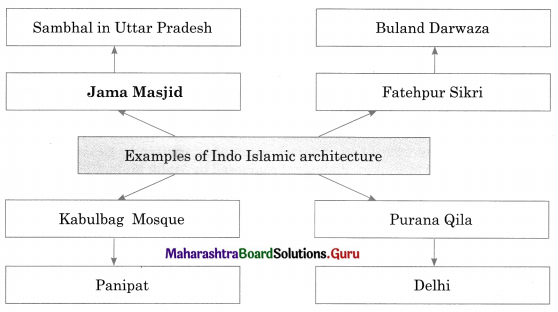
(a) Tombs of Salim Chisti Fatehpur Sikri
(b) Kabulbag mosque Panipat
(c) Jama Masjid Sambhal
(d) Purana Qila Ajmer

Answer:
(d) Purana Qila – Delhi

Question 2.

Set ‘A’ Set ‘B’
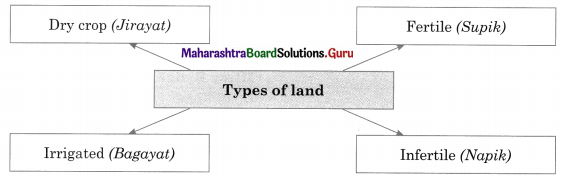
(a) Fertile Stupik
(b) Infertile Napik
(c) Irrigated Bagayat
(d) Dry crop Jiyarat

Answer:
(a) Fertile – Supik

1C. Find the odd one out.

Question 1.
Diwan-i-Aam, Diwan-i-Khaas Jama Masjid, Kutub Minar
Answer:
Kutub Minar

Question 2.
Surat, Dabhol, Agra, Calicut
Answer:
Agra

Question 3.
Rajatarangini, Lilavati, Ramayana, Ramacharitamanas
Answer:
Ramacharitamanas

Question 4.
Pahari, Basauli, Gadhwali, Kangra
Answer:
Pahari

2A. Write the names of historical places, persons, and events.

Question 1.
Documents prepared after the fixing of the tax rate.
Answer:
Kabulayat and Patta

Maharashtra Board Class 11 History Important Questions Chapter 15 India During Mughal Period

Question 2.
He translated Upanishads texts in the Persian language from Sanskrit.
Answer:
Dara

Question 3.
He was born in Uzbekistan.
Answer:
Babur

Question 4.
After Humayun, his son ascended the throne.
Answer:
Akbar

2B. Choose the correct reason and complete the sentence.

Question 1.
The Mughals ruled over India for more than ___________
(a) four centuries
(b) two centuries
(c) one centuries
(d) three centuries
Answer:
(d) three centuries

Question 2.
The grand army of Ibrahim Lodi could not survive in front of ___________
(a) Babur, in the battle of Panipat
(b) Babur, Battle of Khanwa
(c) Rana Pratap, the ruler of Mewar
(d) Humayun’s son Akbar
Answer:
(a) Babur, in the battle of Panipat

2C. Write the correct chronological order.

Question 1.
(a) Babur established his rule in Delhi.
(b) Babur’s son Humayun ascended the throne.
(c) Babur defeated Ibrahim Lodi.
(d) Babur defeated Rajputs in the Battle of Khanwa.
Answer:
(a) Babur defeated Ibrahim Lodi.
(b) Babur established his rule in Delhi.
(c) Babur defeated Rajputs in Battle of Khanwa
(d) Babur’s son Humayun ascended the throne.

Maharashtra Board Class 11 History Important Questions Chapter 15 India During Mughal Period

2D. Complete the table.

Question 1.

1.Tarikh-i-Rashidi ……………………………..
2. …………………….. Khafi Khan
3. Translation of Upanishads in Persian ……………………………..
4. ……………………….. 4. Malik Muhammad Jayasi

Answer:

1. Tarikh-i-Rashidi Mirza Hyder
2. Tarikh-i-Khafikhan Khafi Khan
3. Translation of Upanishads in Persian Dara Shukoh
4. Padmavat Malik Muhammad Jayasi

Question 2.

Ruler Buildings Built
1. Babar …………………………..
2. ………………… TajMahal
3. Akbar ………………………….
4. …………………. Memorial at Sahastram (Bihar)

Answer:

Ruler Buildings Built
1. Babar Kabulbag Mosque
2. Shahjahan TajMahal
3. Akbar Buland Darwaza
4. Shershah Sur Memorial at Sahastram (Bihar)

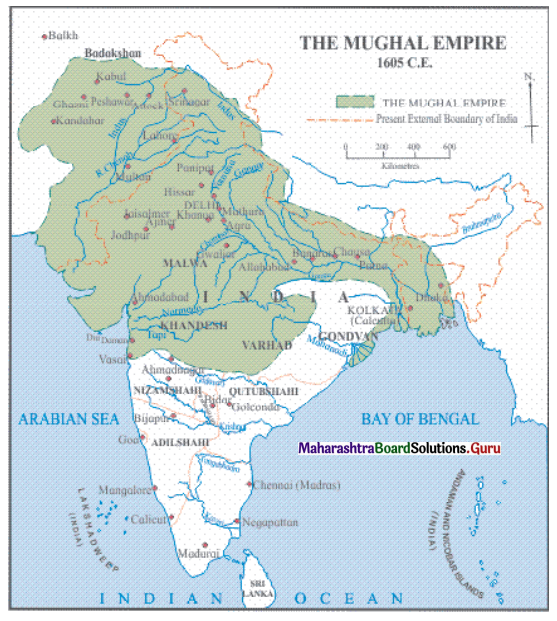
3. Observe the map on page 111 of your textbook and answer the following questions based on it.

Maharashtra Board Class 11 History Important Questions Chapter 15 India During Mughal Period 3

Question 1.
Name the kingdoms in Maharashtra during medieval times.
Answer:
Mughals, Adilshahi, Nizamshahi

Question 2.
Name the rivers in Maharashtra.
Answer:
Narmada, Tapi, Godavari

Question 3.
Name the islands shown on a map.
Answer:
Lakshadweep and Andaman and the Nicobar Islands

Question 4.
Name the ocean at the tip of India.
Answer:
Indian Ocean

Maharashtra Board Class 11 History Important Questions Chapter 15 India During Mughal Period

Question 5.
Name the sea shown on a map.
Answer:
Arabian Sea

4. Complete the concept maps.

Question 1.
Maharashtra Board Class 11 History Important Questions Chapter 15 India During Mughal Period 4 Q1
Answer:
Maharashtra Board Class 11 History Important Questions Chapter 15 India During Mughal Period 4 Q1.1

Question 2.
Maharashtra Board Class 11 History Important Questions Chapter 15 India During Mughal Period 4 Q2
Answer:
Maharashtra Board Class 11 History Important Questions Chapter 15 India During Mughal Period 4 Q2.1

Question 3.
Maharashtra Board Class 11 History Important Questions Chapter 15 India During Mughal Period 4 Q3
Answer:
Maharashtra Board Class 11 History Important Questions Chapter 15 India During Mughal Period 4 Q3.1

5. Explain the following statements with reasons.

Question 1.
For the expansion of the empire, Akbar adopted the strategy of persuasion with the Rajputs.
Answer:

  • Akbar faced many internal and external problems when he started his rule. Mughal power was not completely established and it was vulnerable to attacks.
  • During this period, Rana Pratap, the ruler of Mewar, put up a strong resistance against Akbar. Akbar could never win a war with Rana Pratap.
  • Hence for the expansion of the empire, he adopted the strategy of persuasion with the Rajputs.
  • Akbar had realized that if the Mughal rule has to be strengthened in India then he had to adopt non-offensive policies, which would be popular.

Maharashtra Board Class 11 History Important Questions Chapter 15 India During Mughal Period

Question 2.
Mughal Empire declined.
Answer:

  • After Akbar, Jahangir, Shahjahan, and Aurangzeb ruled efficiently.
  • Aurangzeb attempted to expand his empire in the Deccan with prolonged campaigns. There was a toll on the economic status of the Mughals. The campaign in the south drained huge wealth from the Mughal treasury.
  • Aurangzeb’s reign is notable for his wars in frontier provinces, his political policies in North and South India, staunch religious policies, and the Mughal- Maratha conflict. All these things ultimately resulted in the decline of Mughal power.
  • This period is marked by the expansion of the Maratha kingdom, interference by the Europeans in the political affairs of India, and the decline of Mughal power.
  • Finally, the aftermath of the struggle for Independence in 1857 C.E., saw the end of the Mughal rule under Bahadur Shah.

Question 3.
Akbar’s administration was welfare-oriented.
Answer:

  • An average of the annual yield in the last ten years was calculated and one-third of this average yield was fixed as the base for the tax to be paid.
  • The tax, thus fixed, was applicable for the span of ten years. This offered considerable respite to farmers for a span of ten years.
  • Documents are known as ‘Kabulayat’ and ‘Patta’ were prepared from the farmers after the fixing of the tax rate. The tax was collected in cash or in kind.
  • The farmers have sanctioned loans for tilling the land, which could be repaid in installments.
  • Concessions were also granted to the farmers during times of calamities like famine, floods, and epidemics. These were the Welfare policies of Emperor Akbar.
  • Todarmal in Emperor Akbar’s court is known for his insights regarding the welfare of common people.

6. State your opinion.

Question 1.
Arts flourished during the period of the Mughals.
Answer:

  • The reign of the three emperors, Akbar, Jahangir, and Shahjahan was a period of peace, order, and prosperity. Arts flourish when there is stability.
  • A new era began in the field of art and architecture. The etched designs on the marble walls of mosques, tombs, and palaces are evidence of the highly advanced styles of art and architecture.
  • During the period of Akbar and Jahangir, the art of ivory carving received royal patronage.
  • The Mughal paintings originated from the Persian styles of painting.
  • There are miniature paintings of Persian style in the manuscript of ‘Baburnama’. The art of painting received encouragement during the period of Akbar. He appointed skilled painters in his court.
  • During the period of Jahangir, paintings were done based on the court and hunting scenes. The paintings of this period were done in a more realistic style, which is vibrant and attractive. These paintings, portray birds and animals, cloud formations, human figures, and natural scenery.
  • During the Mughal period, the art of music seems to have received royal patronage.

Question 2.
Mughals could establish their rule in India.
Answer:

  • At the beginning of the 16th century, the political condition in India was somewhat disturbed.
  • The Sultanate’s rule had begun to decline after Muhammad Tughluq. The Delhi Sultanate broke down completely and many new independent kingdoms emerged in North, Central, and South India.
  • The Bahamani kingdom got divided into five branches. The prosperous Vijaynagar empire was’ destroyed by the five Islamic ruling houses in the South.
  • During the same period, the Portuguese began to settle on the western coast of India. The traditional military system of the Indian rulers in the medieval period was not capable of facing the onslaught of new challenges.
  • The Indians were not familiar with modern weaponry. Taking advantage of all this, the Mughals established their rule in India.

Maharashtra Board Class 11 History Important Questions Chapter 15 India During Mughal Period

Question 3.
India received silver every year in large quantities.
Answer:

  • Foreign trade flourished to a great extent during the Mughal period.
  • Exports from India were larger than the imports.
  • Many commodities including silk cloth, precious stones, spices, etc. were exported from India while the imported goods mainly included luxury items.
  • The foreign traders had to pay for the Indian goods in the form of silver.
  • Hence, India received silver every year in large quantities.

7. Answer the following questions with the help of given points.

Question 1.
Write in detail about Mughal Land Revenue System.
(a) Land Survey
(b) Rate of Tax
(c) Welfare Oriented Policy
Answer:
(a) Land Survey:

  • Akbar made further reforms in the revenue system implemented by Shershah Sur. This bought a certain discipline in the Mughal revenue system.
  • He graded the cultivable land based on the systematic land survey. The land was classified into four types on the basis of annual yield, i.e. fertile (supik), infertile (napik), irrigated (bagayat), and dry crop (jirayat) land.

(b) Rate of Tax:

  • Individual land holdings of farmers were registered. An average of the annual yield in the last ten years was calculated and one-third of this average yield was fixed as the base for the tax to be paid.
  • The tax, thus fixed, was applicable for the span of ten years. This offered considerable respite to farmers for a span of ten years. Documents knew as ‘Kabulayat’ and ‘Patta’ were prepared by the farmers after the fixing of the tax rate.

Maharashtra Board Class 11 History Important Questions Chapter 15 India During Mughal Period

(c) Welfare Oriented Policy:

  • The tax was collected in cash or in kind. The farmers have sanctioned loans for tilling the land, which could be repaid in installments.
  • Concessions were also granted to the farmers during times of calamities like famine, floods, and epidemics. These were the Welfare policies of Emperor Akbar.
  • Todarmal in emperor Akbar’s court is known for his insights regarding the welfare of common people. His insights were instrumental for Akbar’s land reforms.

Maharashtra Board Class 11 History Important Questions Chapter 14 Delhi Sultanate, Vijayanagar and Bahamani Kingdom

Balbharti Maharashtra State Board Class 11 History Important Questions Chapter 14 Delhi Sultanate, Vijayanagar and Bahamani Kingdom Important Questions and Answers.

Maharashtra State Board 11th History Important Questions Chapter 14 Delhi Sultanate, Vijayanagar and Bahamani Kingdom

1A. Choose the correct alternative and write the complete sentences.

Question 1.
___________ is the founder of the Slave Dynasty.
(a) Qutubuddin Aibak
(b) Mohd. Ghori
(c) Sultan of Ghazni
(d) Alauddin Khalji
Answer:
(a) Qutubuddin Aibak

Question 2.
Qutub Minar at Mehrauli is a well-known example of ___________ architecture.
(a) Indian
(b) Islamic
(c) Greek
(d) Roman
Answer:
(b) Islamic

Maharashtra Board Class 11 History Important Questions Chapter 14 Delhi Sultanate, Vijayanagar and Bahamani Kingdom

Question 3.
The Italian traveller Nicolo Conti visited ___________
(a) Vijayanagar
(b) Delhi
(c) Iran
(d) Karnataka
Answer:
(a) Vijaynagar

Question 4.
___________ wrote a text called ‘Amuktamalyada’.
(a) Harihara
(b) Bukka
(c) Krishnadeva Raya
(d) Purnaiya
Answer:
(c) Krishnadevaraya

Question 5.
Tuli translated the text of ___________
(a) Koshashastra
(b) Bhadvad Gita
(c) Ramayan
(d) Mahabharata.
Answer:
(a) Koshashatra

Question 6.
___________ built Alai Darwaza.
(a) Alberuni
(b) Alauddin Khalji
(c) Qutubuddin Aibak
(d) Iltutmish
Answer:
(b) Alauddin Khalji

1B. Find the incorrect pair from set B and write the correct ones.

Question 1.

Set ‘A’ Set ‘B’
(a) Mahmud Sultan of Ghazni
(b) Muhammad Ghuri Turkish Empire
(c) Qulibuddin Aibak Sultan of Delhi
(d) Taimur Ruler of Iran

Answer:
(d) Taimur – Ruler of Mongol

Question 2.

Set ‘A’ Set ‘B’
(a) Kalachuris Tripuri
(b) Chalukyas Gujarat
(c) Palas Bengal
(d) Kalachuris Malwa

Answer:
(d) Kalachuris – Gorakhpur

Maharashtra Board Class 11 History Important Questions Chapter 14 Delhi Sultanate, Vijayanagar and Bahamani Kingdom

1C. Find the odd one out.

Question 1.
Monuments erected during Islamic Period:
(a) Quwwat-i-Islam
(b) Qutub Minar
(c) Alai Darwaza
(d) Qawwali
Answer:
(d) Qawwali

Question 2.
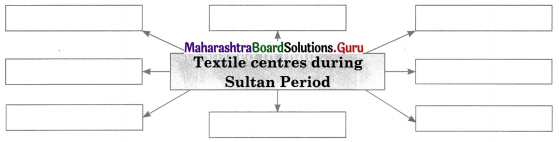
Main centers of Textile during Sultan period:
(a) Delhi
(b) Chennai
(c) Agra
(d) Multan
Answer:
(b) Chennai

Question 3.
Cities set up by Sultan of Tughluq Dynasty:
(a) Mahajanapadas
(b) Tughluqabad
(c) Jahanpanha
(d) Firozabad
Answer:
(a) Mahajanapadas

Question 4.
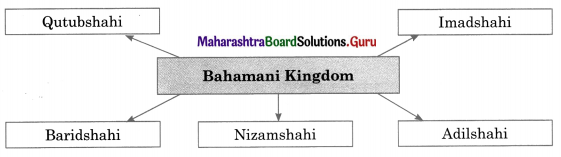
Ruling houses of Bahamani Kingdom:
(a) Imadshahi of Varhad
(b) Baridshahi of Bidar
(c) Adilshahi of Bijapur
(d) Gawan of Golconda
Answer:
(d) Gawan of Golconda

2A. Write the names of historical places, persons, and events.

Question 1.
Rulers of Malwa –
Answer:
Parmars

Question 2.
Railway line near Peshawar in Pakistan –
Answer:
Jamrud

Question 3.
First Sultan of Delhi –
Answer:
Qutubuddin Aibak

Maharashtra Board Class 11 History Important Questions Chapter 14 Delhi Sultanate, Vijayanagar and Bahamani Kingdom

Question 4.
First and the only woman to ascend the throne of Delhi –
Answer:
Razia Sultan

Question 5.
Mongol rulers in Central Asia –
Answer:
Taimur

Question 6.
Well-known poet and scholar in the court of Sultan Balban –
Answer:
Amir Khusrow

Question 7.
The standard unit for the weight of coin –
Answer:
Tola

Question 8.
Mosque at Delhi built by Qutubuddin Aibak –
Answer:
Quwwat-i-Islam

Question 9.
Persian traveller who visited India during the period of Mahmud Ghazni –
Answer:
Al-Beruni

Question 10.
The text was written by Krishnadevaraya –
Answer:
Amuktamalyada

2B. Choose the correct reason and complete the sentence.

Question 1.
The transition of the ancient period to the medieval period is reflected in
Reason ___________
(a) Political
(b) Social
(c) Economic, religious and cultural
(d) All of the above
Answer:
(d) All of the above

Maharashtra Board Class 11 History Important Questions Chapter 14 Delhi Sultanate, Vijayanagar and Bahamani Kingdom

Question 2.
The Indian rules could be defeated easily by the Turks because of ___________
(a) internal dissent
(b) lack of bravery
(c) lack of stability
(d) they were soft targets
Answer:
(a) internal dissent

Question 3.
Alauddin Khilji sent his commander Malik Kafur to south because of ___________
(a) he wanted to subdue the Yadavas and collect tribute from them
(b) he devised some new economic reforms
(c) of social reasons
(d) he wanted to build his empire in the south
Answer:
(a) he wanted to subdue the Yadavas and collect tribute from them

2C. Write the correct chronological order.

Question 1.
(a) Prithviraj Chauhan was defeated in the Second Battle of Tarain.
(b) Muhammad Tughluq shifted the capital from Delhi to Devgiri.
(c) Sabuktgin, the Sultan of Ghazni attacked King Jaipal of Punjab.
(d) Qutubuddin Aibak became the first Sultan of Delhi.
Answer:
(a) Subuktigin, the Sultan of Ghazni attacked King Jaipal of Punjab.
(b) Prithviraj Chauhan was defeated in the Second Battle of Tarain.
(c) Qutubuddin Aibak became the first Sultan of Delhi.
(d) Muhammad Tughluq shifted the capital from Delhi to Devgiri.

Maharashtra Board Class 11 History Important Questions Chapter 14 Delhi Sultanate, Vijayanagar and Bahamani Kingdom

2D. Complete the concept Maps.

Question 1.
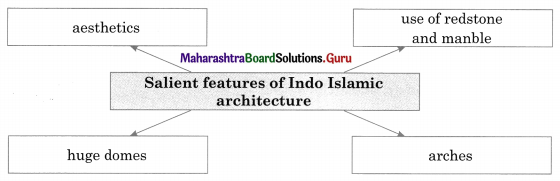
Maharashtra Board Class 11 History Important Questions Chapter 14 Delhi Sultanate, Vijayanagar and Bahamani Kingdom 2 Q1
Answer:
Maharashtra Board Class 11 History Important Questions Chapter 14 Delhi Sultanate, Vijayanagar and Bahamani Kingdom 2 Q1.1

Question 2.
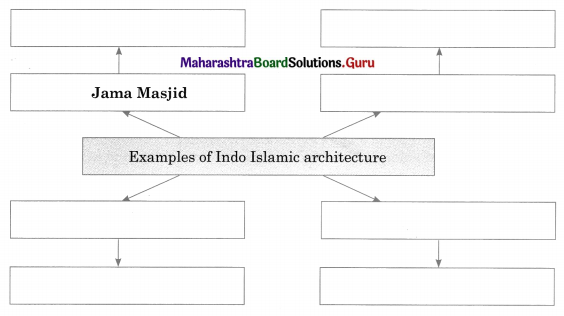
Maharashtra Board Class 11 History Important Questions Chapter 14 Delhi Sultanate, Vijayanagar and Bahamani Kingdom 2 Q2
Answer:
Maharashtra Board Class 11 History Important Questions Chapter 14 Delhi Sultanate, Vijayanagar and Bahamani Kingdom 2 Q2.1

Question 3.
Maharashtra Board Class 11 History Important Questions Chapter 14 Delhi Sultanate, Vijayanagar and Bahamani Kingdom 2 Q3
Answer:
Maharashtra Board Class 11 History Important Questions Chapter 14 Delhi Sultanate, Vijayanagar and Bahamani Kingdom 2 Q3.1

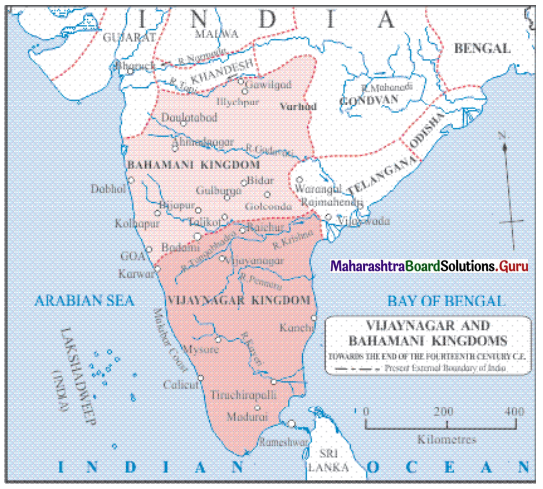
3. Observe the map on page 108 of your textbook and answer the following questions, based on it.

Maharashtra Board Class 11 History Important Questions Chapter 14 Delhi Sultanate, Vijayanagar and Bahamani Kingdom 3

Question 1.
What does the map show?
Answer:
The map shows the Vijayanagar and Bahamani Kingdom.

Question 2.
Name the four rivers in the Vijayanagar Kingdom.
Answer:
River Tungabhadra, River Krishna, River Penneru, and River Kaveri.

Question 3.
Where is Lakshadweep island?
Answer:
The island Lakshadweep is in the Arabian Sea.

Maharashtra Board Class 11 History Important Questions Chapter 14 Delhi Sultanate, Vijayanagar and Bahamani Kingdom

Question 4.
Name the famous coast near Calicut.
Answer:
Malabar Coast is the famous coast near Calicut.

Question 5.
Name the river in Gondvan.
Answer:
River Mahanadi.

4. Write short notes.

Question 1.
Amir Khusrow
Answer:

  • Amir Khusrow was a well-known poet and scholar who composed poetry in the Indian language.
  • He spent his life in the court of Sultan Balban in Delhi.
  • While describing the muslin of Dhaka, he says, “the Muslin is so fine that even if a hundred yards are tied around the head, one could still see the hair.”

5. Explain the statements with reasons.

Question 1.
The Islamic rule was established in India.
Answer:

  • The Islamic rule In India was established by the Turks.
  • They attacked India several times.
  • None of the rulers in India could resist them.
  • They looted enormous wealth from India.
  • Many kingdoms were destroyed and Islamic rule was established.

6. State your opinion.

Question 1.
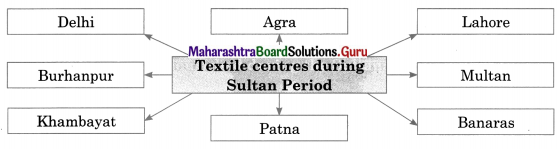
Some cities gain importance as administrative centres while others gain importance as industrial centres.
Answer:

  • The rise and fall of the cities depend on its political and cultural graph of events.
  • The process of urbanisation is associated mainly with political and economic development.
  • The rulers play an important role in the settling and development of a city.
  • According to the Arab historian, Ibn Khaldun, trade gains momentum as a result of the conducive policies of the ruler.
  • Thus, some cities gain importance as administrative centres while others gain importance as industrial centres.

Maharashtra Board Class 11 History Important Questions Chapter 14 Delhi Sultanate, Vijayanagar and Bahamani Kingdom

7. Answer the following questions in detail.

Question 1.
Elaborate on the internal trade in India.
Answer:

  • During the sultanate period, there was an increase in internal trade.
  • The local markets operated through weekly markets(Bazaar) and market places (Mandi/Mandai).
  • New trade centers (Peth) arose due to expanding transactions of trading. Some of the trading centers were Delhi, Multan, Jaunpur, Banaras, Patna, etc.
  • The goods were further transported to various ports via land or riverways.
  • Goods were exported by the sea route to countries like Iran, Arabia, China, etc.
  • The goods mainly included cotton cloth, muslin, dyed cloth, scented oils, etc.
  • Horses were imported to India from Iraq, Turkey, and Iran.
  • Semi-precious stones, mercury, lead, alum, saffron, metals like gold and silver were imported from Mecca and Aden.

Question 2.
Write in detail about Vijayanagar Empire.
Answer:

  • At the end of the 13th century, Alauddin Khalji’s invasions, the coffers of local rulers in South India were emptied to a great extent.
  • This was the time when Harihara and Bukka established the new kingdom of ‘Vijaynagar’ in 1336 C.E.
  • During the rule of King Krishnadevaraya, the kingdom expanded into an empire spreading from South Konkan in the west to Vishakhapatnam in the East and Krishna river in the north to Kanyakumari in the south.
  • Krishnadevaraya wrote a text entitled, ‘Amuktamalyada’ which is about the State and Policy.

Maharashtra Board Class 11 History Important Questions Chapter 13 India, Sri Lanka and Southeast Asia

Balbharti Maharashtra State Board Class 11 History Important Questions Chapter 13 India, Sri Lanka and Southeast Asia Important Questions and Answers.

Maharashtra State Board 11th History Important Questions Chapter 13 India, Sri Lanka and Southeast Asia

1A. Choose the correct alternative to write the complete sentences.

Question 1.
The first kingdom of Sri Lanka established was known as ____________
(a) Tambapanni
(b) Sopara
(c) Pulatthinagar
(d) Srivijaya
Answer:
(a) Tambapanni

Question 2.
____________ was the first woman to become a Buddhist nun in Sri Lanka.
(a) Sanghamitra
(b) Anula
(c) Anuradha
(d) Tara
Answer:
(b) Anula

Maharashtra Board Class 11 History Important Questions Chapter 13 India, Sri Lanka and Southeast Asia

Question 3.
The relics of Gautama Buddha are known as ____________
(a) Stupa
(b) Kesa
(c) Dhatu
(d) Galapotha
Answer:
(c) Dhatu

Question 4.
The ____________ enlist 64 Indian scripts.
(a) Deepvamsa
(b) Mahavamsa
(c) Lalitvistar
(d) Chullavamsa
Answer:
(c) Lalitvistar

1B. Find the incorrect pair from set B and write the correct ones.

Question 1.

Set ‘A’ Set ‘B’
(a) Sri Lanka Tambapanni
(b) Thailand Mueng Thai
(c) Cambodia Malaydvipa
(d) Land of Southeast Asia ‘Suvarnabhumi’

Answer:
(c) Cambodia – Kambujadesha

Question 2.

Set ‘A’ Set ‘B’
(a) Shili Foshi Srivijaya
(b) Ramakien Ram Akhyana
(c) Buddha Dantdhatu
(d) Moonstone Chandrashala

Answer:
(d) Moonstone – Chandrashila

1C. Find the odd one out.

Question 1.
Indo-China, Vietnam, Laos, Sri Lanka
Answer:
Sri Lanka

Maharashtra Board Class 11 History Important Questions Chapter 13 India, Sri Lanka and Southeast Asia

Question 2.
Dambulla, Dulatthinagar, Yongan, Anuradhpur
Answer:
Yongan

Question 3.
Srivijaya, Loas, Majapahita, Shailendra
Answer:
Loas

Question 4.
Funan, Champa, Cambodia, Matram
Answer:
Matram

Question 5.
Shailendra, Indonesia, Thailand, Myanmar
Answer:
Shailendra

2A. Write the names of historical places, persons, and events.

Question 1.
Founder of the kingdom of Tambapanni
Answer:
King Vijaya

Question 2.
The first woman to become a Buddhist nun
Answer:
Anula

Question 3.
Earliest stupas at Mihinthale
Answer:
Kantakchetiya

Maharashtra Board Class 11 History Important Questions Chapter 13 India, Sri Lanka and Southeast Asia

Question 4.
Name of the stupa erected on the remains of Thera Mahinda
Answer:
Ambasthal Thupa

Question 5.
Noted Indian philosopher
Answer:
Buddhaghosha

Question 6.
The text was written by Buddhaghosha
Answer:
Vishuddhimagga

Question 7.
Temple of Dantdhatu in the city of Kandy
Answer:
Sri Dalad Maligava

Question 8.
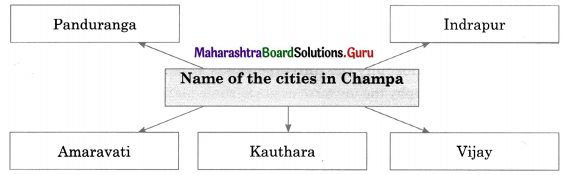
Kingdom in the delta region of Mekong
Answer:
Funan

Question 9.
Ancient kingdom in the coastal region of Vietnam
Answer:
Champa

Question 10.
The ancient name of Cambodia
Answer:
Kambujadesha

Question 11.
Temple built by Suryavarman-II
Answer:
Angkor Wat

Maharashtra Board Class 11 History Important Questions Chapter 13 India, Sri Lanka and Southeast Asia

Question 12.
Name of the founder king of ‘Majapahita’
Answer:
Vijaya

2B. Choose the correct reason and complete the sentence.

Question 1.
The southern kingdom of China was not left with any alternative path to reach the Silk Route because ____________
(a) China was attacked by a foreign power
(b) China disintegrated into three parts
(c) they found a delta region
(d) the Silk Route was infested with robbers
Answer:
(c) they found a delta region

Question 2.
The Shailendra kings built many Buddhist temples and stupas because ____________
(a) they were followers of Buddhism
(b) they were lovers of Buddhist art
(c) they were Tolerant by nature
(d) they hailed from India
Answer:
(a) they were followers of Buddhism

3. Complete the concept maps.

Question 1.
Maharashtra Board Class 11 History Important Questions Chapter 13 India, Sri Lanka and Southeast Asia 3 Q1
Answer:
Maharashtra Board Class 11 History Important Questions Chapter 13 India, Sri Lanka and Southeast Asia 3 Q1.1

Question 2.
Maharashtra Board Class 11 History Important Questions Chapter 13 India, Sri Lanka and Southeast Asia 3 Q2
Answer:
Maharashtra Board Class 11 History Important Questions Chapter 13 India, Sri Lanka and Southeast Asia 3 Q2.1

Maharashtra Board Class 11 History Important Questions Chapter 13 India, Sri Lanka and Southeast Asia

Question 3.
Maharashtra Board Class 11 History Important Questions Chapter 13 India, Sri Lanka and Southeast Asia 3 Q3
Answer:
Maharashtra Board Class 11 History Important Questions Chapter 13 India, Sri Lanka and Southeast Asia 3 Q3.1

4. Explain the following statement with reasons.

Question 1.
The southern kingdom was not left with any alternative path to reach the Silk Route.
Answer:

  • When the rule of the Han dynasty ended, China disintegrated into three parts.
  • Because of this disintegration, China was not left with any alternative path to reach the Silk Route.
  • Hence, the kingdom of the Southern Kingdom sent some people to explore the Sea Route.

Question 2.
According to Buddhist philosophy, the universe exists at three planes.
Answer:
According to Buddhist philosophy, the universe exists at three planes:

  • Kamdhatu (Bondage in the form of desire)
  • Roopdhatu (Bondage in the form of physical appearance and appellations)
  • Aroopdhatu (State of being beyond any bondage).
  • The architectural design of Borobudur Stupa is based on the concept of these three planes.

5. State your opinion.

Question 1.
King Anawrahta the founder of the ‘Pagan empire’ is known as the greatest ruler.
Answer:

  • King Anawrahta is credited with the unification of north and south Myanmar.
  • This unification is said to have given Myanmar its national identity.
  • Anawrahta put a check to the increasing power of the Khmer empire of Cambodia.
  • During his reign, the ‘Theravada Buddhism’, which had grown weaker, was revived.

Maharashtra Board Class 11 History Important Questions Chapter 13 India, Sri Lanka and Southeast Asia

Question 2.
The contact of Indians with the various region in Southeast Asia was on the increase.
Answer:

  • The contact of Indians was on the increase because of trade during the 2nd-century B.C.E.
  • The merchants who had to travel for months together were naturally accompanied by a large retinue of priests, monks, also travelers who were out to test their luck, ambitious members of royal families, etc.
  • These were the people who proved instrumental in the spread of Indian culture in Southeast Asia.

Maharashtra Board Class 11 History Important Questions Chapter 12 India, Nations in the Northwest of the Indian Subcontinent and China

Balbharti Maharashtra State Board Class 11 History Important Questions Chapter 12 India, Nations in the Northwest of the Indian Subcontinent and China Important Questions and Answers.

Maharashtra State Board 11th History Important Questions Chapter 12 India, Nations in the Northwest of the Indian Subcontinent and China

1A. Choose the correct alternative and write the complete sentences.

Question 1.
___________ a port city is mentioned in the ‘Old Testament’.
(a) Ophir
(b) Lothal
(c) Meluhha
(d) Bet Dwaraka
Answer:
(a) Ophir

Question 2.
___________ trained by sailors to reach the coast safely were called ‘Dishakak’.
(a) Sparrows
(b) Crows
(c) Kingfishers
(d) Pigeons
Answer:
(b) Crows

Maharashtra Board Class 11 History Important Questions Chapter 12 India, Nations in the Northwest of the Indian Subcontinent and China

Question 3.
___________ is identified with Babylon.
(a) Nangarhar
(b) Gandhara
(c) Kandahar
(d) Baveru
Answer:
(d) Baveru

1B. Find the incorrect pair from set B and write the correct ones.

Question 1.

Set ‘A’ Set ‘B’
(a) Geographia Strabo
(b) Naturalis Historia Yavana
(c) Geographia Claudius Ptolemy
(d) Indica Arrian

Answer:
(b) Naturalis Historia – Pliny the Elder

Question 2.

Set ‘A’ Set ‘B’
(a) Purushspur Peshawar
(b) Ancient Kapisha Begram
(c) Bhokardan Bhogvardhan
(d) Theravada Kansu

Answer:
(d) Theravada – Hinayana

1C. Find the odd one out.

Question 1.
Spread of Indian culture:
(a) Afghanistan
(b) China
(c) Rome
(d) Japan
Answer:
(c) Rome

Question 2.
Indian trade with distant lands:
(a) Kathasaritsagara
(b) Bhokarda
(c) Deepvamsa
(d) Mahavamsa
Answer:
(b) Bhokarda

Maharashtra Board Class 11 History Important Questions Chapter 12 India, Nations in the Northwest of the Indian Subcontinent and China

Question 3.
Greek Literature:
(a) Geographia
(b) Naturalis Historia
(c) Indica
(d) Periplus of Erythrean Sea
Answer:
(d) Periplus of Erythrean Sea

Question 4.
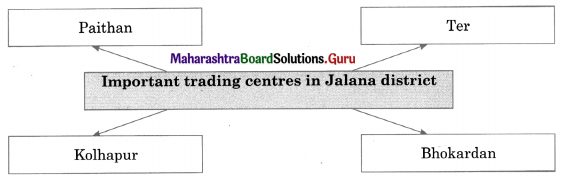
Trading centers in Jalana district:
(a) Paithan
(b) Ter
(c) Gandhara
(d) Bhokardan
Answer:
(c) Gandhara

2. Write the names of historical places, persons, and events.

Question 1.
Port city is mentioned in the ‘Old Testament’ (Bible).
Answer:
Ophir

Question 2.
The Latin name of Periplus of the Erythrean Sea.
Answer:
Periplus Maris Erythraei

Question 3.
Greek mathematician geographer, author of Geographia.
Answer:
Claudius Ptolemy

Question 4.
Famous statues of Buddha away from Kabul.
Answer:
Bamiyan statues

Question 5.
The route that links Asia and Europe.
Answer:
Silk Route

Maharashtra Board Class 11 History Important Questions Chapter 12 India, Nations in the Northwest of the Indian Subcontinent and China

Question 6.
First Buddhist temple built in China
Answer:
White Horse Temple

Question 7.
Caves are located on the ancient Silk Route.
Answer:
Mogao Caves

Question 8.
The grandson of Genghis Khan had a great interest in Buddhism.
Answer:
Kubalai

3. Complete the concept maps.

Question 1.
Maharashtra Board Class 11 History Important Questions Chapter 12 India, Nations in the Northwest of the Indian Subcontinent and China 3 Q1
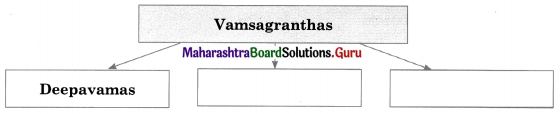
Answer:
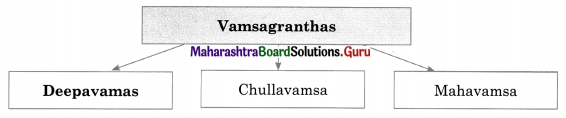
Maharashtra Board Class 11 History Important Questions Chapter 12 India, Nations in the Northwest of the Indian Subcontinent and China 3 Q1.1

Question 2.
Maharashtra Board Class 11 History Important Questions Chapter 12 India, Nations in the Northwest of the Indian Subcontinent and China 3 Q2
Answer:
Maharashtra Board Class 11 History Important Questions Chapter 12 India, Nations in the Northwest of the Indian Subcontinent and China 3 Q2.1

Maharashtra Board Class 11 History Important Questions Chapter 12 India, Nations in the Northwest of the Indian Subcontinent and China

4. State your opinion.

Question 1.
The spread of Buddhism in China introduced a new trend in Chinese art.
Answer:

  • Many of the Buddhism monks who arrived in China hailed from central Asia.
  • Their presence in China inspired the making of images of Gautama Buddha and Bodhisattvas.
  • This art style that originated in the Xinjiang province is known as ‘Serendian Art Style’ (Seres meaning China + India)

5. Answer the following questions in detail.

Question 1.
Write a note on India’s relations with Afghanistan during Emperor Ashoka’s period.
Answer:

  • Emperor Ashoka’s period 13th edict is the names of Greek kings, who were his contemporaries.
  • People in their kingdoms were following the path of morality as outlined in his message of Dhammavijaya. Among these kingdoms was the kingdom of Kamboja in Afghanistan.
  • The Ashokan edict at Kandahar is in Greek language and the script used for it is Aramaic.
  • This inscription shows that Afghanistan was an integral part of Ashoka’s empire.
  • Ashoka had sent ‘Thera Mahyantika’ (Majjhantika) to Kashmir and Afghanistan and ‘Thera Maharakkhita’ to the Greek (Yona) kingdoms, for spreading the teachings of Gautama Buddha.

Question 2.
Write in detail about Kushana Period.
Answer:

  • In the Kushana period, Buddhism reached China by this trade route. Some of the coins of emperor Kanishka carry the image of Gautama Buddha. It also has a legend that reads, ‘Boddo’.
  • This is the oldest representation of Gautama Buddha in an image form on a coin.
  • The Chinese monks like Fa-Hien, Yuan Chwang, who travelled through India have described the Buddhist viharas and stupas in India.
  • There are numerous remains of viharas and stupas in Afghanistan.
  • Among them, a place called ‘Shahji-ki-Dheri’ near Peshawar in Pakistan was excavated.
  • The importance of the stupa discovered at this place is underlined by the fact that it was built during Kanishka’s period.

6. Answers the following questions with the help of given points.

Question 1.
Write about the relations between India and Rome.
(a) Literature (Source of Information)
(b) Trade relations
Answer:
(a) Literature (Source of Information):

  • A Sailor’s handbook of his sea travels is known as ‘Periplus of Erythrean Sea’ (Latin name: Periplus Maris Erythraei).
  • The ancient cities like Bharuch, Sopara, Kalyan, etc., are mentioned in this periplus.
  • There are other texts ‘Geographia’ written by the Greek mathematician-geographer Claudius Ptolemy, Tndica’

Maharashtra Board Class 11 History Important Questions Chapter 12 India, Nations in the Northwest of the Indian Subcontinent and China

(b) Trade relations:

  • The Indo-Roman trade had begun to grow. The silk route and the ports on the south and west coasts of India played a vital role in this trade.
  • The records of the Greek historians mention a group of merchants, who paid a visit to the court of the Roman Emperor Augustus.
  • The coin hoards found in Tamil Nadu had Roman gold coins in them, but they were valued for their gold.
  • Nero, the Roman emperor had paid one million gold coins for a single chalice of emerald of Indian made.
  • Pliny the elder had expressed concern about that the drain of gold from Rome into India.
  • Strabo tells us that animals such as snakes, hunting dogs, tigers, elephants, birds like parrots and peacocks, things like hides and horns of rhinoceros, expensive textiles, pearls, ivory, and spices, etc. from India were in great demand.
  • Apart from the Roman gold coins, many other things like lead, zinc, corals, wines, olive oil were the Roman imports coming to India.
  • Cities like Paithan, Ter, Kolhapur, Bhokardan in the Jalana district were important trading centers.

Maharashtra Board Class 11 History Important Questions Chapter 11 Kingdoms in South India

Balbharti Maharashtra State Board Class 11 History Important Questions Chapter 11 Kingdoms in South India Important Questions and Answers.

Maharashtra State Board 11th History Important Questions Chapter 11 Kingdoms in South India

1A. Choose the correct alternative and write the complete sentences.

Question 1.

_____________ literature is one of the main sources of history of south India.
(a) Sangam
(b) Mahabharata
(c) Ramayana
(d) Indica
Answer:
(a) Sangam

Question 2.
_____________ language is spoken in Baluchistan.
(a) Tamil
(b) Brauhi
(c) Hindi
(d) Urdu
Answer:
(b) Brauhi

Maharashtra Board Class 11 History Important Questions Chapter 11 Kingdoms in South India

Question 3.
The first Chola king was _____________
(a) Raya Raja
(b) Rajendra Chola
(c) Karikala
(d) Rajendra II
Answer:
(c) Karikala

Question 4.
_____________ was the founder of the Vakataka dynasty.
(a) Vindhyashakti
(b) Pravarasena I
(c) Rudrasena
(d) Pravarasena II
Answer:
(a) Vindhyashakti

Question 5.
The founder of the Chalukyas is _____________
(a) Pulakeshin I
(b) Pulakeshin II
(c) Vikramaditya
(d) Jaising
Answer:
(d) Jaising

Question 6.
The capital of the Pallavas was _____________
(a) Chennai
(b) Kanchi
(c) Mahabalipuram
(d) Chingalpet
Answer:
(b) Kanchi

Question 7.
_____________ was a capable king of the Rashtrakuta dynasty.
(a) Dantidurga
(b) Krishna I
(c) Amoghvarsha
(d) Krishna II
Answer:
(c) Amoghvarsha

Maharashtra Board Class 11 History Important Questions Chapter 11 Kingdoms in South India

Question 8.
_____________ called themselves as ‘Tagarapuradhishwar’.
(a) Chalukyas
(b) Cheras
(c) Cholas
(d) Shilaharas
Answer:
(d) Shilaharas

Question 9.
The capital of Shilaharas of North Konkan was _____________
(a) Sthanak (Thane)
(b) Goa
(c) Kolhapur
(d) Panhala
Answer:
(a) Sthanak (Thane)

Question 10.
_____________ was the founder of the Gond dynasty.
(a) Ballal Singh
(b) Kol Bheel
(c) Rani Durgavati
(d) Nilkanth Shah
Answer:
(b) Kol Bheel

Question 11.
The Yadava king Shankardev was killed by _____________
(a) Malik Kafur
(b) Allaudin Khilji
(c) Mohd. Ghori
(d) Mohd. Gazni
Answer:
(a) Malik Kafur

1B. Find the incorrect pair from set B and write the correct ones.

Question 1.

Set ‘A’ Set ‘B’
(a) Cholas Tanjavur
(b) Cheras Kerala
(c) Pandyas Pudukottai
(d) Vakatakas Kanchi

Answer:
(d) Vakatakas – Malwa

Question 2.

Set ‘A’ Set ‘B’
(a) Tiruchirappalli Tamil Nadu
(b) Kurnool Andhra Pradesh
(c) Nandirandhan Nagpur district
(d) Sthanak Washim district

Answer:
(d) Sthanak – Thane

1C. Find the odd one out.

Question 1.
Ancient King’s in South India:
(a) Chola
(b) Pandya
(c) Maurya
(d) Chera
Answer:
(c) Maurya

Maharashtra Board Class 11 History Important Questions Chapter 11 Kingdoms in South India

Question 2.
Examples of Dravida Style:
(a) Kailasnath temple
(b) Elephanta caves
(c) Vaikuntha Perumal temples
(d) Brihadeshwara temples
Answer:
(b) Elephanta caves

Question 3.
Texts composed in South India:
(a) Setubandha
(b) Ratnamalika
(c) Kavirajmarg
(d) Mattavilasa
Answer:
(d) Mattavilasa

Question 4.
Languages in the Dravidian group:
(a) Tamil
(b) Kannada
(c) Malayalam
(d) Marwari
Answer:
(d) Marwari

2A. Write the names of historical places, persons, and events.

Question 1.
Province of Thanjavur and Tiruchirappalli
Answer:
Cholamandala

Question 2.
The ancient name of Kolhapur
Answer:
Kuntala

Question 3.
Composition of Pravarasena II in Maharashtri Prakrit
Answer:
Setu bandha

Question 4.
The passion of art during the Chalukya period
Answer:
Kirtivarman

Question 5.
Sanskrit play written by Mahendravarman
Answer:
Mattavilasa

Maharashtra Board Class 11 History Important Questions Chapter 11 Kingdoms in South India

Question 6.
The famous temple at Ellora built during the time of Krishna I
Answer:
KailasaTemple

Question 7.
Texts composed by Amoghvarsh
Answer:
Ratnamalika and Kavirajmarg

Question 8.
Temple at Ambarnath
Answer:
Rameshwar Mahadev

Question 9.
Temple at Khidrapur
Answer:
Koppeshwar Mahadev

Question 10.
Gond Queen who fought against Akbar
Answer:
Queen Durgavati

Question 11.
Text composed by Sarvasena
Answer:
Harivijaya

Question 12.
Two styles of temple architecture in South India
Answer:
Dravida and Vesara

2B. Choose the correct reason and complete the sentence.

Question 1.
The Indian culture between north India and south India become diverse because of _____________
(a) cultural Exchange
(b) economic Unification
(c) political Unification
(d) the conflict between North and South India
Answer:
(a) cultural Exchange

Maharashtra Board Class 11 History Important Questions Chapter 11 Kingdoms in South India

Question 2.
The Rashtrakuta dynasty declined because of _____________
(a) attacks of Pallavas and Satavahanas.
(b) attacks of Parmars and Chalukyas of Kalyani
(c) attacks of Pallavas and Chalukyas and Satavahanas
(d) attacks of Cholas and Valatakas
Answer:
(b) attacks of Parmars and Chalukyas of Kalyani

3. Observe the map on page 78 of your textbook and answer the following questions, based on it.

Maharashtra Board Class 11 History Important Questions Chapter 11 Kingdoms in South India 3

Question 1.
Name the two famous caves in Maharashtra.
Answer:
Ajanta and Ellora

Question 2.
Name the temples of Vesara style during the Chalukya rule.
Answer:
Aihole, Badami and Pattadakala

Question 3.
Name the two temples created during the Pallava period.
Answer:
Kanchi and Mahabalipuram

Question 4.
What was the capital of the Pandyas?
Answer:
Madurai

Question 5.
What is the name of the dynasty that ruled over present-day Kerala?
Answer:
Chera

4. Complete the concept maps.

Question 1.
Maharashtra Board Class 11 History Important Questions Chapter 11 Kingdoms in South India 4 Q1
Answer:
Maharashtra Board Class 11 History Important Questions Chapter 11 Kingdoms in South India 4 Q1.1

Maharashtra Board Class 11 History Important Questions Chapter 11 Kingdoms in South India

Question 2.
Maharashtra Board Class 11 History Important Questions Chapter 11 Kingdoms in South India 4 Q2
Answer:
Maharashtra Board Class 11 History Important Questions Chapter 11 Kingdoms in South India 4 Q2.1

Question 3.
Maharashtra Board Class 11 History Important Questions Chapter 11 Kingdoms in South India 4 Q3
Answer:
Maharashtra Board Class 11 History Important Questions Chapter 11 Kingdoms in South India 4 Q3.1

5. Write short notes.

Question 1.
Trade-in south India.
Answer:

  • In the kingdom of Cholas, Pandyas, Cheras, Vakatakas, Chalukyas, Rashtrakutas, etc., many professions requiring specialized skills were practiced.
  • Ivory was obtained from the Malayagiri jungle.
  • The Cholamandalam provinces were well known for excellent quality textiles.
  • Plain and coloured cotton cloth, as well as silk cloth, was produced in this province.
  • The Chera kingdom produced fine cloth which was one of the important commodities in the Indo-Roman trade, Marco Polo has mentioned it in his travel accounts.
  • Cities like Paithan, Tagar (Ter), Nashik, etc. flourished because of it.
  • The goods produced in rural areas were brought for sale in the cities.

6. Explain the following statement with reasons.

Question 1.
The Sangham literature is the most ancient in the family tradition.
Answer:

  • The tradition of writing poetry and grammar was prevalent in south India from ancient times.
  • The Sangham literature is the most ancient literature available.
  • This literature is one of the main sources of the political history of south India.

Maharashtra Board Class 11 History Important Questions Chapter 11 Kingdoms in South India

7. State your opinion.

Question 1.
Two styles of architecture are seen in South India.
Answer:

  • Two styles of architecture ‘Dravida’ and ‘Vesara’ developed in South India.
  • The Dravida style emerged and developed in the regions from the Krishna river to Kanyakumari.
  • The important feature of Dravida architecture was identified by the construction of Shikhara.
  • In this type, the stories reduce in size as the Shikhara rises. Examples of this style can be seen in the Kailasnath and
  • Vaikuntha Perumal temples at Kanchi, Brihadeshwara temple at Tanjore.
  • The Chalukyas built temples at places like Aihole, Badami, and Pattadakal.
  • During the Rashtrakuta period, the world-famous ‘Kailasa’ temple was created.

Question 2.
The period during the rule of the kingdom in south India was important from the point of view of Sanskrit literature.
Answer:

  • Kalidasa composed the ‘Meghdoot’ at Ramtek in Vidarbha.
  • During the Vakataka rule, Compositions in the Prakrit language were created. Pravarsena II.
  • The Vakataka king wrote the well-known composition named ‘Setubandha’. ‘Harivijaya’ was composed by Sarvasena, the founder of the Vatsagulma branch of Vakatakas.

8. Answer the following questions in detail.

Question 1.
Write about trade in South India.
Answer:

  • Many professions requiring specialized skills were practiced.
  • Ivory was obtained from the Malayagiri jungle. The Cholamandalam provinces were famous for excellent quality textiles.
  • Plain and coloured cotton cloth, as well as silk clothes, were produced in this province.
  • In the Chera kingdom, the fine cloth was produced. It was one of the important commodities in the Indo-Roman trade.
  • The trade and industries in South India flourished during this period.
  • The goods produced in rural areas were brought for sale.
  • Shreni in South India played an important role in trade and the social system.

Question 2.
Write a note on Literature.
Answer:

  • The ‘Sangham literature’ is supposed to be most ancient in the Tamil tradition.
  • This literature is one of the main sources of the political history of South India.
  • This period is important from the point of view of Sanskrit literature.
  • Kalidasa composed the ‘Meghdoot’ at Ramtek in Vidarbha.
  • During the Vakataka rule, compositions in Prakrit were created.
  • Pravarsena II wrote ‘Setubandha’. ‘Harivijaya’ was composed by Sarvasena, the founder of the Vatsagulm branch of Vakatakas.

Maharashtra Board Class 11 History Important Questions Chapter 11 Kingdoms in South India

9. Answer the following questions with the help of given points.

Question 1.
The important Kingdom in south India.
(a) Cholas
(b) Cheras
(c) Pandyas
Answer:
(a) Cholas: The Cholas established their kingdom in the first century C.E. The Chola dynasty originated in Thanjavur and Tiruchirappalli (Tamil Naidu). This province was known as ‘Cholamandala’ (Coromandel) Karikala was the first Chola king who brought together eleven small kingdoms and build a strong army. He defeated the Chera and Pandya king and established Tamil dominance.

(b) Cheras: The Cheras ruled over Kerala. They are mentioned as ‘Kedalaputra’ (Keralaputra or sons of Kerala) in contemporary literature.

(c) Pandyas: The Pandyas had established their rule from Pudukkottai to Kanyakumari.

10. Explain the concept.

Question 1.
Mandalam
Answer:
The kingdoms of South India especially Cholas were divided into many provinces. These provinces were known as ‘Mandalam’. A member of the royal family was the chief of the Mandalam.

Question 2.
Gonds
Answer:
The Gond dynasty was established at Chanda (Chandrapur) during the Yadava period. Kol Bheel was the founder of this dynasty. He brought the people of the Gond tribe together and encouraged them to rebel against the Naga dynasty. He established the capital at Sirpur. In the later period, Khandkya Ballal Singh built a fort at Ballarpur and shifted the capital from Sirpur to Ballarpur. The temple at Achaleshwar was constructed during his period.

Question 3.
Yadavas
Answer:
Yadava dynasty is one of the important dynasties of medieval Maharashtra. Bhillam V (1185-93 C.E.) is the important king of the Yadava dynasty. He expanded the kingdom by defeating the Kalachuris. He established his capital at Devgiri and got himself coronated. In the later period, Singhan was an important ruler of this dynasty. He defeated the Hoysalas, Shilaharas and expanded the rule of Yadavas.

Maharashtra Board Class 11 History Important Questions Chapter 11 Kingdoms in South India

Question 4.
Rashtrakutas
Answer:
Dantidurga was the first powerful king of the Rashtrakuta dynasty. The rule of Rashtrakutas was spread from the Vindhyan ranges to Kanyakumari in the south. After Dantidurga, his uncle Krishna I became the king. He uprooted Chalukya’s rule. The famous Kailas temple at Ellora is ascribed to Krishna I. The succeeding Rashtrakuta rulers became influential in North India as well.

Question 5.
Shilaharas of North Konkan
Answer:
Kapardi established the north Kokan branch of Shilaharas. Rulers of this branch were initially the feudatories of the Rashtrakutas. Their capital was at Sthanak (Thane). Aparajita was another important king of this branch. He ruled for around thirty-five years. Chittaranjan followed Aparajita as King. His brothers fought for their claim to the throne.

Question 6.
Pallavas
Answer:
From the 6th century C.E. to the 9th century C.E., the Pallavas were known as the most powerful rulers in South India. Historians vary in their views regarding the origin of the Pallavas. Some copperplates of the Pallavas are found. There is a mention of Sinhavarman and Shivaskandavarman Pallava who ruled over the regions of the eastern coast. Kanchi was the capital of the Pallavas. We get detailed information about the Pallava dynasty beginning from the reign of Simhavishnu. He conquered the province of Cholas and extended his rule from Krishna to Kaveri. After Simhavishnu, his son Mahendravarman ascended the throne. He was a great scholar. He wrote the Sanskrit play ‘Mattavilasa’. He wrote books on subjects like music, dance, sculpture, painting, etc.

Maharashtra Board Class 11 History Important Questions Chapter 11 Kingdoms in South India

Question 7.
Chalukyas
Answer:
During the rule of Harshavardhan in North India, the Chalukya dynasty ruled in the south for approximately 200 years. Jaising was the founder of this dynasty. At the beginning of the 6th century C.E. he established his capital at Vatapi (Badami). His grandson Pulakeshin I was the first important king of the Chalukyas. He built the fort of Badami. He performed the Ashwamedha sacrifice and took up the title of ‘Maharaja’. He also took titles like ‘Prithvivallabha’ and ‘Satyashraya’.

Maharashtra Board Class 11 History Important Questions Chapter 10 Changing Times

Balbharti Maharashtra State Board Class 11 History Important Questions Chapter 10 Changing Times Important Questions and Answers.

Maharashtra State Board 11th History Important Questions Chapter 10 Changing Times

1A. Choose the correct alternative and write complete sentences.

Question 1.
The Shakas divided the state into various _____________
(a) provinces
(b) districts
(c) villages
(d) towns
Answer:
(a) Provinces

Question 2.
_____________ was an important king of the Kushana Empire.
(a) Chandragupta II
(b) Kanishka
(c) Harsha
(d) Gondophernes
Answer:
(b) Kanishka

Maharashtra Board Class 11 History Important Questions Chapter 10 Changing Times

Question 3.
Chandragupta I added the title _____________ to his name.
(a) Maharaja
(b) Lokaraja
(c) Samrat
(d) Maharajadhiraja
Answer:
(d) Maharajadhiraja

Question 4.
_____________ was the founder of the Vardhan dynasty.
(a) Harsha
(b) Pulakeshin I
(c) Pushyabhuti
(d) Samudragupta
Answer:
(c) Pushyabhuti

Question 5.
The history of Kashmir can be found in Rajatarangini of _____________
(a) Kalhana
(b) Harsha
(c) Ghatothkach
(d) Kalidasa
Answer:
(a) Kalhana

Question 6.
The use of _____________ script is seen on the Shaka coins.
(a) Brahmi
(b) Sanskrit
(c) Pali
(d) Kharoshthi
Answer:
(d) Kharoshthi

Maharashtra Board Class 11 History Important Questions Chapter 10 Changing Times

Question 7.
The Periplus of Erythrean Sea is written in the _____________ language.
(a) Latin
(b) Greek
(c) English
(d) Pali
Answer:
(b) Greek

Question 8.
Kanishka had organized the fourth Buddhist Council in the Vihara at Kundalvan in _____________
(a) Shigupta
(b) Kashmir
(c) Pallavas
(d) Gondophernes
Answer:
(b) Kashmir

1B. Find the incorrect pair from set B and write the correct ones.

Question 1.

Set ‘A’ Set ‘B’
(a) Bactria Greeks
(b) Central Asia Shakas
(c) Kashmir Karkotakas
(d) South India Vardhan’s

Answer:
(d) North India – Vardhan’s

Question 2.

Set ‘A’ Set ‘B’
(a) Dhanvantari Physician
(b) Kshapanak Astrologer
(c) Amarsinha Lexicographer
(d) Sanku Magician

Answer:
(d) Sanku – Architect

Question 3.

Set ‘A’ Set ‘B’
(a) Chitrapatta Printed silk
(b) Dukul Silk
(c) Pulakbandh Coloured cotton
(d) Pushpapatta Muslin

Answer:
(d) Pushpapatta – Floral designs

1C. Find the odd one out.

Question 1.
Dhanvantari Kshapanak, Sanku, Chitrapatta
Answer:
Chitrapatta

Question 2.
Lokaraja, Maharaja, Maharajadhiraja, Vikramaditya
Answer:
Lokaraja

Maharashtra Board Class 11 History Important Questions Chapter 10 Changing Times

Question 3.
Shakuntalam, Pulakbandh, Pushpapatta, Amshuka
Answer:
Shakuntalam

Question 4.
Nigam, Shreni, Vishaya, Gana
Answer:
Vishaya

Question 5.
Dharnikot, Bhokardan, Amaravati, Nagarjunikonda
Answer:
Bhokardan

Question 6.
Saraswati, Vishnu, Surya, Kushana
Answer:
Kushana

2A. Write the names of historical places, persons, and events.

Question 1.
First Shaka king in India
Answer:
Moga

Question 2.
Sarvarajochchheta
Answer:
Samudragupta

Question 3.
Founder of Karkotaka dynasty
Answer:
Durlabhavardhan

Question 4.
Symbol of Goddess Athena
Answer:
Owl

Question 5.
Chinese traveller during Harsha’s reign
Answer:
Yuan Chwang

2B. Choose the correct reason and complete the sentence.

Question 1.
The Gupta period is considered as the classical age of Indian history because of _____________
(a) political stability
(b) help from foreign powers
(c) centralized Administration
(d) development in Art and Architecture
Answer:
(a) political stability

Maharashtra Board Class 11 History Important Questions Chapter 10 Changing Times

Question 2.
The Gupta kings changed the economic structure of agricultural system because, _____________
(a) many foreign communities came and settled in India
(b) their preference was on giving the land to local farmers for tilling
(c) king was appointed as Viceroy who looked after the provincial administration
(d) the human figure was the central theme of the sculptures in the Gupta period
Answer:
(b) their preference was on giving the land to local farmers for tilling

3. Complete the concept maps.

Question 1.
Maharashtra Board Class 11 History Important Questions Chapter 10 Changing Times 3 Q1
Answer:
Maharashtra Board Class 11 History Important Questions Chapter 10 Changing Times 3 Q1.1

Question 2.
Maharashtra Board Class 11 History Important Questions Chapter 10 Changing Times 3 Q2
Answer:
Maharashtra Board Class 11 History Important Questions Chapter 10 Changing Times 3 Q2.1

Question 3.
Maharashtra Board Class 11 History Important Questions Chapter 10 Changing Times 3 Q3
Answer:
Maharashtra Board Class 11 History Important Questions Chapter 10 Changing Times 3 Q3.1

Maharashtra Board Class 11 History Important Questions Chapter 10 Changing Times

4. Write short notes.

Question 1.
Vardhan Empire
Answer:

  • The declining power of the Guptas saw the rise of dynasties such as Vardhans, Maukharis Maitrakas, etc.
  • The founder of the Vardhan Empire was Pushyabhuti.
  • He was followed by his son, Prabhakarvardhan who made the Vardhan dynasty powerful.
  • He took up the title of ‘Parambhattarak Maharajadhiraj’.
  • The most prominent ruler of this dynasty was Harshavardhan.
  • His empire extended from Nepal to Narmada and Saurashtra to Bengal.
  • ‘Harshacharita’ written by Banabhatta, a court poet, and also travel accounts of Yuan Chwang give information about this period.
  • Universities of Nalanda and Vallabhi became great centers of learning. Harshavardhan’s empire was the last powerful empire in ancient India.

Question 2.
Kushana Empire
Answer:

  • After winning over the small kingdoms, Kushanas followed the system of Shakas and established their Satrapi’s there.
  • A military officer called ‘Satrapa (Kshatrapa) was appointed on the satrapies.
  • The King was the chief of all the Satraps and adopted the titles like ‘Rajadhiraj’, ‘Maharaj’ etc.
  • The concept of the divinity of the King is seen for the first time in the inscriptions on the Kushana coins.
  • They called themselves ‘Devputra’(Son of God).

5. Explain the following statements with reasons.

Question 1.
During the Gupta period, India’s sea trade began to increase on a large scale.
Answer:

  • Indian goods were sent up to the Red Sea and from there via. Egypt to Rome.
  • From India, animals such as tiger, lion, and monkey, birds such as parrot and peacock, wool, silk, muslin, cotton cloth, ivory, pearls, spices, sandalwood, medicinal herbs, diamonds, precious stones, and other luxury terms were exported, whereas, from other countries goods such as lead, copper, glass, silver, gold, wines were imported.
  • Due to this trade, the flow of gold coins was constantly coming in India and hence India became prosperous.

6. State your opinion.

Question 1.
Some Bactrian coins resemble Greek coins.
Answer:

  • Some Bactrian coins resemble Greek coins in terms of their shape and weight.
  • On some of these coins, the image of the owl is seen.
  • Owl is the symbol of Goddess Athena. Athena was the main deity of Athens.
  • Indo-Greek coins are found in Bactria.
  • The Greek legends are written on the obverse side and the legends are written in Prakrit.
  • Kharoshthi script on the reverse side.

Maharashtra Board Class 11 History Important Questions Chapter 10 Changing Times

Question 2.
India became prosperous.
Answer:

  • In contemporary India, agriculture and animal husbandry were the main sources of livelihood.
  • Along with it various industries and trade developed during this period.
  • India’s contact with the foreigners proved to be beneficial for this.
  • During this period also merchant and artisans guilds (shrenis) were in existence.
  • During this period, India’s sea trade began to increase on a large scale.
  • Indian goods were sent up to the Red Sea and from there via Egypt to Rome.
  • From India, animals such as tiger, lion, and monkey; birds such as parrot and peacock; wool, silk, muslin, cotton cloth, ivory, pearls, spices, sandalwood, medicinal herbs, diamonds, precious stones, and other luxury items were exported and from other countries goods such as lead, copper, glass, silver, gold, wines, etc. were imported.
  • Due to this trade, the flow of gold coins was constantly coming in India and hence India became prosperous.

7. Answers the questions in detail.

Question 1.
Write a note on the Kushanas in detail.
Answer:

  • Kujula Khadphises declared himself as the king of Bactria and with this the Kushana rule was established up to Kabul, Kashmir.
  • The Chinese records, Greek and Roman literature provide information about this. The Kushanas’ are referred to as ‘Tukhar’ or ‘Tushar’.
  • The Kushanas followed the system of Shakas and established their Satrapi’s there. A military officer called ‘Satrapa (Kshatrapa) was appointed. The king was the chief of all the Satrapi’s.
  • The kings adopted titles like ‘Rajadhiraj’, ‘Maharaj’ etc.
  • The concept of the divinity of the kings is seen for the first time in the inscription on the Kushana coins.
  • They called themselves ‘Devputra’ (Son of God).
  • Kanishka obtained the status of an emperor. His empire extended from Kabul to Pataliputra and from Kashmir to Malwa.
  • He established two capitals, one at Purushpur (Peshawar) and the other at Mathura.
  • The fourth Buddhist council was organized by Kanishka at Kundalvam in Kashmir.
  • The Kushanas had adopted Indian cultures which is obvious from the name of the last Kushana king “Vasudeva’.

Question 2.
Discuss trade from 2nd C.B.C.E to 4th C.C.E.
Answer:

  • The period from 2nd C.B.C.E to 4th century C.E was the period of arrival of the central Asian tribes and the kingdoms that they established.
  • Various industries and trade developed during this period. India’s contact with the foreigners proved to be beneficial for this.
  • India’s sea trade began to increase on a large scale. Indian goods were sent up to the Red Sea and from there via Egypt to Rome.
  • The items of export were animals such as tigers, lions, and monkeys, birds such as parrots and peacocks, wool, silk, muslin, cotton cloth ivory, pearls, spices, and other luxury items.
  • The items of import were lead, copper, glass, silver, gold, wines, etc.
  • Due to this trade, the flow of gold coins was constantly coming in India and hence India became prosperous.

Maharashtra Board Class 11 History Important Questions Chapter 10 Changing Times

8. Answers the following questions with the help of given points.

Question 1.
Discuss coinage, art, and iconography between 2nd B.C.E and 4th C.E.
(a) Coinage
(b) Art
(c) Iconography
Answer:
(a) Coinage:

  • The flow of gold coins was constantly coming in India.
  • The portraits of kings and images of deities were inscribed on the gold coins of the Bactrian Greeks.
  • There was a great impact of the Greek and Roman coins on the coins of Shaka and Kushana rulers.
  • The Kharoshthi script is seen on the Shaka coins. The coins indicate the mixed impact of Greek, Indian and Persian cultures.
  • The Kushana kings depicted Indian cities on coins.
  • The image of Shiva has been found on gold and copper coins.
  • Kushana coins are found in the border regions of India and China.
  • The legends on the Kushana coins found in Central Asia are in the Prakrit language in the Kharoshthi script.

(b) Art:

  • The Gandhara region had become a melting pot of Indian, Greek, Roman, Persian, and Shaka cultures.
  • A new style of art developed in the cities of Pushkalavati, Taxila, Purushpur, etc. It is known as ‘Gandhara style’.
  • The theme was Indian but the style was Greek.
  • The Mahayana sect of Buddhism gave an impetus to this style of art.

Maharashtra Board Class 11 History Important Questions Chapter 10 Changing Times

(c) Iconography:

  • In the icons of the Gandhara style, there was more emphasis on physical beauty.
  • During the same time, Mathura and Varanasi’s styles of art developed.
  • The images of Gautama Buddha were completely Indian in nature.
  • Mathura was an important center of Indian art of sculpture.
  • Portrait sculpture is the feature of the Mathura Style of art.
  • The statues of Kushan kings, Vima Takshama, and Kanishka are examples of portrait sculptures.
  • Similarly, images of Saraswati, Vishnu, Surya, Shiva, and Kartikeya saw the innovation in sculptural art.

Maharashtra Board Class 11 History Important Questions Chapter 9 Post Mauryan India

Balbharti Maharashtra State Board Class 11 History Important Questions Chapter 9 Post Mauryan India Important Questions and Answers.

Maharashtra State Board 11th History Important Questions Chapter 9 Post Mauryan India

1A. Choose the correct alternative and write complete sentences.

Question 1.
___________ established a second capital at Vidisha.
(a) Chandragupta Maurya
(b) Bimbisara
(c) Pushyamitra Shunga
(d) Hala
Answer:
(c) Pushyamitra Sunga

Question 2.
The ___________ mention the ‘Andhras’ or ‘Andhrabhrutyas’.
(a) Puranas
(b) Upanishadas
(c) Vedas
(d) Jain Tools
Answer:
(a) Puranas

Maharashtra Board Class 11 History Important Questions Chapter 9 Post Mauryan India

Question 3.
___________ was the smallest unit of administration.
(a) Kingdom
(b) State
(c) Grama(village)
(d) District
Answer:
(c) Grama

Question 4.
___________ wrote Brihatkatha.
(a) Hala
(b) Gunadhya
(c) Patanjali
(d) Panini
Answer:
(b) Gunadhya

Question 5.
Gatha Saptashati reflects the social life in ___________ of the Satavahana period.
(a) Maharashtra
(b) Tamilnadu
(c) Uttar Pradesh
(d) Bihar
Answer:
(a) Maharashtra

Question 6.
___________ wrote the ‘Mahabhashya’ based on Panini’s Ashtadhyayi’
(a) Gunadhya
(b) Patanjali
(c) Banabhatta
(d) Kalidasa
Answer:
(b) Patanjali

Question 7.
___________ was the head of trade guilds.
(a) Shreshthi
(b) Sarthavaha
(c) Malakara
(d) Dasaka
Answer:
(a) Shreshthi

Maharashtra Board Class 11 History Important Questions Chapter 9 Post Mauryan India

1B. Find the incorrect pair from set B and write the correct ones.

Question 1.

Set ‘A’ Set ‘B’
(a) Pushymitra shunga Shisunaga dynasty
(b) Chandragupta Mauryan Mauryan dynasty
(c) Gautamiputra Satakarni Satavahana dynasty
(d) Mahapadma Nanda Nanda dynasty

Answer:
(a) Pushyamitra Shunga – Shunga dynasty

Question 2.

Set ‘A’ Set ‘B’
(a) Pratishthan Paithan
(b) Tagar Ter
(c) Nasik Nashik
(d) Karhatak Viharas

Answer:
(d) Karhatak – Karhad

Question 3.

Set ‘A’ Set ‘B’
(a) Lekhanika Scribes
(b) Vaidya Traders of perfumes
(c) Halakiya Cultivators
(d) Suvarnakar Goldsmith

Answer:
(b) Vaidya – Physicians

1C. Find the odd one out.

Question 1.
Shri Satakarni Yajna Satakarni, Hala, Pushyamitra Shunga
Answer:
Pushyamitra Shunga

Question 2.
Vardhaki, Halakiya, Malakara, Lohavanija
Answer:
Halakiya

Question 3.
Amatya, Naigam, Dasaka, Sarthavaha
Answer:
Dasaka

Question 4.
Malakara, Lekhanika, Vaidya, Halakiya
Answer:
Malakara

Maharashtra Board Class 11 History Important Questions Chapter 9 Post Mauryan India

Question 5.
Pratishthan, Tagar, Nasik, Sarthavaha
Answer:
Sarthavaha

2A. Write the names of historical places, persons, and events.

Question 1.
Greek king defeated by Pushyamitra Shunga
Answer:
King Demetrius

Question 2.
Ashtadhyayi
Answer:
Panini

Question 3.
Last king of the Shunga dynasty
Answer:
Devbhuti

Question 4.
Mountain pass on the ancient trade route in Maharashtra
Answer:
Naneghat

Question 5.
Head of trade guilds
Answer:
Shreshthi

Question 6.
Blacksmith
Answer:
Lohavanija

Maharashtra Board Class 11 History Important Questions Chapter 9 Post Mauryan India

Question 7.
Chief of caravan merchant
Answer:
Sarthavaha

Question 8.
Traders of perfumes
Answer:
Gandhika

Question 9.
Goldsmith
Answer:
Suvarnakar

Question 10.
Physicians
Answer:
Vaidya

2B. Choose the correct reason and complete the sentence.

Question 1.
The Satavahana rule declined due to ___________
(a) weak rulers
(b) the constant struggle between Sakas and Satavahanas
(c) economic decline
(d) social decline
Answer:
(b) the constant struggle between Sakas and Satavahanas

Question 2.
Grama was an integral part of the ___________
(a) central machinery
(b) middle machinery
(c) outdoor machinery
(d) absolute machinery
Answer:
(a) central machinery

Maharashtra Board Class 11 History Important Questions Chapter 9 Post Mauryan India

Question 3.
Many Satavahana inscriptions are found in ___________
(a) South Maharashtra
(b) Northwest Maharashtra
(c) North Maharashtra
(d) Central Maharashtra
Answer:
(c) North Maharashtra

Question 4.
___________ reflects the social life in Maharashtra of Satavahana period.
(a) Lohavanija
(b) Dasaka
(c) Halakiya
(d) Gatha Saptashati
Answer:
(d) Gatha Saptashati

3. Complete the concept maps.

Question 1.
Maharashtra Board Class 11 History Important Questions Chapter 9 Post Mauryan India 3 Q1
Answer:
Maharashtra Board Class 11 History Important Questions Chapter 9 Post Mauryan India 3 Q1.1

Question 2.
Maharashtra Board Class 11 History Important Questions Chapter 9 Post Mauryan India 3 Q2
Answer:
Maharashtra Board Class 11 History Important Questions Chapter 9 Post Mauryan India 3 Q2.1

Maharashtra Board Class 11 History Important Questions Chapter 9 Post Mauryan India

Question 3.
Maharashtra Board Class 11 History Important Questions Chapter 9 Post Mauryan India 3 Q3
Answer:
Maharashtra Board Class 11 History Important Questions Chapter 9 Post Mauryan India 3 Q3.1

Question 4.
Maharashtra Board Class 11 History Important Questions Chapter 9 Post Mauryan India 3 Q4
Answer:
Maharashtra Board Class 11 History Important Questions Chapter 9 Post Mauryan India 3 Q4.1

4. Write short notes.

Question 1.
Guilds or Shrenis
Answer:

  • Many industries and trade flourished under the Satavahas.
  • Various shrenis (Guilds) emerged during this period.
  • The trade and industries were controlled with the help of these shrenis.
  • The shrenis also provided loans.

5. Explain the following statements with reasons.

Question 1.
Foreigners like Greek, Pallavas, and Kushanas were absorbed in the social structure.
Answer:

  • The invasion of foreigners like Greek, Pallavas, Shakas, and Kushanas took place during the Satavahana period.
  • But these foreigners were soon absorbed in the social structure.
  • This means that contemporary society was flexible enough to accommodate foreigners.
  • The political invasions brought about social, economic, and cultural changes.

Question 2.
The influence of Persian and Greek sculptural styles of the Mauryan period decreased during the Shunga and Satavahana period.
Answer:

  • A new native Indian style of architecture developed or emerged in this period.
  • For e.g., the four gateways (Toranas) of the Sanchi Stupa No. 1 built during this period are excellent examples of this style.
  • Many incidents from the life of Gautama Buddha are carved on these gateways.
  • A number of rock-cut caves (Viharas and Chaityas) at Bhaje, Nashik, Karle, etc. belong to the Satavahana period.
  • Especially the Chaitya at Karle, its magnificent facade entrance and sculptures are the finest examples of the sculptural art of this period.

Maharashtra Board Class 11 History Important Questions Chapter 9 Post Mauryan India

6. State your opinion.

Question 1.
Before Gautamiputra Satakarni some of the Satavahana kings were not capable.
Answer:

  • Taking advantage of the situation, the Shaka Satrapas established their rule in the western regions of India.
  • Gautamiputra Satakarni, the Satavahana king conquered the Shakas.
  • The Satavahana dynasty regained its strength with this victory.
  • Thus, before Gautamiputra Satakarni some of the Satavahana kings were not capable.

Question 2.
The Shungas contribution to the field of art is important.
Answer:

  • The Shunga’s contributed to art in a big way.
  • The stupas at Sanchi and Bharhut, Garuda pillar at Besnagar are excellent examples of art during this period.
  • The sculptural art in the Shunga period widened its horizons and depicted the life of common people on a large scale.
  • Thus, the Shungas’ contribution to the field of art is important.

7. Answers the questions in detail.

Question 1.
Write a detailed note on the Shunga Empire.
Answer:

  • The Shunga Empire was founded by Pushyamitra Shunga.
  • The Shunga Empire extended from Magadha in the east to Sialkot (Punjab) in the west as well as the Himalayas in the North to Vidarbha in the south.
  • Pushyamitra established a second capital at Vidisha although Pataliputra was the main capital. Pushyamitra was valiant and ambitious.
  • He strengthened his rule in the provinces of Kosala, Vatsa, Avanti, etc.
  • Later he conquered the lost provinces of the Magadha empire up to Sialkot.
  • The Greek king Demetrius was repelled by Pushyamitra.
  • After establishing his rule over North India and some parts of South India he performed the Ashwamedha sacrifice twice.
  • Sanskrit was encouraged. Many texts were reviewed. The Manusmriti was composed during this period.
  • Along with literature, art was encouraged for e.g., the Sanchi and Bharhut stupas and the Garuda pillar at Besnagar are excellent examples of art during this period.
  • Sculptural art widened its horizons and districted the life of common people on a large scale.

Maharashtra Board Class 11 History Important Questions Chapter 9 Post Mauryan India

Question 2.
Give an account of the rise of the Satavahana Empire.
Answer:

  • After the disintegration of the Mauryan Empire, many new powers arose. Among them, the Satavahanas are mentioned as the earliest ruling dynasty in Maharashtra.
  • The Satavahanas ruled over a vast region of Maharashtra, Andhra, and Karnataka.
  • Paithan in Maharashtra was the capital of the Satavahanas. The mention of Puranas the Andhras or ‘Andhrabhrutyas’ Probably these terms refer to the Satavahanas.
  • Simuka was the first Satavahana king to be mentioned in the Naneghat inscription.
  • The most important king of this dynasty was Shri Satakarni, Hala, Gautamiputra Satakarni and Yajna Satakarni.
  • Gautamiputra Satakarni conquered the Shakas and also Central India and the entire regions of Dakshinapatha.
  • He also established his dominance over the Republic states in Central India and Rajasthan.
  • Gautamiputra proved his strength by gaining victory over Nahapana.
  • The Satavahana rule became weak due to the constant struggle between Shakas and Satavahanas.

8. Explain the concept with examples.

Question 1.
Metronomic
Answer:
The Satavahana kings used Metronomics i.e., using the names of their mothers as prefixes for e.g., Gautamiputra Satakarni. Vasishthiputra Pulumavi etc.

Question 2.
Shakapahlavyavannisudan
Answer:
Gautamiputra Satakarni is mentioned as ‘Shakapahlavyavarnnisudan’ i.e. the destroyer of Shakas, Pallavas, and Greeks in the Nashik inscription of his mother Gautami Balashri.

Question 3.
Satavahanakulayashahpratishthapankar
Answer:
Gauthamiputra Satakarni has been referred to as ‘Satavahanakulayashahpratishapankar’ in the Nashik inscription of his mother Gauthami Balashri.

Maharashtra Board Class 11 History Important Questions Chapter 9 Post Mauryan India

Question 4.
Trisamudratoyapitavahana
Answer:
Gautamiputra Satakarni has been mentioned as ‘Trisamudratoyapitavahana’ i.e., One whose horses drank the water of the three seas. Such a type of mentioning indicates that many kings in the southern region must have accepted feudatory status and ruled under the suzerainty of Gautamiputra Satakarni.

Maharashtra Board Class 11 History Important Questions Chapter 8 India During Mauryan Period

Balbharti Maharashtra State Board Class 11 History Important Questions Chapter 8 India During Mauryan Period Important Questions and Answers.

Maharashtra State Board 11th History Important Questions Chapter 8 India During Mauryan Period

1A. Choose the correct alternative and write complete sentences.

Question 1.
There existed ___________ Mahajanapadas in ancient India.
(a) Fourteen
(b) Fifteen
(c) Sixteen
(d) Seventeen
Answer:
(c) Sixteen

Question 2.
The empire of ___________ became strong during the struggle of four Mahajanapadas.
(a) Kasi
(b) Kosala
(c) Avanti
(d) Magadha
Answer:
(d) Magadha

Maharashtra Board Class 11 History Important Questions Chapter 8 India During Mauryan Period

Question 3.
The kingdom of Magadha acquired the form of an ___________
(a) Empire
(b) State
(c) Country
(d) District
Answer:
(a) Empire

Question 4.
The concept of ___________ occurs in the ancient literature on Indian polity.
(a) Raja
(b) Maharaja
(c) Chakravarti
(d) Maharajadhiraj
Answer:
(c) Chakravarti

Question 5.
___________ was the first Chakravarti Emperor.
(a) Chandragupta Maurya
(b) Bimbisara
(c) Mahapadma
(d) Bindusara
Answer:
(a) Chandragupta Maurya

Question 6.
In the 6th century BCE, the ___________ dynasty ruled over Magadha.
(a) Maurya
(b) Gupta
(c) Haryanka
(d) Sunga
Answer:
(c) Haryanka

Maharashtra Board Class 11 History Important Questions Chapter 8 India During Mauryan Period

Question 7.
The Haryanka dynasty is mentioned in the ___________
(a) Mahabharata
(b) Ramayana
(c) Upanishads
(d) Sangam literature
Answer:
(a) Mahabharata

Question 8.
___________ was the first well-known king of the Haryanka dynasty.
(a) Mahapadma
(b) Bimbisara
(c) Ajatashatru
(d) Chandragupta Maurya
Answer:
(b) Bimbisara

Question 9.
Pataligrama came to be known as ___________
(a) Pataliputra
(b) Magadha
(c) Kasi
(d) Kosala
Answer:
(a) Pataliputra

Question 10.
___________ was the founder of the Nanda dynasty.
(a) Shishunaga
(b) Ashoka
(c) Ajatashatru
(d) Mahapadma
Answer:
(d) Mahapadma

Maharashtra Board Class 11 History Important Questions Chapter 8 India During Mauryan Period

Question 11.
___________ was the last king of the Mauryan dynasty.
(a) Asoka
(b) Pushyamitra
(c) Brihadratha
(d) Dhanananda
Answer:
(c) Brihadratha

Question 12.
The great drama in Sanskrit literature Swapnavasavadatta was written by ___________
(a) Kautilya
(b) Bharat
(c) Kalidasa
(d) Bhasa
Answer:
(d) Bhasa

1B. Find the incorrect pair from set B and write the correct ones.

Question 1.

Set ‘A’ Set ‘B’
(a) In the text of Mahavamsa, Chandragupta is referred as The Emperor of Jambudvipa
(b) Ashoka called himself as Devanampiya Piyadasi
(c) Centre of Higher education Taxila
(d) Tax paid by the people in the form of Physical Labour Bhag

Answer:
(d) Tax paid by the people in the form of Physical Labour – Vishti

Question 2.

Set ‘A’ Set ‘B’
(a) Antiochus II Theos Syria
(b) Ptolemy II Philadelphus Egypt
(c) Antigonus Gonatus Macedonia
(d) Magas (Epirus) Cyrene

Answer:
(d) Magas – Cyrene

1C. Find the odd one out.

Question 1.
Famous texts of Jain literature
(a) Dashavaikalika
(b) Tipitaka
(c) Upasakadashanga
(d) Acharanga Sutra
Answer:
(b) Tipitaka

Question 2.
Prakrit languages
(a) Pali
(b) Ardhamagadhi
(c) Shaurseni
(d) Sanskrit
Answer:
(d) Sanskrit

Question 3.
Bimbisara relations with royal houses
(a) Kosala
(b) Lichchhavi
(d) Madra
(c) Patali
Answer:
(c) Patali

Maharashtra Board Class 11 History Important Questions Chapter 8 India During Mauryan Period

Question 4.
Contemporary kings from the western world
(a) Maurya
(b) Ptolemy II Philadelphus
(c) Antigonus Gonatus
(d) Alexander of Epirus
Answer:
(a) Maurya

2A. Write the names of historical places, persons, and events.

Question 1.
First Buddhist Council
Answer:
Rajagriha

Question 2.
Revenue Minister in the Arthashastra
Answer:
Samaharta

Question 3.
The technique of mirror polish of the stone during the Mauryan period
Answer:
Mauryan polish

Question 4.
National Emblem of India
Answer:
Ashokan pillar

2B. Choose the correct reason and complete the sentence.

Question 1.
Rise of Magadha –
(a) Fertile and rich land
(b) Strong fort
(c) King’s position
(d) Political stability
Answer:
(a) Fertile and rich land

Maharashtra Board Class 11 History Important Questions Chapter 8 India During Mauryan Period

Question 2.
Ashoka’s Victory at Kalinga proved a turning point in the history as well as the life of Ashoka.
Reasons ___________
(a) Ambition of Ashoka
(b) Influence of Buddhism
(c) Great loss of human life
(d) Weak rules of Kalinga
Answer:
(c) Great loss of human life

2C. Write the correct chronological order.

Question 1.
(a) Maurya dynasty
(b) Nanda dynasty
(c) Haryanka dynasty
(d) Shishunaga dynasty
Answer:
(a) Haryanka dynasty
(b) Shishunaga dynasty
(c) Nanda dynasty
(d) Maurya dynasty

Question 2.
(a) Magas of Cyrene and Alexander of Epirus
(b) Ptolemy II, Philadelphus of Egypt
(c) Antigonus Gonatus of Macedonia
(d) Antiochus II, Theos of Syria.
Answer:
(a) Antiochus II, Theos of Syria.
(b) Ptolemy II, Philadelphus of Egypt
(c) Antigonus Gonatus of Macedonia
(d) Magas of Cyrene and Alexander of Epirus

3. Observe the map/picture on page 58 of your textbook and answer the questions based on it.

Maharashtra Board Class 11 History Important Questions Chapter 8 India During Mauryan Period 3

Question 1.
Name some locations of Ashoka’s pillar.
Answer:
Locations of Ashoka’s pillars is Mansehra, Taxila, Kalsi, Toshali, Maski, Kupaga, etc.

Question 2.
Name some locations of Ashoka’s stone inscriptions.
Answer:
The location of Ashoka’s stone inscriptions is Topra, Meerut, Nigliva, Rummindei, Lauruja Nandangarh, etc.

Maharashtra Board Class 11 History Important Questions Chapter 8 India During Mauryan Period

Question 3.
Name the mountain mentioned in a map.
Answer:
The mountain mentioned on the map is Hindukush Mountains.

4. Complete the concept maps.

Question 1.
Maharashtra Board Class 11 History Important Questions Chapter 8 India During Mauryan Period 4 Q1
Answer:
Maharashtra Board Class 11 History Important Questions Chapter 8 India During Mauryan Period 4 Q1.1

Question 2.
Maharashtra Board Class 11 History Important Questions Chapter 8 India During Mauryan Period 4 Q2
Answer:
Maharashtra Board Class 11 History Important Questions Chapter 8 India During Mauryan Period 4 Q2.1

Question 3.
Maharashtra Board Class 11 History Important Questions Chapter 8 India During Mauryan Period 4 Q3
Answer:
Maharashtra Board Class 11 History Important Questions Chapter 8 India During Mauryan Period 4 Q3.1

5. Write short notes.

Question 1.
Mauryan Polish
Answer:

  • During the Mauryan period, it appears that the artists had acquired the skill of cutting and carving the stone.
  • In both, the skill of specific expressions of art and the technique of mirror polish of the stone are seen.
  • This is known as ‘Mauryan Polish’.

Maharashtra Board Class 11 History Important Questions Chapter 8 India During Mauryan Period

Question 2.
Chakravarti
Answer:

  • The concept of ‘Chakravarti’ occurs in the literature of ancient Indian polity.
  • The sovereign ruler whose chariot could roll in all four directions without any obstruction was known as Chakravarti.
  • It was expected that his rule should be ethical and for the welfare of the state.
  • During his tenure, the wheel of ‘Ruta’ remains intact.
  • His rule is on an extended territory. Chandragupta Maurya was the first Chakravarti Emperor.

6. Explain the following Statements with reasons.

Question 1.
Magadha emerged as a powerful kingdom in the 6th century B.C.E.
Answer:

  • Magadha was an important kingdom among the mahajanapadas that existed in ancient India.
  • Fertile and rich land, perennial rivers, excellent facilities of navigation, availability of commercial markets, etc., were the reasons for the rise of Magadha as an empire.
  • In the 6th century BCE, the Haryanka dynasty ruled over Magadha.
  • Thus, Magadha emerged as a powerful kingdom in the 6th century B.C.E.

Question 2.
Bimbisara established matrimonial relations with many royal houses.
Answer:

  • Bimbisara started building the foundation of the Magadha Empire.
  • He attacked the neighbouring kingdom of Anga and conquered it.
  • This victory increased the power of Magadha.
  • Bimbisara established matrimonial relations with many royal houses such as Kosala, Lichchhavi, Videh, Madra to support his expansionist policy.
  • At the foot of the fort of Girivraja, he established the new capital of Rajgriha.

Question 3.
Ashoka erected many pillars.
Answer:

  • The destruction caused by the Kalinga war brought about a great change in the mind of Ashoka.
  • Great loss of human life diverted Ashoka’s mind towards the non-violent, peaceful Buddhist religion.
  • So, Ashoka erected many pillars to spread the religious ideals propagated by him.

7. State your opinion.

Question 1.
Literature of the Mauryan period reflects the thought process of the people.
Answer:

  • Literature of the Mauryan period not only reflects the thought process of the people but also the political, social, economic, and religious conditions of the period.
  • During the Mauryan period along with literature in the Sanskrit language, Pali and Ardhamagadhi were also used.
  • Jain and Buddhist Literature were created in the Prakrit language. The Prakrit language includes Pali, Ardhamagadhi, Shaurseni, Maharashtri, etc.
  • Panini’s Ashtadhyayi, Bhasa’s Swapnavasavadattam, Kautilya’s Arthashastra were some of the important works of this period.
  • Along with Sanskrit literature, many texts were written in the Prakrit language. The orders of Asoka inscribed on rocks and pillars are in Prakrit.
  • The famous Buddhist ‘Tipitakas’ were edited during this period. Abhidhammapitaka was composed after the 3rd Buddhist council.
  • Jam literature too flourished during this period for e.g., texts like ‘Dashavaikalika’, Upasakadashanga Bhagvati Sutra were composed during this period.

Maharashtra Board Class 11 History Important Questions Chapter 8 India During Mauryan Period

Question 2.
The Mauryan period has multiple dimensions.
Answer:

  • The Mauryan period obtained historical significance due to its multiple dimensions.
  • After the death of Ashoka, the centralized administration grew weak and the empire disintegrated into small kingdoms.
  • There was development in almost all aspects of human life.
  • Thus, The Mauryan period has multiple dimensions.

8. Answers the following questions in detail.

Question 1.
Write in detail on the Rise of Magadha.
Answer:

  • Magadha was an important kingdom among the Mahajanapadas Fertile land, perennial rivers, excellent facilities of navigation availability of commercial markets, etc were the reasons for the rise of Magadha as an empire.
  • The Haryanka dynasty ruled over Magadha in the 6th century BCE. Bimbisara was the first well-known king.
  • His father Mahapadma established the first capital at Magadha.
  • Bimbisara laid the foundation of the Magadha empire. Bimbisara made Rajagriha, the new capital.
  • Ajatashatru, son of Bimbisara became the next king and adopted the expansionist policy of his father, Bimbisara.
  • He expanded the Magadha kingdom up to the foot of the Vindhya ranges. Ajatashatru built a small fort on the bank of Ganga at acquired Pataligrama which later on became a center of trade for local commodities.
  • Pataliputra became the capital of the Mauryan Empire.
    Political stability as well as other factors were responsible for the strengthening of Magadha as an Empire.
  • The political ambitions of the rulers combined with wealth and prospering trade were the reasons for the development of Magadha’s rule and the establishment of a huge empire.

Question 2.
Write a note on Ashoka’s effort to spread Buddhism.
Answer:

  • Ashoka adopted his ancestor’s policy of Digvijaya and expansion of the kingdom.
  • He attacked Kalinga and conquered it.
  • Ashoka’s victory proved to be a turning point in history as well as in the life of Ashoka. There was a great loss of human life.
  • The destruction caused due to the Kalinga war brought about a great change in the mind of Ashoka.
  • He adopted a non-violent peaceful attitude. The desire of Digvijaya was replaced by Dhammavijaya.
  • For the implementation of Dhammavijaya, he introduced new policies, for example, the appointment of ‘Dharmamahamatras’ ban on intoxicating drinks, guiding principles regarding code of conduct, etc.
  • He also sent monks to various countries for the spread of Buddhism.

Question 3.
Write a note on the expansion of the Mauryan Empire in Maharashtra.
Answer:

  • The expansion of the Mauryan Empire in Maharashtra took place from 321 BCE to 181 BCE.
  • The Maurya’s must-have entered Sopara from Gujarat. Sopara and Chaul were prosperous trade centers and learning centers of Buddhism.
  • Bhagvanlal Indraji excavated the Stupa at Sopara which is known as ‘Baruda Rajacha kot’.
  • In this excavation, the fragments of the rock edict of Ashoka were found.
  • It is the 8th rock edict among the 14 edicts of Ashoka.
  • The 9th rock edict was found in the Bhuigaon village.

Maharashtra Board Class 11 History Important Questions Chapter 8 India During Mauryan Period

9. Answers the following questions with the help of given points.

Question 1.
Explain the role of the following:
(a) Trade
(b) Literature
(c) Art and Architecture
(d) Social life
Answer:
(a) Trade:

  • Due to a well-organized taxation system, there was an increase in revenue. Various kinds of taxes were levied, for e.g., ‘Bali’ was a tax to be given in the scale of land under cultivation, ‘Bhag’ was a share from the tax on production.
  • Agricultural land and the tax acquired from agricultural production were the basic foundation of the administrative system.
  • Industries gained momentum during this period for e.g., cloth industry, metallurgy, carpentry, etc.
  • The prosperous agriculture and flourishing industries led to a flourishing internal and foreign trade.
  • There was import and export trade and for the protection of the trading community, the government had appointed officers like Chorarajjuka and Seemaswami.

(b) Literature:

  • During the Mauryan period, along with literature in Sanskrit, the use of Pali and Ardhamagadhi literature in the Prakrit language is also seen.
  • For the spread of Jainism and Buddhism literature was created in the Prakrit language.
  • The world-famous work of Panini’s Ashtadhyayi was composed in this period.
  • Bhasa one of the greatest dramatists of Sanskrit literature flourished during this period. The most important work of this period is texts Kautilya’s Arthashastra
  • The orders of Ashoka are inscribed on the rocks and pillars in the Prakrit language.
  • The famous texts of Buddhist literature Tipitakas were edited during this period. Jain texts like Dashavaikalika, Upasakadashanga Acharanga Sutra Bhagvati Sutra, etc., were composed during this period.

(c) Art and Architecture:

  • Mauryan art is the beginning of ancient Indian architecture and sculptural art.
  • It appears that the artists had acquired the skill of cutting and carving the stone.
  • The technique of mirror polish of stone known as ‘Mauryan Polish’ was acquired during this period.
  • During this period stone statues of Yaksha and Yakshi were found, for e.g., the statue of Chauri bearer of Didarganj.
  • The pillars erected by Emperor Ashoka and the sculpture on them are excellent examples of Mauryan sculpture, the beginning of rock-cut caves.

(d) Social life:

  • Megasthenes mentions the seven classes of Indian society based on their professions.
  • Life was prosperous and happy.
  • The class of entertainers is mentioned. Chariot and horse racing wrestling as well as dance and singing competition were the popular means of entertainment.
  • The system of education during the Vedic period continued Cities of Taxila, Kashi, Ayodhya, etc became great centers of higher education and art.
  • Female education suffered but Kautilya’s Arthashastra mentions that women were given certain rights.
  • Women had complete control over Stridhana. The Mauryan period had multiple dimensions.

Maharashtra Board Class 11 History Important Questions Chapter 8 India During Mauryan Period

Question 2.
Write about the following:
(a) Nanda Dynasty
(b) Mauryan Empire
Answer:
(a) Nanda Dynasty:

  • The Nanda dynasty is mentioned in the Puranas. The Meghan empire established by Ajatashatru was further expanded by Mahapadma Nanda.
  • According to some scholars, the Nanda rule had spread up to Nanded in the South, whereas some scholars think that it was extended up to Mysore.
  • On this basis, it can be said that Mahapadma Nanda was the first great emperor of India. Dhana Nanda was the last ruler of the Nanda dynasty.
  • During his period, the state treasury was enormously rich. His military was also very huge. It consisted of 2,00,000 infantry, 60,000 cavalry, 6000 elephants and 2000 chariots.

(b) Mauryan Empire:

  • Mauryan Empire was the first well-organized and strongly controlled empire in the history of India.
  • Religious texts and other literature, inscriptions, coins, sculptures, etc. are the sources that help us to clearly understand the political, social, economic, and religious conditions of this period.
  • The Mauryan empire had spread on a large region of the Indian sub-continent and was controlled by a central power.
  • The Mauryan rule brought about the consolidation of the political system.