Evolution of Mankind Class 5 Questions And Answers EVS Chapter 5 Maharashtra Board

Balbharti Maharashtra State Board Class 5 Environmental Studies Solutions Chapter 5 Evolution of Mankind Notes, Textbook Exercise Important Questions and Answers.

5th Standard EVS 2 Lesson Number 5 Question Answer Evolution of Mankind Maharashtra Board

Std 5 EVS 2 Chapter 5 Question Answer

1. Fill in the blank.

Question a.
Homo is a Latin word which means ____________.
Answer:
Homo is a Latin word which means man.

Question b.
The Neanderthals primarily lived in ____________.
Answer:
The Neanderthals primarily lived in caves.

2. Answer question in one sentence.

Question a.
Who is said to have first made tools like the hand-axe?
Answer:
Homo erectus is said to have first made tools like a hand-axe.

Question b.
What is heredity?
Answer:
Heredity is similarity in appearance and health characteristics of human beings to their ancestors.

Maharashtra Board Class 5 EVS Solutions Part 2 Chapter 5 Evolution of Mankind

3. Give reasons for the following.

Question a.
The Neanderthals became extinct.
Answer:

  1. Homo sapiens were the neighbours of the Neanderthals in Europe. Conflicts with the Homo sapiens took place; wherein the Neanderthals suffered.
  2. The Neanderthals failed to adapt to environmental changes. As a result, the Neanderthals became extinct.

Question b.
Humans could produce subtle and varied types of sounds.
Answer:

  1. Homo sapiens had developed to a stage wherein they had fully developed larynx.
  2. Their jaws and muscles inside the mouth were fully developed.
  3. Their tongue was flexible. Therefore, human beings (Homo sapiens) could produce subtle and varied types of sounds.

4. Read the clues given below and find the words hidden in the box.

Question 1.
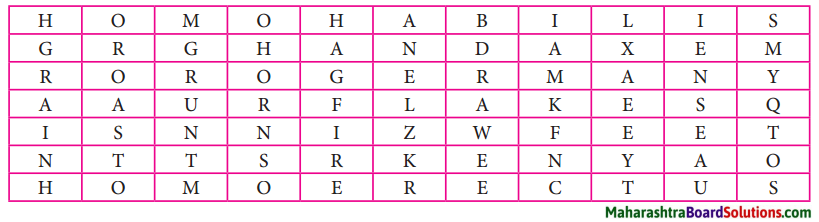
Read the clues given below and find the words hidden in the box.
Maharashtra Board Class 5 EVS Solutions Part 2 Chapter 5 Evolution of Mankind 1

  • Humans who stood upright.
  • A sound that Neanderthals could make.
  • Humans who used their hands.
  • Homo sapiens sapiens began to grow this in fields.
  • Pieces of stone used to make tools.
  • It kept Homo erectus warm although they could not make it.
  • A country in which remains of Homo habilis were found.
  • A way of preparing food that Neanderthals used.
  • A tool made by Homo erectus.
  • Homo sapiens could do this to make pictures.
  • Humans could use their hands because they learnt to stand on two of these.
  • The country in which remains of Neanderthals were first found.
  • These were buried with them when Neanderthals died.

Activity :

Question 1.
Prepare a chart to show the progress of Man at the various stages from Homo habilis to Homo sapiens sapiens.

Maharashtra Board Class 5 EVS Solutions Part 2 Chapter 5 Evolution of Mankind

Environmental Studies Part 2 Standard 5th Solutions Chapter 5 Evolution of Mankind Additional Important Questions and Answers

Fill in the blanks :

  1. The species of humans who could use their hands effectively is known as the ……….. human.
  2. The scientist Louis Leakey who discovered this species named it …………………
  3. Homo habilis could ………………… on two feet and walk.
  4. The spine of Homo habilis was slightly ……. and not quite erect.
  5. The stone tools made by Homo habilis were not useful for hunting ………. animals.
  6. Homo habilis was a ………….
  7. Homo erectus marks an important stage in human ………….
  8. Compared to Homo habilis, Homo erectus has a more ……………………. brain.
  9. Homo erectus species lived in ……….
  10. During the time of ……………….., the earth was covered with ice sheets.
  11. Homo erectus made tools like the
  12. The remains of Homo erectus have been found along with his ……………………. in the continents of Africa, Asia and Europe.
  13. The …………………. man was physically big and strong
  14. His……………….. was more developed than that of Homo erectus.
  15. They made tools out of big ……………….
  16. The Neanderthals hunted ………. animals.
  17. They used ………………… clothing.
  18. They were mainly …………….. eaters.
  19. They ate meat…………… on fire.
  20. They knew the art of making………
  21. Some scientists believe that the Neanderthals communicated with each other by producing ……… and other primary sounds.
  22. Neanderthals had established some ………… of burying the dead.
  23. Some groups of Neanderthals left …………………. and migrated up to the continents of Europe and Asia.
  24. They had to …………. new ways of living and finding food.
  25. ………………… is the name used for humans that were more advanced than the Neanderthals.
  26. Homo sapiens means ……………. Man.
  27. The ………….. became extinct about 30,000 years ago
  28. In Europe, Homo sapiens is also known as ……………. Man.
  29. Homo sapiens used to make stone ……………. and fix them in grooves’ and notches made in wood or bone handles.
  30. Homo sapiens could produce a variety of ……………. and modulate his ……… ….. the way he liked.
  31. Homo sapiens had a well-developed ……………. system.
  32. Homo sapiens could draw…………….. on the basis of actual observation as well as imagination.
  33. The capacity of the human brain and his grasping power went on continuously.
  34. ………………. is a science that studies heredity.
  35. Genetics research has shown that we have inherited some traits of the ………….. man.
  36. Homo sapiens sapiens developed the technique of cultivating ………….. and keeping ………………..
  37. He began to live a more …………. life.
  38. The changed lifestyle and diet affected the …….. of humans.
  39. The name ……………………. reflects his intellectual and cultural rather than his physical prowess”.
  40. In Europe, …………… is also known as Cro-Magnon Man’.
  41. The stone tools made by ………… were not useful for hunting big animals.

Answer:

  1. skilled
  2. Homo
  3. stand
  4. bent
  5. big
  6. forager
  7. evolution
  8. developed
  9. groups
  10. Homo erectus
  11. hand-axe
  12. tools
  13. Neanderthal
  14. brain
  15. pebbles
  16. big
  17. leather
  18. meat
  19. roasted
  20. fire
  21. grunts
  22. rituals
  23. Africa
  24. adopt
  25. Homo sapiens
  26. Intellectual
  27. Neanderthal
  28. CroMagnon
  29. blades
  30. sounds, voice
  31. language
  32. pictures
  33. developing
  34. Genetics
  35. Neanderthal
  36. land, animals
  37. settled
  38. appearance
  39. Homo sapiens sapiens
  40. Homo sapiens
  41. Homo habilis

Maharashtra Board Class 5 EVS Solutions Part 2 Chapter 5 Evolution of Mankind

Match the columns :

Question 1.

Column ‘A’ Column ‘B’
1. Homo habilis a. The man who stands erect.
2. Homo erectus b. Intellectual Man.
3. Neanderthal Man c. A man who uses his hands skillfully.
4. Homo sapiens d. Remains found in Europe, Asia, Africa.
5. Cro-Magnon Man e. Knew the art of making fire.
6. Louis Leakey f. Science that studies heredity.
7. Neanderthal Man g. Made tools like the hand-axe.
8. Homo erectus h. Had a well developed language system
9. Homo sapiens i. Remains found in Germany.
10. Genetics j. Discovered the species ‘Homo habilis’

Answer:

Column ‘A’ Column ‘B’
1. Homo habilis c. A man who uses his hands skillfully.
2. Homo erectus a. The man who stands erect.
3. Neanderthal Man e. Knew the art of making fire.
4. Homo sapiens b. Intellectual Man.
5. Cro-Magnon Man d. Remains found in Europe, Asia, Africa.
6. Louis Leakey j. Discovered the species ‘Homo habilis’
7. Neanderthal Man i. Remains found in Germany.
8. Homo erectus g. Made tools like the hand-axe.
9. Homo sapiens h. Had a well developed language system
10. Genetics f. Science that studies heredity.

Maharashtra Board Class 5 EVS Solutions Part 2 Chapter 5 Evolution of Mankind

Answer if the following statements are True/False. If false, then state the correct answer:

Question 1.

  1. The scientist Louis Leakey named the first species of humans as Homo erectus.
  2. In Latin “Homo’ means ‘man’.
  3. Homo erectus means The man who can use his hands skilfully
  4. The stone tools made by Homo habilis were not useful for hunting big animals.
  5. Homo habilis was not a forager”
  6. Homo erectus species lived in groups.
  7. Homo erectus knew the technique of making fire.
  8. Homo erectus made tools like the hand-axe.
  9. The Neanderthal Man was more developed than that of Homo erectus.
  10. The Neanderthal Man hunted small animals.
  11. The Neanderthal Man knew the art of making fire.
  12. The Neanderthals established some rituals of burying the dead
  13. Some groups of Neanderthals left Africa and migrated to India
  14. Homo sapiens means Intellectual Man.
  15. The Neanderthals became extinct about 30,000 years ago
  16. Homo sapiens is also known as the ‘Cro Magnon Man’ in Europe.
  17. The Homo sapiens could only grunt and make some sounds.
  18. Genetics is a science that studies heredity.
  19. The changed lifestyle and diet affected the appearance of humans.
  20. Homo sapiens sapiens reflects his intellectual and culture rather than his physical prowess.

Answer:

  1. False. The scientist Louis Leakey named the first species of humans as Homo habilis.
  2. True.
  3. False. Homo habilis means “The man who can use his hands skilfully’.
  4. True.
  5. False. Homo habilis uns a forager.
  6. True
  7. False. Homo erectus knew the use of fire but had not mastered the technique of making fire.
  8. True
  9. True.
  10. False. The Neanderthal Man hunted big animals.
  11. True.
  12. True.
  13. False. Some groups of Neanderthals left Africa and migrated to the continents of Europe and Asia.
  14. True.
  15. True.
  16. True.
  17. False. The Homo sapiens has a well-developed language system.
  18. True.
  19. True
  20. True.

Maharashtra Board Class 5 EVS Solutions Part 2 Chapter 5 Evolution of Mankind

Answer the following questions in one sentence each:

Question 1.
What was the species of humans who could use their hands effectively known as?
Answer:
The species of humans who could use their hands effectively is known as ‘The skilled human

Question 2.
Where was the first evidence of this species found?
Answer:
The first evidence of this species was found in the border region between Tanzania and Kenya in the continent of Africa.

Question 3.
What was this species named and by which scientist?
Answer:
The scientist Louis Leakey who discovered this species, named it “Homo habilis’.

Question 4.
What does Homo habilis mean?
Answer:
Homo habilis means ‘the one who uses his hands skillfully.

Maharashtra Board Class 5 EVS Solutions Part 2 Chapter 5 Evolution of Mankind

Question 5.
Why was he called Homo habilis?
Answer:
He was called Homo habilis because besides their fossilized remains, some tools made by them were also found.

Question 6.
Give two uses of the stone tools made by Homo habilis.
Answer:
The stone tools made by Homo habilis had limited uses such as scraping” meat from the skin of dead animals or breaking bones to get the marrows

Question 7.
How did Homo habilis acquire his food?
Answer:
Homo habilis was a forager. It is possible that he hunted small animals, gathered eggs, wild fruits and roots to eat.

Question 8.
What does Homo erectus mean?
Answer:
Homo erectus means ‘the one who stands erect’.

Question 9.
How did Homo erectus survive the extreme climatic conditions during the ice-age?
Answer:
Homo erectus could survive the extreme climatic conditions during the ice-age because he knew the use of fire but had not mastered the technique of making fire.

Maharashtra Board Class 5 EVS Solutions Part 2 Chapter 5 Evolution of Mankind

Question 10.
Where have the remains of Homo erectus been found?
Answer:
The remains of Homo erectus have been found in the continents of Africa, Asia and Europe.

Question 11.
Where were the remains of the Neanderthal Man found?
Answer:
The remains of the Neanderthal Man were first found at Neanderthal in Germany.

Question 12.
How did the Neanderthal Man eat roasted meat?
Answer:
The Neanderthal knew the art of making fire and hence ate roasted meat.

Question 13.
How did the Neanderthal Man communicate with each other?
Answer:
The Neanderthals communicated with each other by producing grunts and other primary sounds.

Question 14.
Where did the Neanderthal Man migrate?
Answer:
Some groups of Neanderthal Man left Africa and migrated up to the continents of Europe and Asia.

Maharashtra Board Class 5 EVS Solutions Part 2 Chapter 5 Evolution of Mankind

Question 15.
What was the challenge to the Neanderthal Man in Europe and Asia?
Answer:
The Neanderthals had to adopt to the new way of living and finding food as they had to face a different environment.

Question 16.
Which Species of humans were more advanced than the Neanderthal Man?
Answer:
The Homo sapiens was more advanced than the Neanderthal Man.

Question 17.
What does Homo sapiens mean?
Answer:
Homo sapiens means Intelligent or Intellectual man.

Question 18.
How many years ago did the Neanderthal Man become extinct?
Answer:
The Neanderthal Man became extinct about 30,000 years ago

Question 19.
What are Homo sapiens known as in England?
Answer:
Cro-Magnon man.

Question 20.
Where have their remains been found?
Answer:
Their remains have been found in Europe, Asia and Africa.

Maharashtra Board Class 5 EVS Solutions Part 2 Chapter 5 Evolution of Mankind

Question 21.
Describe the tools used by the Cro-Magnon man.
Answer:
The Cro-Magnon man used tools made of stone blades and fixed them in grooves and notches made of wood or bone handles.

Question 22.
Why was the human species later called as Homo Sapiens Sapiens?
Answer:
The human species was later known as Homo sapiens sapiens as their capacity to think developed even further than that of Homo sapiens.

Question 23.
What is Genetics?
Answer:
Genetics is a science that studies ‘heredity’.

Give reasons for the following:

Question 1.
Homo habilis was a forager.
Answer:
i. Homo habilis was a forager.
ii. This is because he ate the leftovers of animals that had been hunted by others.

Question 2.
Homo erectus could survive during the ice age.
Answer:
i. During the time of Homo erectus, the earth was covered with icesheets and the climate was extremely cold.
ii. As the Homo erectus had learnt the use of fire, he could survive the extreme climate.

Maharashtra Board Class 5 EVS Solutions Part 2 Chapter 5 Evolution of Mankind

Question 3.
The human species Homo Neanderthalensis was known as the Neanderthal Man.
Answer:
The human species Homo Neanderthalensis was commonly known as the Neanderthal Man because his remains were first found in Neanderthal in Germany.

Question 4.
The Neanderthals ate meat roasted on fire.
Answer:
i. The Neanderthals knew the art of making fire.
ii. As they were meat eaters, they ate meat roasted on fire.

Question 5.
Homo sapiens had a well-developed language system.
Answer:
i. The Homo sapiens could produce a variety of sounds and modulate his voice.
ii. Using his imagination, he could name the things around him and soon could put his thoughts and feelings into words thus developing a language system.

Question 6.
The Homo sapiens was named as an Intelligent Man.
Answer:

  1. During the course of their evolution, Homo sapiens had developed a language system.
  2. He could also draw pictures on the basis of observation and imagination.
  3. Hence, he was named as an Intelligent Man.

Maharashtra Board Class 5 EVS Solutions Part 2 Chapter 5 Evolution of Mankind

Question 7.
It is said that the Neanderthal Man and Homo sapiens are both ancestors of the modern humans.
Answer:
i. Genetic research has shown that the modern man has inherited some traits of the Neanderthal Man.
ii. Thus, it can be said that the Neanderthal Man and Homo sapiens are both ancestors of the modern humans.

Answer the following in brief :

Question 1.
Why was the first human species named Homo habilis?
Answer:

  1. The scientist Louis Leakey who discovered this first human species named it ‘Homo habilis’.
  2. He found some tools made by them beside their fossilized remains.
  3. In Latin ‘Homo habilis’ means the man who can use his hands skillfully.
  4. Thus, the first human species got their name.

Question 2.
Describe Homo habilis.
Answer:

  1. Homo habilis could stand on two feet and walk.
  2. His spine was slightly bent and was not quite erect.
  3. His brain was bigger than the apes although – he looked somewhat similar.

Maharashtra Board Class 5 EVS Solutions Part 2 Chapter 5 Evolution of Mankind

Question 3.
Give the two uses of the stone tools made by Homo habilis.
Answer:

  1. The stone tools made by Homo habilis were not useful for hunting big animals.
  2. They had limited uses such as scraping meat from the skin of dead animals.
  3. They were also used for breaking bones to get the marrow.

Question 4.
Homo erectus knew the use of fire – Explain.
Answer:

  1. During the time of Homo erectus, the Earth was covered with icesheets, hence the climate was extremely cold.
  2. Homo erectus could survive that extreme climate because he had learnt to use fire.
  3. However, he had not yet mastered the technique of making fire.

Question 5.
Compare the Neanderthal Man to his predecessors.
Answer:

  1. The Neanderthal Man was physically big and strong.
  2. His brain was more developed.
  3. He made tools out of big pebbles. The tools were fixed on a bone or a wooden shaft to make weapons like the spear, axe etc.
  4. He hunted big animals, ate their meat and used their leather as clothing.
  5. He knew the art of making fire.

Maharashtra Board Class 5 EVS Solutions Part 2 Chapter 5 Evolution of Mankind

Question 6.
How did the Neanderthal Man make fire?
Answer:
i. The Neanderthals knew the technique of making fire.
ii. They rubbed sticks of hard wood on each other or by striking one flintstone on another to obtain sparks.

Question 7.
How did the Neanderthals treat their dead?
Answer:

  1. When a member of the group died, the Neanderthals buried tools, horns etc. along with the dead body.
  2. They applied red ochre to the dead body before burying it.
  3. The Neanderthals thus established some rituals of burying the dead.

Question 8.
Describe the tools made by Homo sapiens.
Answer:
i. Homo sapiens made different kinds of tools and implements to suit the tasks they needed to do.
ii. They made sharp blades of stone and fixed them in grooves and notches made in wood or bone handles.

Question 9.
Why was the Homo sapien called “The Thinking Man’?
Answer:

  1. The tools made by Homo sapien were sharper and more precise than the other species.
  2. He had a well-developed language system.
  3. He could draw pictures on the basis of observation as well as imagination.
  4. Hence, he was called as The Thinking Man’.

Question 10.
Describe the development of the Homo sapiens.
Answer:

  1. Homo sapiens sapiens developed the technique of cultivating land and keeping animals.
  2. With his well-developed capacity to think, the speed at which he improved his technology went on increasing
  3. He lived a more settled life.
  4. He began to grow food grains in the fields.

Maharashtra Board Class 5 EVS Solutions Part 2 Chapter 5 Evolution of Mankind

Question 11.
The name Homo sapiens sapiens reflects his intellectual and cultural rather than his physical prowess – Explain.
Answer:

  1. Modern humans are not satisfied with only meeting their basic need for food.
  2. To enrich their life, human beings acquired a culture and continued to develop it.
  3. The technological and cultural progress achieved by modern humans has been extremely rapid.
  4. Hence, we can rightly say that the life of the Homo sapiens sapiens reflects his intellectual and cultural progress rather than his physical prowess.

Glossary :

  1. effectively : in such a manner as to achieve a desired result
  2. skillfully : with expertise
  3. grunts : low short sound
  4. appearance : the way something or someone looks
  5. established : existed and recognised
  6. migrated : move from one region to another
  7. grooves : a long narrow cut in a hard material
  8. notches : an incision on a surface
  9. modulate : change the o tone pitch of voice
  10. prowess : skill in a particular field
  11. pebbles : small stones
  12. adopt : choose to take up on follow
  13. forager : someone who reaches for food
  14. scraping : remaining from a surface with forceful strokes
  15. marrow : a tissue o in the body, next to bones
  16. roasted : cooked
  17. ancestors: a person from whom one is descended
  18. subtle: very delicate and precise
  19. larynx : a hollow passage holding the vocal cords in the human body
  20. traits : a distinguishing quality
  21. predecessors : someone who came before
  22. ochre : an earthy clay-like thing

Class 5 Environmental Studies Questions and Answers:

Growth and Personality Development Class 5 Questions And Answers EVS Chapter 22 Maharashtra Board

Balbharti Maharashtra State Board Class 5 Environmental Studies Solutions Chapter 22 Growth and Personality Development Notes, Textbook Exercise Important Questions and Answers.

5th Standard EVS 1 Lesson Number 22 Question Answer Growth and Personality Development Maharashtra Board

Std 5 EVS 1 Chapter 22 Question Answer

1. What’s the solution?

Question 1.
What’s the solution?
Kabir wants to be a professor of zoology. What can he do today to prepare for that?
Answer:
Kabir should study regularly and sincerely. He should read various books on animals. He should learn to speak in public by participating in elocution competition. Also he should do the project work given by the teacher and explain it in the class to his friends. By doing all these things he will develop all the skills necessary for becoming a professor.

Maharashtra Board Class 5 EVS Solutions Part 1 Chapter 22 Growth and Personality Development

2. Use your brain power!

Question (a)
What skills do we already have before we leam to ride bicycle?
Answer:
Before riding a bicycle we know to walk, run, jump, climb, skip and hop. Hence we are able to climb and sit on the bicycle and balance it by touching the ground with our legs.

Question (b)
Suman wishes to run a restaurant of her own in the future. Which of the skill she is learning today will be of use in her future occupation?
Answer:
The following skill mentioned below which she is learning today will be of help to Suman: The skill of cooking meals, writing down the recipe, keeping an account of the money spent, making the list of grocery item needed, serving food, packing food, cleaning the table etc. are some of the few skills which will help her to run a restaurant in future.

3. Answer the following questions:

Question (a)
What is meant by heredity? (Explain)
Answer:
People of one family show similarities in physical characteristics in many ways. Some features or traits are like our grandparents, some like our parents and some like our brothers and sisters. Being bom with certain features or traits in common with the members of our family is called heredity.

Question (b)
What differences do we see between children in preprimary classes and children in standard?
Answer:
Preprimary children are not able to read and write. They cannot dress on their own, they cannot tie shoe laces, comb their hair etc. They are dependent on their mother, teachers, and Aya for everything. Whereas a standard child can read and write, dress on his own, he can do most of the routine work independently.

Question (c)
What changes take place in us from birth till adulthood?

Maharashtra Board Class 5 EVS Solutions Part 1 Chapter 22 Growth and Personality Development

Question (d)
Name any three skills you have acquired.
Answer:
The skills that I have acquired are skipping, jumping, reading, writing, cycling etc.

Question (e)
What is meant by physical growth?
Answer:
Growing in height and weight from childhood to adulthood is called physical growth.

4. True or false?

Question 1.
State whether the following statements are true or false:
(a) A baby gradually learn to perform newly learnt tasks without making mistake.
(b) At, birth we already learn all skills.
(c) We cannot manage all our tasks entirely by overselves.
(d) Our height manage all our tasks entirely by oversieves.
Answer:
(a) True
(b) False
(c) True
(d) False

Environmental Studies Part 1 Standard 5th Solutions Chapter 22 Growth and Personality Development Additional Important Questions and Answers

Fill in the blank with the correct answers from the options given below:

Question 1.
All living things eat grow ………………… .
(a) physically
(b) spritually
(c) mentally
Answer:
(a) physically

Maharashtra Board Class 5 EVS Solutions Part 1 Chapter 22 Growth and Personality Development

Question 2.
Human beings grow in height and weight from birth to ………………….. .
(a) childhood
(b) adulthood
(c) teens
Answer:
(b) adulthood

Question 3.
When a person begins to do a task more easily without doing mistake his ……………… increase.
(a) inefficiency
(b) practicality
(c) efficiency
Answer:
(c) efficiency

Question 4.
The greater the number of skills we learn, the less is our …………………. on others.
(a) independence
(b) effort
(c) dependence
Answer:
(c) dependence

Question 5.
We must all learn to take ……………….. for doing our personal tasks ourselves.
(a) responsibility
(b) jobs
(c) irresponsibility
Answer:
(a) responsibility

Question 6.
The features and traits that we possess right from the time we are born are known as……………….. traits.
(a) inborn
(b) inherited
(c) physical
Answer:
(b) inherited

Maharashtra Board Class 5 EVS Solutions Part 1 Chapter 22 Growth and Personality Development

Question 7.
Our personality develops through our …………………. and ……………….. .
(a) efforts
(b) strength
(c) interest
Answer:
(c) interest, (a) efforts

Question 8.
Only when ………………….. are put into practice, we can say the personality developed in excellent.
(a) good thoughts/values
(b) vices
(c) bad thoughts
Answer:
(a) good thoughts/values

Question 9.
Lack of …………….. also affects growth adversely even if we take nutritious food.
(a) money
(b) exercise
(c) jewellery
Answer:
(b) exercise

Question 10.
We can live an independent useful and enriched life with the help of ………………. .
(a) property
(b) skills
(c) vices
Answer:
(b) skills

Question 11.
Small babies ………………. do anything for themselves.
(a) can
(b) cannot
(c) able to
Answer:
(b) cannot

Question 12.
Achieving control of one’s …………………. or learning to do something new is called ‘learning a skill’.
(a) limbs
(b) movements
(c) arms
Answer:
(b) movements

Question 13.
Everyday, we keep …………….. .
(a) repeating
(b) walking
(c) learning
Answer:
(c) learning

Maharashtra Board Class 5 EVS Solutions Part 1 Chapter 22 Growth and Personality Development

Question 14.
With age our ……………… strength also increases.
(a) spiritual
(b) mental
(c) physical
Answer:
(c) physical

Question 15.
Animals learn only a certain number of ……………….. in their life.
(a) skills
(b) hunting
(c) steps
Answer:
(a) skills

Question 16.
Our height grows till we are about …………………. years old.
(a) 15
(b) 18
(c) 20
Answer:
(b) 18

Question 17.
People of one family show ……………….. in many ways.
(a) similarities
(b) dissimilar
(c) bonding
Answer:
(a) similarities

Question 18.
No one has any …………………. over which traits we will inherit and which we will not.
(a) tolerance
(b) control
(c) hand
Answer:
(b) control

Question 19.
We …………….. the ability to learn many skills.
(a) inherit
(b) remember
(c) copy
Answer:
(a) inherit

Question 20.
………………… our skills helps us to live an independent, useful and enriching life.
(a) Working out
(b) Practising
(c) Developing
Answer:
(c) Developing

Maharashtra Board Class 5 EVS Solutions Part 1 Chapter 22 Growth and Personality Development

Question 21.
Food is necessary for ……………….. .
(a) body
(b) growth
(c) diet
Answer:
(b) growth

Question 22.
Along with nutritious food, adequate ………………….. is also necessary for growth and development.
(a) skills
(b) cycling
(c) exercise
Answer:
(c) exercise

Question 23.
Lack of exercise ……………… growth adversely.
(a) effects
(b) affects
(c) defects
Answer:
(b) affects

Question 24.
Each person has every right to get the opportunity to make progress and ……………. their own life.
(a) bench
(b) prosperous
(c) enrich
Answer:
(c) enrich

Question 25.
Our physical and mental make up is not the ………………… as that of anyone else.
(a) different
(b) same
(c) similar
Answer:
(b) same

Maharashtra Board Class 5 EVS Solutions Part 1 Chapter 22 Growth and Personality Development

Question 26.
Our ……………….. develops through our interests and efforts.
(a) personality
(b) excellence
(c) exercise
Answer:
(a) personality

Question 27.
Our personality can be said to be …………….. only when we put good thoughts into practice.
(a) weak
(b) average
(c) excellent
Answer:
(c) excellent

Question 2.
State whether the following statements are true or false:

  1. The child is motivated to practice an activity again and again when he is praised for trying to carry out the activity.
  2. Animals go on learning many skills throughout their life.
  3. In a family all the brothers and sisters are identical.
  4. A baby learn to walk and run only after his parents teach him.
  5. If a baby is not able to walk and talk by the time it is two years, then growth and development of the baby is not taking place properly.
  6. Learning various skills makes us independent as it helps us to do various tasks on our own.

Answer:

  1. True
  2. False
  3. False
  4. False
  5. True
  6. True

Answer the following questions in one sentence:

Question 1.
What do you mean by ‘inherited’ traits?
Answer:
The traits with which we are bom, and are common with members of our family are called ‘inherited’ traits.

Question 2.
What things would you like to do just for recreation?
Answer:
I would like to play football, cricket or do drawing, painting, or read a story book.

Maharashtra Board Class 5 EVS Solutions Part 1 Chapter 22 Growth and Personality Development

Question 3.
Which are the skills that a child of Std V should learn so that he can get ready for school without depending on his mother’s help?
Answer:
He should leam to wear his own tie, tie his shoes laces, wear shoes and socks, comb his hair, wear his clothes on his own. So that he can get ready for school without depending on his mother for her help.

Question 4.
What is meant by addiction?
Answer:
When a particular skill or activity increases our dependence on it, by making us crave for repeating it again and again it is called addiction.

Question 5.
Name a few activities which lead to addiction and affect development of a child.
Answer:
Playing video games, eating gutka, paan masala, playing games on mobile, eating chocolates etc. are a few skills or activities which lead to addiction and have bad effects on the development of a child.

Question 6.
What is learning a skill?
Answer:
Achieving control of one’s movements or leam to do something new is called ‘learning a skill’.

Question 7.
What is development?
Answer:
As we grow, our height, weight and physical strength increase, also we leam a lot of new skills. This progress we make is called development.

Question 8.
What skills do animals learn from their mothers?
Answer:
Animals learn from their mother, skills to obtain food, protect themselves from the sun, rain and from enemies.

Maharashtra Board Class 5 EVS Solutions Part 1 Chapter 22 Growth and Personality Development

Question 9.
How do people sometimes recognize us?
Answer:
People of one family show similarities, some of our features or traits are like those of our grandparents or our parent’s siblings. That is why sometimes people who know them recognize us.

Question 10.
What is heredity?
Answer:
Being bom with certain features or traits in common with the members of our family is ‘heredity’.

Question 11.
What leads to good development?
Answer:
We must study well, avoid addiction, develop hobbies, take part in sports, learn new skills. This way of life leads to good development.

Use your brain power!

Question 1.
Sayali is in the sixth standard. They are going for a picnic. Sayali’s Aai is going to make ladoos for the whole class. But she needs Sayali’s help. What can Sayali do to help?
Answer:
Sayali can make a list of the ingredients needed to make ladoos with the help of her mother. Sayali can assist her mother to give shape to the ladoos. Sayali can pack the ladoos in a tiffin box. This is how Sayali can help mother.

Maharashtra Board Class 5 EVS Solutions Part 1 Chapter 22 Growth and Personality Development

Question 2.
Many skills have been mentioned in this lesson up to now. Can you do without learning some of them? Which ones are necessary for any person?
Answer:
Yes, it is not necessary to leam all the skills. Everyone need not leam the skill of playing football, cook a meal, write a story, press clothes etc. However everyone should be able to eat with one’s own hand, wash one’s own face, have a bath, dressing oneself, reading a book, writing answers, communicate his thoughts etc.

Answer the following questions:

Question 1.
How many years does it take the young ones of the tiger/elephant to start living independently?
Answer:
The cub of a tiger starts living independently after 18 months. However sometimes it takes 2 years to 2 1/2 years also. The calf of an elephant starts living independently after 6 years. However sometimes they may become independent after 8-10 years also.

Question 2.
Explain what do you mean by development.
Answer:
As we grow, our height and weight increases. With age our physical strength also increase. We also keep learning more and more new skills. In this way every individual makes progress. ‘This is called development’.

Maharashtra Board Class 5 EVS Solutions Part 1 Chapter 22 Growth and Personality Development

Question 3.
Describe the factors that affect growth and development.
Answer:
The factors that affect growth and development are the food we eat, exercise and our values and behaviour.
1. The food that we eat: If we have nutritious food we gain strength and ability to learn various skills. We also grow tall and develop a good personality. If food is not nutritious we become malnourished and development and growth gets affected.
2. Exercise also brings about proper growth and development. Lack of exercise affects growth adversely.
3. Along with food and exercise it is important that we have Food values and we put it into practice. Our values and behaviour also affect development. Good thoughts put into practice make us an excellent personality.

Give reasons:

Question 1.
Always playing video games or games on mobile is not good for development.
OR
Always playing video games has an adverse effect on personality.
Answer:
Always playing video games and games on mobile makes a person addicted to it. The person cannot think of anything else and looses concentration in other activities. The child playing these games cannot concentrate in studies, nor is he able to develop new good skills.

Seeing the violence in the video game the child does not get good thoughts. Hence due to all this, good development does not take place and it affects the child’s growth and personality adversely.

Can you tell:

Question 1.
Can an infant feed itself?
Answer:
No, the infant cannot feed itself. The mother has to feed the infant.

Maharashtra Board Class 5 EVS Solutions Part 1 Chapter 22 Growth and Personality Development

Question 2.
Can a two years old child fold clothes neatly?
Answer:
No, a two year old child cannot fold his clothes neatly. However if taught he can try to fold his handkerchief.

Question 3.
When do they learn to these task?
Answer:
The child learns to feed himself a when he is one year old. However he can feed himself properly without spilling after two years. The child can fold his clothes after he becomes five years old.

Question 4.
Which of the following things have you learnt to do? Which Ones have you yet to learn?
Answer:
The tasks which a fifth Std child can do are skipping on a rope, writing an essay, combing his hair, telling a story, using a computer, etc. The child may not be able to give a speech, riding a bicycle, swimming, counting money, climbing a tree etc.

Maharashtra Board Class 5 EVS Solutions Part 1 Chapter 22 Growth and Personality Development

Glossary:

1. traits – genetically determined characteristic
2. addiction – to become dependent on something.

Class 5 Environmental Studies Questions and Answers:

Let us Solve Our own Problems Class 5 Questions And Answers EVS Chapter 7 Maharashtra Board

Balbharti Maharashtra State Board Class 5 Environmental Studies Solutions Chapter 7 Let us Solve Our own Problems Notes, Textbook Exercise Important Questions and Answers.

5th Standard EVS 1 Lesson Number 7 Question Answer Let us Solve Our own Problems Maharashtra Board

Std 5 EVS 1 Chapter 7 Question Answer

1. Fill in the blanks with the correct answers from the options given below:

Question (a)
Turning a blind eye towards problems makes them ……………….. .
(a) worse
(b) good
(c) better
Answer:
(a) worse

Maharashtra Board Class 5 EVS Solutions Part 1 Chapter 7 Let us Solve Our own Problems

Question (b)
It is important to be able to identify ……………………. .
(a) handwriting
(b) fossils
(c) issues
Answer:
(c) issues

2. Answer in one sentence.

Question (a)
What is meant by issues in civic life?
Answer:
The problems faced by people in cities and villages are called issues in civic life.

Question (b)
How can problems in civic life be solved?
Answer:
Problems in civic life can be solved through everyone’s efforts and co-operation.

Question (c)
Name the great personalities that stressed the importance of cleanliness.
Answer:
Sant Gadgebaba and Rashtrasant Tukdoji Maharaj are the two great personalities that stressed the importance of cleanliness.

3. Answer in short.

Question (a)
Explain the concept of cleaning the village through ‘Shramdaan’.
Answer:

  1. The people of Khudawadi village in Osmanabad district cleaned their village through Shramdaan or voluntary contribution of labour.
  2. They decided that everyone should help in the cleaning of the village.
  3. First the waste water was dealt with.
  4. The garbage was used to make manure using vermiculture”.
  5. A toilet was built in each house.

Maharashtra Board Class 5 EVS Solutions Part 1 Chapter 7 Let us Solve Our own Problems

Question (b)
How can a suitable environment for peace by created?
Answer:

  1. For a society to be peaceful, the basic needs of all its sections need to be met.
  2. Each person must get the necessary security.
  3. The exploitation in society must stop. Inequality must decrease.
  4. Everyone must have the right to participate in public life.
  5. By learning the importance of peace and by using peaceful methods, we can create a peaceful environment in our family, school and community.

4. What will you do in the following situations?

Question (a)
The class leader wishes to maintain quiet in the class room.
Answer:
We must listen and obey the class leader. If all students honestly obey then it will be easy to maintain discipline in the classroom.

Question (b)
For, some unavoidable reason, the maths teac her is unable to attend class today.
Answer:
We must take the upper hand of the free time available and quietly do our home work or read some text book and prepare for the class or simply practice difficult maths sums.

Maharashtra Board Class 5 EVS Solutions Part 1 Chapter 7 Let us Solve Our own Problems

Question (c)
During a match, a dispute has arisen between the two teams on the play ground.
Answer:
If you are a spectator, we must maintain peace by keeping quiet and not taking sides. If you are a participant you must be obedient and let the referee, coach or teacher clear the misunderstanding amicably

Environmental Studies Part 1 Standard 5th Solutions Chapter 7 Let us Solve Our own Problems Additional Important Questions and Answers

Fill in the blanks with the correct answers from the options given below:

Question 1.
We encounter many problems in our ………………… life.
(a) childhood
(b) civic
(c) adulthood
Answer:
(b) civic

Question 2.
Civic problems cause us ……………… .
(a) peace
(b) inconvenience
(c) problems
Answer:
(b) inconvenience

Question 3.
Civic problems can be solved through everyone’s efforts and ………………….. .
(a) co-operation
(b) obstruction
(c) transformation
Answer:
(a) co-operation

Question 4.
The well-being of a village is affected by constant …………………. .
(a) talks
(b) disputes
(c) work
Answer:
(b) disputes

Maharashtra Board Class 5 EVS Solutions Part 1 Chapter 7 Let us Solve Our own Problems

Question 5.
Disputes lead to loss of unity and ………………… the progress of the village.
(a) obstructs
(b) disrupts
(c) destroys
Answer:
(a) obstructs

Question 6.
Since 2007, the ‘Mahatma Gandhi Dispute – Free Village Mission’ is being implemented in our …………. .
(a) nation
(b) state
(c) village
Answer:
(b) state

Question 7.
Solving disputes increases ……………….. in the village.
(a) friends
(b) trade
(c) harmony
Answer:
(c) harmony

Question 8.
The people of Khudawadi village in Osmanabad district cleaned their village through …………….. or voluntary contribution of labour.
(a) shramdaan
(b) shramdin
(c) Maharashtra day
Answer:
(a) shramdaan

Question 9.
The villagers decided that everyone should help in ……………….. the village.
(a) washing
(b) cleaning
(c) ploughing
Answer:
(b) cleaning

Maharashtra Board Class 5 EVS Solutions Part 1 Chapter 7 Let us Solve Our own Problems

Question 10.
Garbage was used to make manure using ……………… .
(a) Horticulture
(b) Floriculture
(c) Vermiculture
Answer:
(c) Vermiculture

Question 11.
A was built in each house.
(a) kitchen
(b) bedroom
(c) toilet
Answer:
(c) toilet

Question 12.
Sant Gadgebaba used ……………… to stress the importance of keeping the village clean.
(a) bhajans
(b) kirtans
(c) poojas
Answer:
(b) kirtans

Question 13.
Rashtrasant Tukdoji Maharaj explained the importance of cleanliness through his ………………… .
(a) Bhagwad Geeta
(b) Ramayan
(c) Gram Geeta
Answer:
(c) Gram Geeta

Question 14.
For a society to be ………………….. the basic needs of all its sections need to be met.
(a) peaceful
(b) prosperous
(c) healthy
Answer:
(a) peaceful

Question 15.
The …………………. in society must stop.
(a) work
(b) transportation
(c) exploitation
Answer:
(c) exploitation

Question 16.
Everyone must have the right to ……………………. in public life.
(a) participate
(b) information
(c) opinion
Answer:
(a) participate

Question 17.
……………………. has been designated by the UN as ‘International Peace Day’.
(a) 12th September
(b) 11th September
(c) 21st September
Answer:
(c) 21st September

Maharashtra Board Class 5 EVS Solutions Part 1 Chapter 7 Let us Solve Our own Problems

Question 18.
Peace contributes ……………….. to progress.
(a) significantly
(b) responsibility
(c) beneficiary
Answer:
(a) significantly

Question 19.
Peace becomes a ………………… value rather than a personal need.
(a) social
(b) political
(c) economical
Answer:
(a) social

Answer in one sentence:

Question 1.
What do civic issues cause us?
Answer:
Civic issues cause us a lot of inconvenience.

Question 2.
How is the well-being of a village affected?
Answer:
The well-being of a village is affected by constant disputes.

Question 3.
What do constant disputes lead to?
Answer:
Constant disputes lead to loss of unity and obstructs the progress of the village.

Question 4.
When was the ‘Mahatma Gandhi Dispute – Free Village Mission’ established?
Answer:
The Mahatma Gandhi Dispute – Free Village Mission was implemented in our state since 2007.

Question 5.
What is the aim of the ‘Mahatma Gandhi Dispute – Free Village Mission?
Answer:
The aim of this scheme is that villages should be able to solve their own disputes through peaceful discussions.

Question 6.
How have the villages been motivated towards peace?
Answer:
All those villages which have solved their disputes by using the ‘Mahatma Gandhi Dispute – Free Mission’ were awarded the ‘peace award’. In this way the villages were motivated towards peace.

Maharashtra Board Class 5 EVS Solutions Part 1 Chapter 7 Let us Solve Our own Problems

Question 7.
What is ‘Shramdaan’?
Answer:
‘Shramdaan’ means voluntary contribution of labour.

Question 8.
How did Sant Gadgebaba stress on keeping the village clean?
Answer:
Sant Gadgebaba used Kirtans to stress the importance of keeping the village clean.

Question 9.
How did Rashtrasant Tukdoji Maharaj explain about cleanliness?
Answer:
Rashtrasant Tukdoji Maharaj explained the importance of cleanliness through his ‘Gram Geeta’.

Question 10.
When is ‘International Peace Day’?
Answer:
21st September has been designated by the UN as ‘International Peace Day’.

Answer in short:

Question 1.
Why should disputes in various towns and villages be solved?
Answer:

  1. The well-being of a village in affected by constant disputes.
  2. It leads to loss of unity and obstructs the progress of the village.
  3. If the disputes are not serious, they can be solved locally by speaking to the parties involved.
  4. However, if the dispute is not solved in this way it has to be taken to the appropriate bodies or the courts.

Question 3.
What were the teachings of Sant Gadgebaba?
Answer:
1. Sant Gadgebaba used Kirtans to stress the importance of keeping the village clean.
2. He told the people that we cannot make progress without cleanliness, education and self-reliance.
3. He showed the people how to clean the village through his own actions.

Maharashtra Board Class 5 EVS Solutions Part 1 Chapter 7 Let us Solve Our own Problems

Question 4.
How can a suitable environment for peace by created?
Answer:

  1. For a society to be peaceful, the basic needs of all its sections need to be met.
  2. Each person must get the necessary security.
  3. The exploitation in society must stop. Inequality must decrease.
  4. Everyone must have the right to participate in public life.
  5. By learning the importance of peace and by using peaceful methods, we can create a peaceful environment in our family, school and community.

Question 5.
How is the International Peace Day celebrated?
Answer:

  1. 21 st September has been designated by the UN as ‘International Peace Day’.
  2. On this day in New York, where the United
  3. This is followed by a few moments of silence.
  4. This bell is significant as it has been made from coins given by people from around 60 nations.

Question 6.
Why is peace considered as a social value?
Answer:
1. Peace contributes significantly to progress.
2. It creates scope for advances in various fields like business, industry, education, art, literature, entertainment, science and technology.
3. In this way, peace becomes a social value rather than a personal need.

(A) Can you tell?

Question 1.
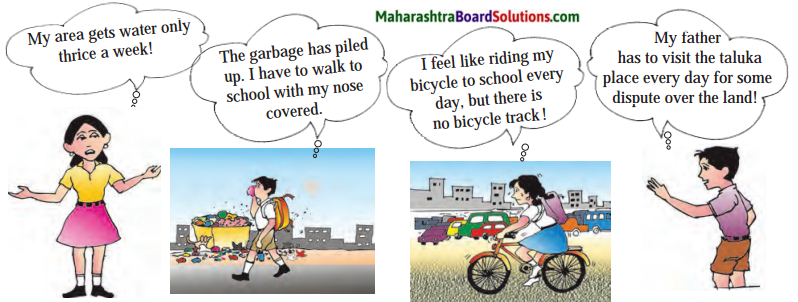
What problems can you identify from the above pictures?
Maharashtra Board Class 5 EVS Solutions Part 1 Chapter 7 Let us Solve Our own Problems 1Answer:

  1. Lack of water
  2. Lack of cleanliness I hygiene
  3. Lack of safety for children
  4. Dispute problem.

(B) Can you tell?

Question 1.
Do you think there should be a group of peacekeepers in your school?
Answer:
Yes, it is very essential to have a group of peacekeepers in every school as students do have problems and fights among themselves all the time.

Maharashtra Board Class 5 EVS Solutions Part 1 Chapter 7 Let us Solve Our own Problems

Question 2.
What criteria will you use to select these peace keepers?
Answer:
When these peacekeepers are being selected it must be borne in mind that the peacekeeper be self-disciplined, intelligent and impartial.

Question 3.
Which rules will you include in the rule book for these peace keepers?
Answer:
Rules which must be included in the rule book are as follows:
1. Naughty children must be identified and strict vigilance be kept on them.
2. Naughty children should be warned once or twice then be taken to the teacher in-charge of discipline or the Principal.

Question 4.
What methods should peacekeepers use to solve your disputes?
Answer:
Peacekeepers should use methods like:
1. Children of similar age-group should play together in order to avoid older children bullying or pushing the younger ones.
2. Peacekeepers must be allotted places so that they can familiarize with those children and they should keep moving among the children to identify any problems.

Question 5.
How do you understand that disputes can be solved peacefully?
Answer:
Problems can be solved peacefully if both parties are given time to speak about their point of view. Decisions regarding the issue must be seriously thought about and the decisions must be impartial.

Maharashtra Board Class 5 EVS Solutions Part 1 Chapter 7 Let us Solve Our own Problems

Glossary:

  1. encounter – faced
  2. implemented – put into effect.
  3. voluntary – to work (without payment) with one’s own free will
  4. designated – appointed
  5. obstructs prevents, hinders.
  6. vermiculture – cultivation of earthworms
  7. exploitation – to make use of unfairly.
  8. amicably – friendly manner.

Class 5 Environmental Studies Questions and Answers:

Family Values Class 5 Questions And Answers EVS Chapter 5 Maharashtra Board

Balbharti Maharashtra State Board Class 5 Environmental Studies Solutions Chapter 5 Family Values Notes, Textbook Exercise Important Questions and Answers.

5th Standard EVS 1 Lesson Number 5 Question Answer Family Values Maharashtra Board

Std 5 EVS 1 Chapter 5 Question Answer

1. Fill in the blanks with the correct answers from the options given below:

Question (a)
Honesty is our ……………… .
(a) policy
(b) strength
(c) unity
Answer:
(b) strength

Maharashtra Board Class 5 EVS Solutions Part 1 Chapter 5 Family Values

Question (b)
Everyone needs ………………. in public life.
(a) seperation
(b) recognition
(c) co-operation
Answer:
(c) co-operation

Question (c)
…………………… has a significance in our country.
(a) Tolerance
(b) Honesty
(c) Truthfulness
Answer:
(a) Tolerance

Question (d)
By developing a sense of equality everyone gets to ………………..
(a) learn
(b) play
(c) study
Answer:
(a) learn

2. Answer in one sentence:

Question (a)
Who should make decisions regarding changes in our environment?
Answer:
The government should make decisions regarding changes in our environment.

Question (b)
What is toerance?
Answer:
Respecting opinions which are different from our own is called tolerance or broadmindedness.

Question (c)
What is gender equality?
Answer:
Considering boys and girls to be equal without discrimination is called gender equality.

Maharashtra Board Class 5 EVS Solutions Part 1 Chapter 5 Family Values

Question (d)
What are the common needs of men and women?
Answer:
Food, clothing, shelter, health and education are the common needs of men and women.

3. Answer in short:

Question (a)
How do you take part in the decision-making process in the family?
Answer:
To make any decision in the family
1. Talk to each other before making decisions about anything in the house.
2. Consult each other and make decisions that everyone agrees with.

Question (b)
How do we develop a sense of tolerance?
Answer:
1. Sometimes, there are disagreements between friends.
2. We must try to understand the point of view of others without insisting that our view is correct.
3. We must listen to other persons.
4. In this way, we learn to be tolerant.

Environmental Studies Part 1 Standard 5th Solutions Chapter 5 Family Values Additional Important Questions and Answers

Fill in the blanks with the correct answers from the options given below:

Question 1.
In newspapers, we read about matters requiring …………………… participation.
(a) human
(b) public
(c) leaders
Answer:
(b) public

Maharashtra Board Class 5 EVS Solutions Part 1 Chapter 5 Family Values

Question 2.
If we are dishonest, we lose our
(a) self-confidence
(b) respect
(c) fame
Answer:
(a) self-confidence

Question 3.
Honesty is the best way to increase ………………. and in public life.
(a) discipline
(b) tolerance
(c) efficiency
Answer:
(a) discipline

Question 4.
Diversity can be preserved through …………………. .
(a) discipline
(b) tolerance
(c) efficiency
Answer:
(b) tolerance

Question 5.
We live together in a …………………….. .
(a) city
(b) family
(c) village
Answer:
(b) family

Question 6.
Just as we have a role in making decisions in our family, we also have a role in …………….. decision making.
(a) public
(b) private
(c) family
Answer:
(a) public

Question 7.
The government we elect makes decisions regarding ……………….. matters.
(a) personal
(b) public
(c) private
Answer:
(a) public

Question 8.
If we feel that a decision made by the government is wrong, we can register our
(a) phone number
(b) opinion
(c) photographs
Answer:
(b) opinion

Question 9.
When we realise that we have made a mistake, we should …………………. about it openly with our friends and family.
(a) play
(b) discuss
(c) talk
Answer:
(c) talk

Maharashtra Board Class 5 EVS Solutions Part 1 Chapter 5 Family Values

Question 10.
It is necessary to be honest and sincere in our …………………… .
(a) work
(b) team
(c) class
Answer:
(a) work

Question 11.
We must try hard to keep the ………………….. in any relationship and never cheat.
(a) friendship
(b) network
(c) trust
Answer:
(c) trust

Question 12.
We must be honest at home as well as in ……………… .
(a) class
(b) public
(c) playground
Answer:
(b) public

Question 13.
Every one ……………….. an honest person.
(a) salutes
(b) bows
(c) respects
Answer:
(c) respects

Question 14.
Respecting opinions which are different from our own is called ………………….. or broadmindedness.
(a) tolerance
(b) narrow-mindedness
(c) selfish
Answer:
(a) tolerance

Question 15.
People from various religions, creeds, cultures and following different …………………… lives in our country.
(a) creed
(b) religion
(c) custom
Answer:
(c) customs

Question 16.
Diversity enriches our ……………… life.
(a) social
(b) school
(c) tution
Answer:
(a) social

Maharashtra Board Class 5 EVS Solutions Part 1 Chapter 5 Family Values

Question 17.
We can solve problems in our ………………….. by being broadminded.
(a) environment
(b) homes
(c) school
Answer:
(a) environment

Question 18.
Considering boys and girls to be equal without discrimination is called ………………… equality.
(a) social
(b) gender
(c) economic
Answer:
(b) gender

Question 19.
Boys and girls must ………………… one another.
(a) respect
(b) fight
(c) socialise
Answer:
(a) respect

Question 20.
We must maintain this sense of …………………… as citizens when we grow up.
(a) justice
(b) equality
(c) honesty
Answer:
(b) equality

Question 21.
Men and women must get equal opportunities of ………………….. .
(a) work
(b) study
(c) progress
Answer:
(c) progress

Maharashtra Board Class 5 EVS Solutions Part 1 Chapter 5 Family Values

Match the following:

Question 1.
Match the following:

‘A’ ‘B’
1. Use public transport (a) Common need
2. Respecting opinions (b) Preserve diversity
3. Food (c) Buy a ticket
4. Tolerant attitude (d) Tolerance

Answer:

‘A’ ‘B’
1. Use public transport (c) Buy a ticket
2. Respecting opinions (d) Tolerance
3. Food (a) Common need
4. Tolerant attitude (b) Preserve diversity

Question 2.
Say whether the following statements are true or false:

  1. We feel we are an important part of the family when we see that our opinions are valued.
  2. Fair and rallies6 can only be arranged successfully if we co-operate with one another.
  3. The feeling of co-operation is restricted to only sports.
  4. Tolerance has a special significance in our country.
  5. Honesty decreases efficiency in public life.

Answer:

  1. True
  2. True
  3. False
  4. True
  5. False

Answer in one sentence:

Question 1.
Which qualities make our community life harmonious and peaceful?
Answer:
Tolerance and cooperation makes our community life harmonious and peaceful.

Question 2.
What happens when all citizens are honest in their public life?
Answer:
If all citizens are honest in their public life, then we will get better public services and facilities.

Maharashtra Board Class 5 EVS Solutions Part 1 Chapter 5 Family Values

Question 3.
It is necessary for everyone to be tolerant.
Answer:
1. Tolerance has a special significance in our country.
2. People from various religions, creeds, cultures and following different customs live here.
3. Therefore, it is necessary for everyone to be tolerant.

Answer in short:

Question 1.
How can we be a part of the decision making process of our country?
Answer:
1. The government we elect makes decisions regarding public matters.
2. If we feel that a decision made by the government is wrong, we can register our opinion.
3. In this way, we can be a part of the decision-making process.

Question 2.
What happens when everyone has a role in decision making?
Answer:
1. Each person gets the opportunity to say what they think.
2. By asking everyone’s opinion, the subject is thoroughly discussed from every aspect.
3. We feel we are an important part of the family when we see that our opinions are valued.

Question 3.
How can we learn to be honest?
Answer:
1. Sometimes we make mistakes.
2. When we realise that we have made a mistake, we should talk about it openly with our friends and family.
3. By doing this, we learn to be honest and find a way to correct our mistake.

Question 4.
Men and women should get equal opportunity. Explain.
Answer:
1. Food, clothing, shelter, health and education are the common needs of men and women.
2. For the purpose of equality, each of these needs must be fulfilled.
3. Men and women have equal right to these facilities such as these and by developing this sense of equality, everyone gets to learn and make progress.
4. Therefore men and women must get equal opportunities of progress.

Maharashtra Board Class 5 EVS Solutions Part 1 Chapter 5 Family Values

Write short notes on:

Question 1.
Effects of honesty:
Answer:
The effects of honesty are as follows :

  1. To gain trust in any relationship.
  2. Not to be afraid.
  3. Gain self-confidence.
  4. Everyone respects an honest person.

What is the solution?

Question 1.
We meet a boy who has lost his way.
Answer:
(a) Ask for his address and guide him home.
OR
(b) Ask for his parents’ telephone number and try to contact them.
OR
(c) If he is unable to give address or telephone number then take him to the nearest police station for assistance.

Question 2.
While on a trip, we realise that our friend has forgotten her tiffin at home.
Answer:
We will share our tiffin with our friend without any hesitation.

Question 3.
Some people are stuck in the lift of a building.
Answer:
We will ask for help from the building people and call the watchman to rescue13 the people stuck in the lift.

Question 4.
In some homes, boys’ uniforms, textbook and bags are bought first. Purchase for girls are put off.
Answer:
This shows the family shows discrimination between boys and girls. We must counsel the parents to treat boys and girls equally.

Maharashtra Board Class 5 EVS Solutions Part 1 Chapter 5 Family Values

Question 5.
When his team lost a Kabaddi match, Raju began to cry. Dinesh said, “Why are you crying like a girl?”
Answer:
This shows Dinesh thinks that only girls cry which is wrong, he should be told that happy and sad feelings are expressed by both girls and boys.

Question 6.
Vandana likes the bat and ball a lot. However, she is given dolls and toy stoves and utensils to play ‘house’.
Answer:
Vandana should express her desire to her parents that she likes cricket and cricket is a game which both boys and girls like.

Question 7.
Sarika helps her mother with the cooking and household chores. Her brother is never asked to do the same.
Ans.
Sarika’s parents should encourage Sarika’s brother also to do the household chores, with this he will learn the dignity14 of labour and learn to co-operate in household affairs. He will learn not to differentiate between ‘girl’s work’ and ‘boys work’.

Can you tell?

Question 1.
Which of the children show honest behaviour?
(a) Afreen borrowed a pencil from Meenu. After she finished using it, she returned it.
(b) Shama fell from her bicycle. However, she told her mother, “Neha pushed me off the bicycle.”
(c) Mary took the bag she found in a rickshaw to a police station.
Answer:
Afreen and Mary have shown honest behaviour.

Class 5 Environmental Studies Questions and Answers:

The Environment and Us Class 5 Questions And Answers EVS Chapter 18 Maharashtra Board

Balbharti Maharashtra State Board Class 5 Environmental Studies Solutions Chapter 18 The Environment and Us Notes, Textbook Exercise Important Questions and Answers.

5th Standard EVS 1 Lesson Number 18 Question Answer The Environment and Us Maharashtra Board

Std 5 EVS 1 Chapter 18 Question Answer

1. What’s the solution?

Question 1.
Rivers and lakes are filled with water hyacinth.
Answer:
Water hyacinth are formed in rivers and lakes due to pollution. That is mainly due to mixture of detergents in the water. To control it the water hyacinth should be removed and waste water from households or washing clothes in water should be banned.

Maharashtra Board Class 5 EVS Solutions Part 1 Chapter 18 The Environment and Us

2. Use your brain power!

Question 1.
What would happen if no kites (birds) are left in a particular region? Which living things would increase in number? Which would decrease?
Answer:
If no kites are left in a particular region the number of birds, amphibian, small mammals and earthworms would increase.

3. Answer the following questions.

Question (a)
What is meant by migration?
Answer:
Movement from one place to another for a short period of time or permanently is called migration.

Question (b)
Describe the life cycle of birds.
Answer:
Birds lay eggs. The eggs are hatched and after a few days, the small birds come out. They grow up in the nest. After three-four weeks they become an adult bird and start laying eggs.

Question (c)
Give two causes of air pollution.
Answer:
The two causes of air pollution are as follows:
1. Fuels are burnt in vehicles, give out certain poisonous gas and smoke.
2. Industries let out some poisonous gases into the air.

Question (d)
For what purpose do we use land obtained by clearing forests?
Answer:
We use land for agriculture, housing, industry and for building roads and railways by clearing forest.

Maharashtra Board Class 5 EVS Solutions Part 1 Chapter 18 The Environment and Us

4. Give reasons:

Question (a)
It is important to conserve the living components of the environment.
Answer:
It is important to conserve the living components of the environment because:

  1. Due to human intervention in nature the non living components are getting polluted.
  2. So the living things are threatened.
  3. Several living things have already become extinct.
  4. If one factor of the environment is damaged, it disturbs environmental balance.
  5. The process of extinction is increasingly fast.
  6. This will be a threat to the whole living world.

Question (b)
The numbers of wild animals are falling day by day.
Answer:

  1. Forests have been cut down to make place for various reasons of man’s need.
  2. Forest provide shelter and food to the wild animals.
  3. If the plants on the earth are destroyed the number of animals also fall day by day.
  4. Because of hunting, the population of wild animals is falling.

5. True or False:

Question (a)
Dead plants and animals are a biotic components.
Answer:
False

Question (b)
It is necessary to conserve biodiversity.
Answer:
True

Maharashtra Board Class 5 EVS Solutions Part 1 Chapter 18 The Environment and Us

6. Classify the following as natural or man-made:

Question 1.
Classify the following as natural or man-made:
Soil, horse, stone, water hyacinth, book, sunlight, dolphin, pen, chair, water, cottonwool, table, trees, brick.
Answer:
Natural – horse, water hyacinth, sunlight, dolphin, water, trees, cottonwool.
Manmade – soil, stone, book, pen, chair, table, brick.

Environmental Studies Part 1 Standard 5th Solutions Chapter 18 The Environment and Us Additional Important Questions and Answers

Fill in the blanks with the correct answers from the options given below:

Question 1.
The population of the world is now close to hundred crore.
(a) four
(b) five
(c) six
Answer:
(c) six

Question 2.
Tremendous quantities of ………………… enter the air due to burning of fuels.
(a) oxygen
(b) nitrogen
(c) carban dioxide
Answer:
(c) carban dioxide

Question 3.
The ………………….. sanctuary is known for bisons.
(a) Radhanagari
(b) Tadoba
(c) Kaziranga
Answer:
(a) Radhanagari

Question 4.
…………………… state has declared the Nannaj area a sanctuary for the Great Indian Bustard.
(a) Maharashtra
(b) Madhya Pradesh
(c) Meghalaya
Answer:
(a) Maharashtra

Maharashtra Board Class 5 EVS Solutions Part 1 Chapter 18 The Environment and Us

Question 5.
In Madhya Pradesh, Devrais are known as ………….. .
(a) Devran
(b) Sharanvan
(c) Sharanrais
Answer:
(b) Sharanvan

Question 6.
Masrhy or low-lying areas are filled to …………….. the land.
(a) rebuild
(b) reclaim
(c) restore
Answer:
(b) reclaim

Question 7.
There are many types of ……………….. in forests.
(a) plants
(b) rivers
(c) dams
Answer:
(a) plants

Question 8.
Birds build their nests in ………………. .
(a) shrubs
(b) bushes
(c) trees
Answer:
(c) trees

Question 9.
Water sources get ……………… if waste water is let into them without processing.
(a) polluted
(b) clogged
(c) depleted
Answer:
(a) polluted

Question 10.
……………… water is also given out from factories into their surroundings.
(a) Waste
(b) Running
(c) Stagnant
Answer:
(a) Waste

Question 11.
If water from such polluted sources keeps soaking into the soil, it becomes ……………….. .
(a) fertile
(b) infertile
(c) marshy
Answer:
(b) infertile

Question 12.
Chemical fertilizers and pesticides are used on a large scale for ………………. .
(a) Horticulture
(b) Vermiculture
(c) Agriculture
Answer:
(c) Agriculture

Maharashtra Board Class 5 EVS Solutions Part 1 Chapter 18 The Environment and Us

Question 13.
…………………. is used in all homes.
(a) Fuel
(b) Coal
(c) Kerosene
Answer:
(a) Fuel

Question 14.
There are big industries and factories in which ……………… is used in great quantities.
(a) water
(b) smoke
(c) fuel
Answer:
(c) fuel

Question 15.
When the proportion of carbon dioxide in the air rises, it leads to rise in ………………….. .
(a) rain
(b) temperature
(c) pollution
Answer:
(b) temperature

Question 16.
When fuels are burnt in vehicles, they give out certain ……………… gases as well as smoke.
(a) poisonous
(b) polluted
(c) natural
Answer:
(a) poisonous

Question 17.
Industries also let out some ……………….. gases into the air.
(a) poisonous
(b) polluted
(c) natural
Answer:
(a) poisonous

Question 18.
Due to human ……………………. in nature, large scale changes are taking place in air, water and land.
(a) interval
(b) intervention
(c) invention
Answer:
(b) intervention

Question 19.
From time to time, some of the living things on the earth become ………………. .
(a) strong
(b) weak
(c) extinct
Answer:
(c) extinct

Maharashtra Board Class 5 EVS Solutions Part 1 Chapter 18 The Environment and Us

Question 20.
Food, water and clothes are the …………….. of all people.
(a) basics
(b) needs
(c) pollution
Answer:
(b) needs

Question 21.
We need to take steps to prevent the …………………. of the environment.
(a) degradation
(b) pollution
(c) conservation
Answer:
(a) degradation

Question 22.
Let us all ensure that no action on our part will cause ……………….. or cause harm to living things.
(a) conservation
(b) intervention
(c) pollution
Answer:
(c) pollution

Question 23.
Let us make all possible efforts for the …………………. of the living world.
(a) conservation
(b) degradation
(c) confrontation
Answer:
(a) conservation

Question 24.
Several projects are being implemented at the international level to …………………. the balance of nature.
(a) mountain
(b) maintain
(c) destroy
Answer:
(b) maintain

Question 25.
It is important to raise the awareness of people all over the world about the …………………. to environmental balance.
(a) threat
(b) reservation
(c) treat
Answer:
(a) threat

Question 26.
In ‘biodiversity park’, biodiversity is both preserved and ……………….. .
(a) memorized
(b) studied
(c) destroyed
Answer:
(b) studied

Question 27.
People visiting ‘biodiversity park’, enjoy being close to ……………….. .
(a) parks
(b) grass
(c) nature
Answer:
(c) nature

Question 28.
Some areas which are important for the protection and conservation of wild life are …………… for them.
(a) revered
(b) reserved
(c) protected
Answer:
(b) reserved

Maharashtra Board Class 5 EVS Solutions Part 1 Chapter 18 The Environment and Us

Question 29.
If the plants on the earth are destroyed the numbers of …………………….. also fall.
(a) humans
(b) trees
(c) animals
Answer:
(c) animals

Question 30.
If deforestation is stopped, and instead tree plantation is stepped up, animals that depend on plants will get protection and ……………………. .
(a) thrive
(b) threat
(c) deplete
Answer:
(a) thrive

Question 31.
………………… lake has formed due to a dam built on the Chand river in Satara district.
(a) Victoria
(b) Mayani
(c) Tulsi
Answer:
(b) Mayani

Question 32.
………………….. from the Siberia region in northern Asia migrate to this lake.
(a) Deer
(b) Bison
(c) Flamingos
Answer:
(c) Flamingos

Question 33.
Mayani lake has been declared a ………………… for birds.
(a) sanctuary
(b) conservatory
(c) threat
Answer:
(a) sanctuary

Question 34.
People believe that a Devrai is really a jungle reserved for ………………. .
(a) us
(b) god
(c) people
Answer:
(b) god

Question 35.
Devrais give ………………. not only to the plants but also to the animals that live there.
(a) shelter
(b) food
(c) clothing
Answer:
(a) shelter

Question 2.
State whether the following statements are True or False:

  1. Pollution of water is a threat to aquatic plants and animals.
  2. Nature provides enough for every man’s greed, but not for every man’s need.
  3. The Maldhok is also called the Great Indian Bustard.
  4. Marshy or low lying areas are filled to reclaim the land.
  5. Man is also a part of nature.

Answer:

  1. True
  2. False
  3. True
  4. True
  5. False

Maharashtra Board Class 5 EVS Solutions Part 1 Chapter 18 The Environment and Us

Name the following:

Question 1.
Two National Parks.
Answer:
Kaziranga National Park and Tadoba National Park.

Question 2.
Lake built on the Chand river in Satara.
Answer:
Mayani.

Question 3.
Birds which migrate to Asia from Siberia.
Answer:
Flamingo.

Question 4.
The biggest Maldhok sanctuary in Asia.
Answer:
Nannaj in Solapur district

Question 5.
State known for Devrais.
Answer:
Maharashtra

Question 6.
Village famous for peacock population
Answer:
Morachi Chincholi

Answer in one sentence:

Question 1.
What is a biodiversity park?
Answer:
An area which is reserved for the purpose of protecting and conserving the biodiversity of a region is called a biodiversity park.

Maharashtra Board Class 5 EVS Solutions Part 1 Chapter 18 The Environment and Us

Question 2.
What are national parks?
Answer:
Some areas reserved for the protection and conservation of wildlife are called national parks.

Question 3.
What is a sanctuary?
Answer:
Certain forest areas are reserved for the protection and conservation of a particular animal or plant. It is called a sanctuary.

Question 4.
What are Devrai?
Answer:
In Indian culture, people believe that a jungle is reserved for god which is known as Devrai.

Question 5.
Which trees are commonly looked after for birds in Morachi Chincholi?
Answer:
Tamarind trees are commonly looked after for birds in Morachi Chincholi.

Question 6.
What is the population of the world?
Answer:
The population of the world is now close to six hundred crore.

Question 7.
Why is man using up more and more land and water resources?
Answer:
Man is developing new technology to meet the needs of all the people, so man is using more and more land and water resources.

Question 8.
What happens if forests are reduced?
Answer:
If forests are reduced, biodiversity is also depleted.

Question 9.
How do water sources get polluted?
Answer:
Water sources get polluted if waste water is let into them without processing.

Maharashtra Board Class 5 EVS Solutions Part 1 Chapter 18 The Environment and Us

Question 10.
What happen when water from polluted sources keep soaking into the soil?
Answer:
If water from polluted sources keep soaking into the soil, the soil become infertile.

Question 11.
What happens when the proportion of carbon dioxide in the air rises?
Answer:
When the proportion of carbon dioxide in the air rises, it leads to rise in temperature.

Question 12.
How is the environmental balance disturbed?
Answer:
If one factor of the environment is damaged, its relationships with other factors also get affected. Thus the environmental balance is disturbed.

Question 13.
What steps can be taken to prevent the degradation of the environment?
Answer:
We must use our means frugally and recycle used articles, if every person practices this sincerely then we can prevent degradation of the environment.

Question 14.
What happens when deforestation is stopped and tree plantation is stepped up?
Answer:
If deforestation is stopped and instead tree plantation is stepped up, animals that depend on plants will get protection and thrive.

Question 15.
How is the Mayani lake helpful to migratory birds?
Answer:
Mayani lake homes flamingos from Siberia who migrate to this lake. Here they build nests, lay eggs and when the baby bird grows big enough they return with them to Siberia.

Question 16.
What steps has the Maharashtra State government taken to protect the Great Indian Bustard?
Answer:
Maharashtra State has declared the Nannaj area a sanctuary for Great Indian Bustard thus helping them from extinction.

Maharashtra Board Class 5 EVS Solutions Part 1 Chapter 18 The Environment and Us

Question 17.
The environment is being degraded rapidly.
Answer:
(a) Man fulfil his needs by using materials from environment.
(b) All the people in the world have similar needs and desires.
(c) So, the environment is being degraded rapidly.

Question 18.
Flamingos have stopped coming to Mayani Lake.
Answer:
1. Flamingos used to migrate from Silbeia to Mayani lake to build their nests and lay eggs.
2. In the recent past, the water level in the dam has fallen.
3. Therefore, the flamingos have stopped coming to Mayani lake.

Question 19.
The Indian Bustard are the farmers’ friend.
Answer:

  1. The Indian Bustard live in open grasslands.
  2. They feed on insects thus giving protection to crops in fields.
  3. Therefore, they are the farmers’ friend.

Answer briefly:

Question 1.
Give two causes of water pollution.
Answer:
The two causes of water pollution are as follows:
1. Waste water given out from factories are let into water bodies without processing.
2. Chemical fertilizers and pesticides are used in agriculture which seep into the soil and finally flow into rivers with rainwater.

Maharashtra Board Class 5 EVS Solutions Part 1 Chapter 18 The Environment and Us

Can you tell?

(A) With the help of the questions below, explain what would happen if forests are cleared on a large scale.

Question 1.
Will water and food sources for living things grow or dwindle? Why?
Answer:
If forests are cleared the amount of rain will become less and the amount of food required will dwindle.

Question 2.
Will the living things look for shelters elsewhere or stay on? Why?
Answer:
The living things will look for shelter elsewhere if forest is cleared because forest is their home.

Question 3.
Will the space occupied by the plants and animals increase or decrease? Why?
Answer:
The space occupied by the plants and animals will decrease because forest that is cleared will be used for other purpose.

Question 4.
Will the number of living things increase or decrease? Why?
Answer:
The number of living things will decrease because forest provides food, shelter and water.

Maharashtra Board Class 5 EVS Solutions Part 1 Chapter 18 The Environment and Us

(B)

Question 1.
What could be the reasons of air pollution?
Answer:
The reasons of air pollution are increasing use of vehicles and growth of industries.

Question 2.
What are the different purposes for which fuels such as petrol, diesel, kerosene, natural gas, coal and wood are used?
Answer:
Petrol and diesel are used in vehicles. Kerosene is used in stoves. Natural gas is used for cooking. Coal and wood are used for burning.

Question (C)
You see a food chain in the picture above. One of the links is missing. What effect will it have on the grasshopper? On the bird? What picture should there be in the blank space? If this living thing really died out, what would be the threat to the entire living worlds? Discuss your answers in the class.
Maharashtra Board Class 5 EVS Solutions Part 1 Chapter 18 The Environment and Us 1
Answer:
Grass is missing. If grass is not there then the number of grasshoppers will become less or even become extinct. Birds will not get enough food and become less or may even extinct.

Maharashtra Board Class 5 EVS Solutions Part 1 Chapter 18 The Environment and Us

Glossary:

  1. biodiversity -variety of plant and animal life in a particular habitat
  2. deforestation – clearing/cutting of forests or trees.
  3. depleted – reduced
  4. frugally – sparingly
  5. degradation – breaking down.
  6. components – parts
  7. intervention – interference
  8. extinction – non-existence.
  9. dwindle diminish gradually.

Class 5 Environmental Studies Questions and Answers:

Constituents of Food Class 5 Questions And Answers EVS Chapter 19 Maharashtra Board

Balbharti Maharashtra State Board Class 5 Environmental Studies Solutions Chapter 19 Constituents of Food Notes, Textbook Exercise Important Questions and Answers.

5th Standard EVS 1 Lesson Number 19 Question Answer Constituents of Food Maharashtra Board

Std 5 EVS 1 Chapter 19 Question Answer

1. What’s the solution?

Question 1.
The body requires adequate quantity of protein.
Answer:
To meet the requirement of protein necessary for our body, we should consume protein rich food. We should include foods like, eggs, meat, fish, pulses, beans and dairy products like cheese, milk, yoghurt etc. in our diet. Vegetarian people should include at least one cup (katon) of dal daily in their diet as that is the only source of protein in their diet.

Maharashtra Board Class 5 EVS Solutions Part 1 Chapter 19 Constituents of Food

2. Use your brain power!

Question 1.
Why are children told to drink milk everyday?
Answer:
Children are growing tall and hence their bones are also growing. Calcium is needed for strong bones. Hence children need to get large amounts of calcium, for proper growth of bones. Milk is a source of calcium which can supply the required amount of calcium necessary for growth of bones. Therefore children are told to drink milk everyday.

3. Give two sources of each of the following constituents:

Question 1.
Give two sources of each of the following constituents:
Answer:

Constituents Examples of Sources of food
(a) Minerals (1) Milk (2) Green leafy vegetables
(b) Proteins (1) Egg (2) Pulses
(c) Starch (1) Potato (2) Jowar

4. Fill in the blanks:

Question (a)
………………….. in our food give us the ability to resist diseases.
(a) proteins
(b) vitamins
(c) fats
Answer:
(b) vitamins

Maharashtra Board Class 5 EVS Solutions Part 1 Chapter 19 Constituents of Food

Question (b)
Calcium makes our bones …………………… .
(a) strong
(b) weak
(c) smooth
Answer:
(a) strong

Question (c)
Food stuff that taste sweet contain various kinds of ……………….. .
(a) sugars
(b) jaggery
(c) honey
Answer:
(a) sugars

Question (d)
A diet that provides all the constituents of food in the right proportions is called a …………….. diet.
(a) irregular
(b) regular
(c) balanced
Answer:
(c) balanced

5. Answer the following questions.

Question (a)
Of what use are the sugars that we get from the digestion of starch?
Answer:
The sugars obtained from digestion of starch bum slowly in our body and release energy which is necessary for doing various works.

Question (b)
Name the sources of fibre in our diet.
Answer:
Sources of fibres in our diet are cereals, like wheat, jowar, bajra etc. from which we make chapati or bhakari and all the fruits and vegetables that we eat.

Question (c)
What are carbohydrates?
Answer:
Constituents of food like starch, fibres and sugars that provide energy to our body are called carbohydrates.

Maharashtra Board Class 5 EVS Solutions Part 1 Chapter 19 Constituents of Food

Question (d)
What is meant by malnutrition?
Answer:
Our diet should supply various constituents like carbohydrates, proteins, fats, viatmins and minerals in the right proportion for proper nourishment and growth. If the diet taken lacks in some constituents over a long period of time, the person does not get proper nourishment. This leads to a condition called malnutrition . Malnutrition has serious consequence on health. Lack of sufficient quantities of proteins and carbohydrates lead to stunted growth.

6. Match the following:

Question 1.
Match the following:

Column ‘A’ Column ‘B’
1. Fats (a) Jowar
2. Proteins (b) Oil
3. Vitamins (c) Bran of cereals
4. Minerals (d) Pulses
5. Starchy foods (e) Iron

Answer:

Column ‘A’ Column ‘B’
1. Fats (b) Oil
2. Proteins (d) Pulses
3. Vitamins (c) Bran of cereals
4. Minerals (e) Iron
5. Starchy foods (a) Jowar

Environmental Studies Part 1 Standard 5th Solutions Chapter 19 Constituents of Food Additional Important Questions and Answers

Fill in the blanks with the correct answers from the options given below:

Question 1.
Starch turns blackish blue when it comes in contact with ………………… solution.
(a) sodium
(b) calcium
(c) iodine
Answer:
(c) iodine

Maharashtra Board Class 5 EVS Solutions Part 1 Chapter 19 Constituents of Food

Question 2.
Cereals like jowar, bajra, wheat, rice contain a lot of ………………. .
(a) starch
(b) protein
(c) vitamin
Answer:
(a) starch

Question 3.
When the starchy foods we eat are digested …………………. are formed.
(a) chocolate
(b) sugars
(c) fuel
Answer:
(b) sugars

Question 4.
Sugars formed by the digestion of starch act as ………………… of our body.
(a) strength
(b) fuel
(c) muscles
Answer:
(b) fuel

Question 5.
Fibre is also called …………………. .
(a) muscles
(b) fruits
(c) roughage
Answer:
(c) roughage

Question 6.
If our diet does not contain enough fibre, it can lead to ……………….. .
(a) constipation
(b) vomiting
(c) fever
Answer:
(a) constipation

Question 7.
……………… deposited under the skin prevents loss of heat from the body.
(a) Fats
(b) Oil
(c) Muscles
Answer:
(a) Fats

Question 8.
…………………. are known as the building blocks of our body.
(a) Vitamins
(b) Proteins
(c) Carbohydrates
Answer:
(b) Proteins

Maharashtra Board Class 5 EVS Solutions Part 1 Chapter 19 Constituents of Food

Question 9.
Night blindness is caused due to lack of …………………… .
(a) vitamin D
(b) vitamin A
(c) vitamin B
Answer:
(b) vitamin A

Question 10.
Deficiency of ……………….. leads to anaemia.
(a) calcium
(b) protein
(c) iron
Answer:
(c) iron

Question 11.
When a person does not get enough proteins and carbohydrates through their diet their growth is ………….. .
(a) increased
(b) decreased
(c) stunted
Answer:
(c) stunted

Question 12.
Sago and sweet potato contain …………………… .
(a) starch
(b) protein
(c) carbohydrates
Answer:
(a) starch

Question 13.
Cereals like jowar, bajra, wheat, rice contain a lot of ………………… .
(a) protein
(b) starch
(c) fuel
Answer:
(b) starch

Question 14.
We get …………………. from starchy foods.
(a) fuel
(b) energy
(c) sugar
Answer:
(b) energy

Question 15.
Our body uses energy for different kinds of …………………. .
(a) food
(b) fuel
(c) work
Answer:
(c) work

Maharashtra Board Class 5 EVS Solutions Part 1 Chapter 19 Constituents of Food

Question 16.
Wheat is ground into a ………………… .
(a) fuel
(b) paste
(c) flour
Answer:
(c) flour

Question 17.
Bran is a …………………. substance.
(a) fibrous
(b) starchy
(c) sticky
Answer:
(a) fibrous

Question 18.
In the process of digestion, fibre has a function.
(a) festive
(b) special
(c) delicious
Answer:
(b) special

Question 19.
……………………. helps to form stool from undigested food.
(a) Protein
(b) Sugar
(c) Fibre
Answer:
(c) Fibre

Question 20.
Oil is a ………………. substance.
(a) fatty
(b) sugary
(c) fibrous
Answer:
(a) fatty

Question 21.
Paper becomes ………………… when a fatty substance is applied to it.
(a) pulpy
(b) translucent
(c) sticky
Answer:
(b) translucent

Question 22.
Fats in our food provide ……………… to our body.
(a) energy
(b) starch
(c) sugar
Answer:
(a) energy

Question 23.
Fats give …………………. as much energy as carbohydrates.
(a) once
(b) twice
(c) thrice
Answer:
(b) twice

Maharashtra Board Class 5 EVS Solutions Part 1 Chapter 19 Constituents of Food

Question 24.
The fats we eat get …………………. in our body.
(a) used
(b) digested
(c) stored
Answer:
(c) stored

Question 25.
The ………………….. undergoes wear and tear continuously.
(a) body
(b) mind
(c) soul
Answer:
(a) body

Question 26.
Malnutrition has serious …………………. for the person’s health.
(a) essentials
(b) viruses
(c) consequences
Answer:
(c) consequences

2.

Question (A)
Match the following:

Column ‘A’ Column ‘B’
1. Iron deficiency (a) Weak and brittle bones
2. Calcium deficiency (b) Malnutrition
3. Vitamin A deficiency (c) Weak bones and teeth
4. Vitamin D deficiency (d) Anaemia
5. Proteins and Carbohydrate deficiency (e) Night blindness

Answer:

Column ‘A’ Column ‘B’
1. Iron deficiency (d) Anaemia
2. Calcium deficiency (c) Weak bones and teeth
3. Vitamin A deficiency (e) Night blindness
4. Vitamin D deficiency (a) Weak and brittle bones
5. Proteins and Carbohydrate deficiency (b) Malnutrition

Question (B)
Match the following:

Column ‘A’ Column ‘B’
1. Constituent of food giving energy (a) Iron
2. Costituent of food needed for repair (b) Vitamins
3. Constituent of food proetcting internal organs (c) Proteins
4. Constituents of food helping in resisting diseases (d) Carbohydrates
5. Constituent of food necessary to supply enough oxygen (e) Fats

Answer:

Column ‘A’ Column ‘B’
1. Constituent of food giving energy (d) Carbohydrates
2. Costituent of food needed for repair (c) Proteins
3. Constituent of food proetcting internal organs (e) Fats
4. Constituents of food helping in resisting diseases (b) Vitamins
5. Constituent of food necessary to supply enough oxygen (a) Iron

Maharashtra Board Class 5 EVS Solutions Part 1 Chapter 19 Constituents of Food

Question 1.
Give two sources of each of the following constituents:
Answer:

Constituents Examples of Sources of food
(a) Vitamin A (1) Carrots (2) Papaya
(b) Calcium (1) Milk, cheese (Dairy products) (2) brocoli (3) Leafy vegetables
(c) Fats (1) Oils (2) Butter (3) Peanut
(d) Iron (1) Meat (2) Spinach (palak)
(e) Vitamin C (1) Lemon (2) Tomatoes (3) Sprouted pulses
(f) Sugars (1) Fruits (2) Sugarcane
(g) Vitamin D (1) Fish oil like (Cod liver oil) (2) egg yolk
(h) Vitamin B (1) Nuts (2) Green leafy vegetables like spinach, broccoli etc. (3) cereals (wheat, millet)

Answer the following in one or two sentences:

Question 1.
How will you detect the presence of starch in food?
Answer:
The presence of starch in food is detected by adding iodine solution. If the food turns bluish black then starch is present.

Question 2.
What is a balanced diet?
Answer:
A diet which provides all the constituents like, protein, carbohydrates, fats, vitamins and minerals in right quantities is called a balanced diet.

Question 3.
Which food constituents are necessary for normal functioning of various processes in our body and help in maintaining resistance to diseases.
Answer:
Vitamins and minerals are the food constituents which are necessary for normal functioning of various processes in our body and help in maintaining resistance to diseases.

Question 4.
Why are proteins called building blocks of our body?
Answer:
Proteins help in healing and repairing of our body which undergoes wear and tear continuously and it also helps in building muscles. Therefore they are called building blocks of our body.

Maharashtra Board Class 5 EVS Solutions Part 1 Chapter 19 Constituents of Food

Question 5.
Which mineral in necessary for carrying oxygen to different parts of our body?
Answer:
Iron is necessary for carrying oxygen to different parts of our body.

Question 6.
Which minerals and vitamin help to make our bones strong?
Answer:
Vitamin D and the mineral calcium makes our bones strong.

Question 7.
What do we obtain from cereals?
Answer:
We obtain flour from cereals like jowar, bajra, wheat and rice.

Question 8.
What is the sugar obtined from jaggery and table sugar called?
Answer:
Sugar obtained from jaggery and table sugar is called sucrose.

Question 9.
How does fibrous substance help in our digestion?
Answer:
Fibrous substances help the food to move forward in the alimentary canal at the right speed.

Question 10.
How is carbohydrates useful to the body?
Answer:
The most important use of carbohydrates is to provide the body with energy.

Question 11.
What happens if our food does not contain enough fibre?
Answer:
If our food does not contain enough fibre it can lead to constipation.

Question 12.
What does paper becoming translucent signify?
Answer:
Paper becoming translucent is a sign of the presence of fats in the food stuff kept on it.

Maharashtra Board Class 5 EVS Solutions Part 1 Chapter 19 Constituents of Food

Question 13.
Which food item contain fats?
Answer:
Cream, butter, ghee, oil, nuts, meat, egg, yolk contain fats.

Question 14.
Why does our body store the fats we eat?
Answer:
Our body store the fats we eat because if sometimes food is not available then it can get energy from the stored fats.

Question 15.
Where does the body store fats?
Answer:
The body stores fats in a layer under the skin.

Question 16.
How does fats under the skin help us?
Answer:
The fats under the skin gives shape to the body and like a blanket prevents loss of heat from the body.

Question 17.
How are our internal organs protected?
Answer:
The layer of fat in the body protects our internal organs, that is why, an injury from outside does not at once cause damage to our bones or other internal organs.

Maharashtra Board Class 5 EVS Solutions Part 1 Chapter 19 Constituents of Food

Question 18.
Why is protein required in our body?
Answer:
The healing and repair of the tissues in our body goes on all the time without us being aware of it. Proteins are necessary for this process.

Question 19.
Which food stuff contains protein?
Answer:
All the different daals, pulses, groundnuts, milk and milk products like yoghurt, khoya, paneer, eggs, meat and fish are rich sources of proteins.

Question 20.
What are macronutrients?
Answer:
Our body requires carbohydrates, fats and proteins in large proportions. These food constituents are called macronutrients.

Question 21.
What are micronutrients?
Answer:
We need certain food constituents in very small quantities. These are called micronutrients, e.g. vitamins and minerals.

Maharashtra Board Class 5 EVS Solutions Part 1 Chapter 19 Constituents of Food

Question 22.
Which vitamins are most important vitamins?
Answer:
Vitamin A, B, C, D, E and K are the most important vitamins.

Question 23.
Why do we need vitamins in our body?
Answer:
We need very small quantities of vitamins in . our body as lack of or deficiency of any vitamin
results in serious disorders.

Question 24.
What does deficiency of vitamin ‘A’ lead to?
Answer:
Deficiency of vitamin A leads to night blindness.

Question 25.
What does deficiency of vitamin D lead to?
Answer:
Deficiency of vitamin D results in weak and brittle2 bones.

Question 26.
Which minerals are essential for the body?
Answer:
Minerals like iron, calcium, sodium, potassium are essential for the body.

Question 27.
What is ‘anaemia’?
Answer:
If there is a deficiency of iron in the blood, the body does not get enough supply of oxygen and one feels constantly weak and tired. This condition is called ‘anaemia’.

Maharashtra Board Class 5 EVS Solutions Part 1 Chapter 19 Constituents of Food

Question 28.
What are the sources of vitamins and minerals?
Answer:
All kinds of fruits, vegetables, green leafy vegetables, sprouted, pulses, their skin and the bran of cereals and pulses are all sources of vitamins and minerals.

Question 29.
What is the requirement for our good health?
Answer:
For good health, our body should get all the different constituents of food, namely, carbohydrates, proteins, fats, vitamins and minerals in the right quantities.

Question 30.
What happens when a person does not get enough carbohydrates and proteins?
Answer:
If a person does not get enough carbohydrates and proteins, their growth gets stunted, he feels constantly tired and cannot cope with his studies, games or other tasks.

Give reasons:

Question 1.
We should eat fruits with their skins as far as possible.
Answer:

  1. The skin of fruits contains, fibres, viatmins and minerals.
  2. Vitamins and minerals help our body to resistance.
  3. Vitamins and minerals also help in smooth working of all the process taking place in our body.
  4. The roughage present in skin allow the smooth movement of food in the alimentary canal and hence prevents constipation.

Therefore we should eat fruits with their skins as far as possible.

Maharashtra Board Class 5 EVS Solutions Part 1 Chapter 19 Constituents of Food

Question 2.
Growing children and body builders need to have more proteins in their diet.
Answer:
Proteins are the building blocks of our body. They are needed for healing and repairing the wear and tear taking place in our body. They are also needed for building muscles. Since building up processes take place more in growing children and body builders, their diet should contain more proteins.

Question 3.
If a person is suffering from anaemia, he constantly feels weak and tired.
Answer:
A person suffers from anaemia when he has iron deficiency. Iron is present in the blood cells. Iron helps transporting oxygen to various parts of our body. The oxygen is used to bum the sugars slowly and release energy. This energy releases is used for doing various work.

When there is deficiency of iron, sufficient oxygen is not transported and supplied to various parts of the body. Due to less supply oxygen less energy is released from sugars. Due to lack of energy the person suffering from anaemia constantly feels weak and tired.

Question 4.
It is necessary to include some amount of fats in our food.
Answer:
Fats are stored in our body and when food is not available the body uses this fat to release energy. The fats stored give shape to our body and also prevent loss of heat from our body. This helps in keeping the body warm. The fats also protect our internal organs from damage. Therefore it is necessary to include some amount of fat in our food.

Question 5.
We doesnot wash vegetables after cutting them.
Answer:
Vegetables conatin vitamins and minerals which get washed away if vegetables are washed after cutting them. Hence we do not wash vegetables after cutting them.

Question 6.
State whether the following statements are right or wrong:

  1. By eating vada pav daily we can fulfill the nutritional requirement of our body.
  2. Deficiency diseases can be prevented by eating a balanced diet.
  3. Our diet will be balanced diet if it contains, variety of food, like dal, rice, roti, vegetable, cereals and salads.
  4. Daily eating meat alone would provide all the nutrients to the body.
  5. Eating vegetables and fruits makes a person disease resistant.

Answer:

  1. Wrong
  2. Right
  3. Right
  4. Wrong
  5. Right

Maharashtra Board Class 5 EVS Solutions Part 1 Chapter 19 Constituents of Food

Answer the following questions:

Question 1.
Read the items of food listed below:
Classify them into carbohydrates rich, protein rich and fat rich food and write it in the tabular form.
Chick pea (chana) dal, fish, mustard oil, sweet potato, rice, peas, maize, white bread, sweet corn, paneer, egg, palm oil, ghee, butter.
Answer:

Carbohydrate rich Protein rich Fat rich
Rice Chickpea dal (chana dal) Mustard oil
Sweet potato Fish Palm oil
Maize Peas Ghee
White bread Paneer Butter
Sweet corn Egg

Question 4.
Why do we use a padding of cloth under a mortar, when we place it on the floor and pound something on it?
Answer:
The cloth serves as shock absorberIt prevents the floor from getting damaged from the vibrations of the mortar and pestle by absorbing these vibrations. Thus we use the cloth to protect the floor and prevent from cracking due to the providng of the mortar and pestle.

Question 5.
How can you test presence of starch in food?
Answer:
We should take the food item and mash it and put it in a test tube and add some drops of iodine solution. If the colour changes to blackish blue, starch is present. If it remains pale yellow . starch is absent.

Question 6.
What are vitamins?
Answer:
Vitamins are components of foods which help us to fight diseases and they build up our resistance. They are required in small quantities. There are different kinds of vitamins like vitamin A, B, C, D, K and E. The main sources of vitamins are green leafy vegetables and fruits.

Maharashtra Board Class 5 EVS Solutions Part 1 Chapter 19 Constituents of Food

Question 7.
Why are carbohydrates called energy giving food?
Answer:
When carbohydrates are digested they are converted to sugars. The sugars combine with oxygen and bum slowly in our body releasing energy. This energy is utilised for doing various work. Hence carbohydrates are called energy giving food.

Question 8.
State the functions of fats in our body.
Answer:
Fats provide energy like carbohydrates. They are stored in our body and are utilised to provide energy when carbohydrates are not available. They give shape to our body and prevent heat loss. Hence they keep our body warm. They also proetct our internal organs from damage as they act like shock absorber.

What’s the solution?

Question 1.
Sameer is having difficulty in seeing things in dim light. Specially he has difficulty in seeing at night. Doctor suggested he is suffering from Night blindness.
Answer:
Sameer is suffering from Vitamin A deficiency. So he should include foods rich in vitamin A. He should include foods like carrots, pumpkins, green leafy vegetables, raddish, mango, papaya in his diet. He can also take vitamin A drops which are given by the doctors in Municipal hospital.

Can you tell?

Question 1.
What substances do we use to give our food a sweet taste?
Answer:
We use sugar and jaggery to give our food a sweet taste. Sometimes dates, also are used to give sweet taste.

Maharashtra Board Class 5 EVS Solutions Part 1 Chapter 19 Constituents of Food

Question 2.
What are the preparations that are served as mid day meal?
Answer:
Mostly Khichdi made by cooking mixture of rice, pulses like moongdal, groundnuts, vegetables etc. is served as mid day meal. This is a whole some food as it serves all the nutrients like carbohydrates, proteins, minerals, fats and vitamins. Sometimes snacks like upma and poha are also served as mid day meal.

Question 3.
Why are boxes of fragile articles like TV, refrigerator, light, bulbs, glasses, mirrors packed with corrugated cardboard, thermocol or bubble wrap?
Answer:
The corrugated cardboard, thermocol or bubble wrap absorb the shocks, when there is a jerky movement and protect the fragile articles from getting damaged. Therefore they are used for packing these fragile articles.

Question 4.
Suppose a wall is to be built. The cement, sand, water is all there but the mason says the most important material is missing. What can that be?
Answer:
The bricks which are building blocks are missing. Without these the walls cannot be built.

Maharashtra Board Class 5 EVS Solutions Part 1 Chapter 19 Constituents of Food

Use your brain power:

Question 1.
Threads get stick between the teeth when we eat certain types of magoes. Which kind of carbohydrates are they?
Answer:
The threads found in mangoes are made up of fibres and they are a type of carbohydrate.

Question 2.
Do we get all the different constituents of food from a meal that consists of a green veg thalipeeth eaten with yoghurt?
Answer:
Thalipeeth is made from a flour made by grinding a mixture of cereals and pulses. Cereals and pulses will provide us with carbohydrate and proteins. Green vegetable added to it will provide us with vitamins and some minerals. Yoghurt will also provide us with minerals and proteins. Therefore we will get all the constituents needed if we eat this green veg thalipeeth with yoghurt.

Question 3.
Which food constituents do we get from the ingredients used to make bhel?
Answer:
From the murmura or puffed rice used we get carbohydrates. The sev and farsan used provide, proteins and fats. The vegetables like onion, tomato, coriander etc. provide us with vitamins and minerals. The (sweet and hot) chutneys used also provide us with sugars, vitamins and minerals.

Maharashtra Board Class 5 EVS Solutions Part 1 Chapter 19 Constituents of Food

Question 4.
Why do we feel hungrier in winter than we do in summer?
Answer:
The sugars obtained by digestion of carbohydrates are slowly burnt to release energy. Some of the energy released is utilised by the body to generate heat and keep the body warm. During winter when the temperature outside is cold. Therefore the body needs to bum more sugar to generate more heat to keep the body warm. Whereas in summer less heat is required so less sugar is burnt to produce heat.

Since more sugar is required in winter to keep the body warm than in summer, we feel hungrier in winter than we do in summer.

Glossary:

  1. resisting – trying to prevent.
  2. brittle – hard but can break easily
  3. stunted – reduced, spoiled.
  4. anaemia – weakness.
  5. malnutrition – lack of proper nutrition
  6. absorber – reduce the effect of
  7. pestle – a device used since ancient times to prepare ingredients or substances by crushing and grinding them into a fine paste or powder.
  8. corrugated – a series of parallel ridges and furrows
  9. fragile – not strong.

Class 5 Environmental Studies Questions and Answers:

Clothes – Our Necessity Class 5 Questions And Answers EVS Chapter 17 Maharashtra Board

Balbharti Maharashtra State Board Class 5 Environmental Studies Solutions Chapter 17 Clothes – Our Necessity Notes, Textbook Exercise Important Questions and Answers.

5th Standard EVS 1 Lesson Number 17 Question Answer Clothes – Our Necessity Maharashtra Board

Std 5 EVS 1 Chapter 17 Question Answer

1. Write the names of those objects in the list below that you would like to own.

Question 1.
Write the names of those objects in the list below that you would like to own.

  1. Water bottle
  2. Ball
  3. Marbles
  4. Laptop
  5. Flower pot
  6. Mobile phone
  7. Bicycle
  8. Scooter
  9. Photoframe
  10. Tiffin box

Which of these objects will you use yourself?

Maharashtra Board Class 5 EVS Solutions Part 1 Chapter 17 Clothes - Our Necessity

2. Make a note of the clothes you would choose to wear on a ‘traditional day’.

3. The names of some States are given in the table below. Write the names of the fabric or garments they are famous for.

State Fabric/Garment
Maharashtra
Gujarat
Punjab
Odisha
West Bengal
Karnataka

Environmental Studies Part 1 Standard 5th Solutions Chapter 17 Clothes – Our Necessity Additional Important Questions and Answers

Fill in the blanks with the correct answers from the options given below:

Question 1.
Wanting clothes and really ………………. them are different things.
(a) needing
(b) kneading
(c) threading
Answer:
(a) needing

Maharashtra Board Class 5 EVS Solutions Part 1 Chapter 17 Clothes - Our Necessity

Question 2.
Wanting things when we do not need them is simply ……………….., not necessity.
(a) need
(b) greed
(c) desire
Answer:
(c) desire

Question 3.
The diversity in clothes is a part of the in our country.
(a) varsity
(b) diversity
(c) city
Answer:
(b) diversity

Question 4.
During the evolution of man, his ……………… went through many changes.
(a) clothes
(b) body
(c) hairstyle
Answer:
(b) body

Question 5.
We see a variety in the ………………… used by man through the ages.
(a) clothes
(b) utensils
(c) roads
Answer:
(a) clothes

Question 6.
After man began to hunt, he wore the ………………… of animals he had killed.
(a) bones
(b) skins
(c) horns
Answer:
(b) skins

Question 7.
…………………. has given us enough to fulfill everyone’s needs.
(a) Trees
(b) Rocks
(c) Nature
Answer:
(c) Nature

Question 8.
Man must give priority to his ………………….. and not desires.
(a) needs
(b) clothing
(c) fashion
Answer:
(a) needs

Question 9.
……………….. was famous worldwide for its textile mills.
(a) Chennai
(b) Delhi
(c) Mumbai
Answer:
(c) Mumbai

Maharashtra Board Class 5 EVS Solutions Part 1 Chapter 17 Clothes - Our Necessity

Question 10.
……………… became an important hub for financial activity in India.
(a) Goa
(b) Bangalore
(c) Mumbai
Answer:
(c) Mumbai

Question 11.
The clothes worn in different regions of the country are different depending on the local …………. .
(a) climate
(b) job
(c) trends
Answer:
(a) climate

Answer in one sentence:

Question 1.
Under what conditions can attraction to clothes turn to greed.
Answer:
When we are attracted towards the clothes shown in advertisements on TV or hoardings, this attraction can turn to greed.

Question 2.
Name some sarees from different parts of India.
Answer:
Lucknow chikan, Kashmir silk, Benarasi silk, Kadiyal, Pitambari, Pochampalli, Narayanpet, Kanjivaram, Patola and Mysore silk are some types of sarees from different parts of India.

Question 3.
Why have a variety of fabrics and costumes come into use?
Answer:
A variety of fabrics and costumes have come into use due to the diverse climatic conditions in different parts of the country.

Question 4.
How have these fabrics and costumes become available in all places?
Answer:
Due to better transport facilities, these fabrics and costumes have become available in all places.

Question 5.
When can nature take care of us?
Answer:
When man gives priority to his needs and not desires, only then will nature be able to take care of us all.

Question 6.
Why did Mumbai become a big centre for textile?
Answer:
The humid weather facilitated the manufacture of long thread for making cloth. That is why, Mumbai became a big centre for textile.

Question 7.
How did Mumbai become an important hub for financial activity in India?
Answer:
The flourishing cloth industry attracted workers from all over the country who came and settled here. From then on, Mumbai became an important hub for financial activity in India.

Question 8.
Why are clothes worn in different regions of the country different?
Answer:
The clothes worn in different regions of the country are different depending on the local climate.

Answer the following in brief:

Question 1.
List some of the textile specialties of Maharashtra.
Answer:
The examples of the textiles that are the specialties of Maharashtra are:

  1. The Paithani of Paithan.
  2. Yeola, Himroo shawls of Aurangabad.
  3. Bedsheets and bed spreads from Solapur.
  4. Handloom and powerloom cloth from Ichalkaranji.

Question 2.
On evolving, why did man feel the need for clothes?
Answer:

  1. During the evolution of man, his body went through many changes.
  2. One of the prominent changes was the reduction in the amount of body hair.
  3. As a result, he began to need protection from the elements in certain weather conditions.
  4. Thus arose the need for clothes.

Question 3.
Showcase the variety in the clothing used by man through the ages.
Answer:
1. In prehistoric times, man did not find the need to wear clothes. Later he began using the bark and leaves of trees.
2. After that he began to hunt and used the skins of animals that he killed.
3. Later he learnt to make yam from materials like cotton, wool.
4. From then on he began to use cotton cloth in a variety of ways.

Maharashtra Board Class 5 EVS Solutions Part 1 Chapter 17 Clothes - Our Necessity

Try this:

Question 1.
Visit people in your surroundings who often take shelter at places like railway or bus stations, brick kilns open grounds etc. Discuss the following points with them and make notes.

Question 1.
What is the total number of clothes they have?
Answer:
One pair which is worn and probably another pair if someone has been charitable to them.

Question 2.
What do they wear in summer?
Answer:
They do not have a choice, as they wear whatever is given to them, no matter the fit or how oversized it is.

Question 3.
What kind of clothes do they wear in winter?
Answer:
They wear layers of clothes one top of another just to ward off the winter as they cannot afford woollens nor have much shelter.

Question 4.
What clothes do they use during the monsoon season?
Answer:
They wear the same clothes that are available to them and mostly they cover themselves with a plastic sheet to protect themselves from rain.

Question 4.
What do they wear to functions and festivities?
Answer:
They do not get a chance to visit any function nor can they afford any festivities. If at all they go to any functions, they go as labourers or maids. So, they wear their daily clothes.

Question 5.
How many times a day do they change their clothes?
Answer:
Only once when they bathe, that too if they get water.

Question 6.
What did you realise from the activity above?
Answer:
I realise that I have too many clothes than I really require.

During a visit to textile industry obtain information about the following points:

Question 1.
What industry is this?
Answer:
Cottage industry/ smaH scale industry

Question 2.
What is the product of this industry?
Answer:
They are producing cloth.

Question 3.
What raw material is used to produce this fabric?
Answer:
Cotton bales and yams of thread is used to produce this fabric.

Question 4.
From where does this raw material come?
Answer:
From the farms in the nearby areas.

Question 5.
In what form is the raw material obtained?
Answer:
The raw material is obtained in the form of cotton.

Question 6.
Where is the finished product sent for sale?
Answer:
The finished product is sent to local and retail shops.

Maharashtra Board Class 5 EVS Solutions Part 1 Chapter 17 Clothes - Our Necessity

Question 7.
In which season are these textiles mainly used?
Answer:
These textiles are mainly used in monsoon and winter i.e. when the climate is humid.

Question 8.
What kinds of workers are needed for this industry?
Answer:
People with little or no education, but highly skilled to do their job.

Question 9.
Where do these workers come from?
Answer:
These workers come from remote villages in search of job in cities or from areas nearby the industry.

Question 10.
In what way have centres of textile industry changed since the olden days?
Answer:
Early days they had machines run by man power. Nowadays, every machine is run on electric power and production is swift and efficient.

Question 11.
What problems are encountered in this industry?
Answer:
It is difficult to get skilled labourers who will work honestly for long hours for a very miserable salary.

3. To find out more about the different varieties of clothes, visit a clothes market with your parents. Discuss the points given below, with the people there and make notes.

Question 1.
Look at the variety of clothes and make a list of their names.
Answer:
Salwar Kameez, saree, trousers, jeans, T-shirts, formar and informal shirts, dresses, skirts, tops, shorts etc.

Question 2.
Which of these are meant only for children, for adults or for aged people?
Answer:
For children – Shorts, skirts, tops, t-shirts, jeans
For adults – Trousers, shirts, jeans, tops, sarees etc.
For aged people – Sarees, salwar kurta, dhoti, shirts etc.

Question 3.
Find out about the various types of sarees.
Answer:
Lucknow chikan, Kashmir silk, Benarasi silk, Kadiyal, Pitambari, Pochampalli, Narayanpet, Kanjivaram, Patola, Mysore silk etc.

Question 4.
Note down the names of places famous for their sarees.
Answer:
Paithan, Lucknow, Benaras, Kashmir, Kamatak etc.

Talk to the elderly people in your family or locality to obtain this information.

Question 1.
What clothes did they wear during their childhood? Make a list of the clothes they name.
Answer:
Frock for girls and shorts and shirt for boys.

Maharashtra Board Class 5 EVS Solutions Part 1 Chapter 17 Clothes - Our Necessity

Question 2.
Take the list to a cloth/garment shop and see which of these clothes in your list are available there.
Answer:
It will be available in very few shops.

Question 3.
Find out which of the clothes are not worn any more.
Answer:
Half saree, Pawdaa, Lungi, Dhoti, Lugda etc.

Question 4.
Find out the places where these clothes used to come from.
Answer:
These clothes come from different states of India.

Question 5.
Find out why these clothes went out of use.
Answer:
People in urban areas mostly wear western clothes so they do not find these clothes trendy any more.

Maharashtra Board Class 5 EVS Solutions Part 1 Chapter 17 Clothes - Our Necessity

Glossary:

1. hub – the effective centre of an activity.
2. facilitated – made easy or easier
3. kilns – furnaces or ovens for making bricks.

Class 5 Environmental Studies Questions and Answers:

Historic Period Class 5 Questions And Answers EVS Chapter 10 Maharashtra Board

Balbharti Maharashtra State Board Class 5 Environmental Studies Solutions Chapter 10 Historic Period Notes, Textbook Exercise Important Questions and Answers.

5th Standard EVS 2 Lesson Number 10 Question Answer Historic Period Maharashtra Board

Std 5 EVS 2 Chapter 10 Question Answer

1. Answer the following question in one sentence.

Question a.
Where did the people in the New Stone Age establish their village settlements?
Answer:
The people in the New Stone Age established their village-settlements on the banks of rivers.

Maharashtra Board Class 5 EVS Solutions Part 2 Chapter 10 Historic Period

Question b.
What articles were the Harappan craftsmen skilled at making?
Answer:
The Harappan craftsmen were highly skilled in making bronze objects and beads from semi-precious stones of different colours.

2. Answer the following question in brief.

Question a.
What are some of the well-known characteristics of Harappan cities?
Answer:
The well-known characteristics of Harappan cities are :

  1. Systematic town planning.
  2. The houses were built in blocks created by parallel roads that crossed each other at right angles.
  3. Huge granaries and spacious houses.
  4. Concern for public hygiene indicated by bathrooms and latrines in every house and a covered drainage system.
  5. Carefully constructed private and public wells.
  6. City divided into two to four parts, each having a separate fortification.

Maharashtra Board Class 5 EVS Solutions Part 2 Chapter 10 Historic Period

Question b.
What made the soil on the banks of the Nile fertile?
Answer:

  1. The river Nile gets flooded every year.
  2. The land along her banks has become very fertile due to flood deposits.
  3. Small embankments were built on the river to store the floodwater.
  4. After the soil in the flood water settled to the bottom, the water was used for irrigation.

3. Complete the following chart.

Question 1.
Complete the following chart.
Maharashtra Board Class 5 EVS Solutions Part 2 Chapter 10 Historic Period 1

Maharashtra Board Class 5 EVS Solutions Part 2 Chapter 10 Historic Period

Activities :

Question a.
Show the sites of Harappan Culture in an outline map of india.

Question b.
Visit various artistes in your locality who play musical instruments. Collect information a bout their instruments.

Question c.
Visit some senior citizens in your locality and collect information about the traditional sports and games of their times.

Environmental Studies Part 2 Standard 5th Solutions Chapter 10 Historic Period Additional Important Questions and Answers

Fill in the blanks :

Question 1.

  1. ………………….. records are available in the form of inscriptions, manuscripts, books, etc.
  2. We humans change the natural character of our …………….. to some extent.
  3. Humans do not eat their ……………….. in its natural form as other animals do.
  4. Humans make pots, bricks and many other things from ……………
  5. Cultures which flourished in the New Stone Age were based on an ………………… way of life.
  6. Fertile soil and constant water supply are essential to grow good ………
  7. People in the New Stone Age established their village-settlements on the banks of various
  8. New Stone Age cultures gave rise to early …………
  9. The civilizations of the four regions are known as ……… Civilizations.
  10. Mesopotamia is the name of a ………………….
  11. Mesopotamia means the ………………… between two rivers.
  12. Ancient Mesopotamia was the land between two rivers ………………….. and …………
  13. Ancient ……………. has great cities like Ur, Uruk, Nippur etc.
  14. The river ………………. flows through the eastern part of the Sahara Desert
  15. One of the ancient civilizations that flourished along the banks of river Nile is known as ……………… civilization
  16. The ancient civilization of China developed and flourished in the valley of the ……………… river.
  17. According to the Chinese tradition, a king named ………………….. introduced agriculture, animal husbandry, carts, chariots, boats and clothing in China.
  18. Luoyang, Beijing and Chang are among the important cities of ancient ………… .
  19. The earliest civilization on the Indian subcontinent is known as ………… civilization.
  20. ……………. in Punjab and ……..in Sind are the two sites of the ………………… civilization.
  21. The Harappan worshipped……………. and a mother goddess.
  22. ……………….. and ………………. were important means of entertainment in Harappan civilization.
  23. Games played with the help of game boards and ………….. were also popular.
  24. Music and ……………. were also very important in the early civilization.
  25. Ancient people used many types of ……… instruments.
  26. In Mesopotamia, a stringed instrument ………… known as ……………… was very popular.
  27. Egyptian kings were known as ………..
  28. A bronze image of a …………….. was found in excavation at Mohen-jo-daro.

Answer:

  1. written
  2. surroundings
  3. food
  4. clay
  5. agricultural
  6. crop
  7. rivers
  8. civilizations
  9. Riverine
  10. region
  11. and
  12. Tigris, Euphrates
  13. Mesopotamia
  14. Nile
  15. Egyptian
  16. Huang He
  17. Huangdi
  18. China
  19. Harappan
  20. Harappa, Mohen-jo-daro
  21. Pashupati
  22. hunting, wrestling
  23. gamesmen
  24. dance
  25. musical
  26. Balag
  27. Pharaoh
  28. dancer.

Maharashtra Board Class 5 EVS Solutions Part 2 Chapter 10 Historic Period

Answer each of the following questions in one sentence :

Question 1.
How are written records available?
Answer:
Written records are available in the form of inscriptions, manuscripts, books etc.

Question 2.
What brought an end to the New Stone Age?
Answer:
With the rise of ancient civilization, the New Stone Age came to an end and the Historic Period began.

Question 3.
What is a significant difference between humans and animals?
Answer:
Animals do not bring about change in their environment, whereas humans change the character of their surroundings, they process substances from nature to suit their needs. This is the significant difference between humans and animals.

Question 4.
Where did the people in the New Stone Age establish their village-settlements?
Answer:
The people in the New Stone Age established their village settlements on the banks of various rivers.

Maharashtra Board Class 5 EVS Solutions Part 2 Chapter 10 Historic Period

Question 5.
Why did the people in the New Stone Age establish their village-settlements on the banks of various rivers?
Answer:
Fertile soil and constant water supply are essential to grow good crops. Since the people in the New Stone Age followed the agricultural way of life, they established their village settlements on the banks of various rivers.

Question 6.
What gave rise to the early civilizations?
Answer:
Increased production because of industrial skills, the use of the wheel, flourishing of trade, use of well-developed scripts etc. gave rise to the early civilization.

Question 7.
In which four regions of the world did the ancient civilization come into existence?
Answer:
Mesopotamia, Egypt, the Indian subcontinent and China are the four regions of the world where ancient civilization came into existence.

Question 8.
What are these four civilizations called? Why?
Answer:
The ancient civilizations in these four regions developed in river valleys and hence they are called ‘Riverine Civilizations!

Maharashtra Board Class 5 EVS Solutions Part 2 Chapter 10 Historic Period

Question 9.
What does Mesopotamia mean?
Answer:
Mesopotamia means ‘Land between two rivers’

Question 10.
Between which two rivers did Mesopotamia bloom?
Answer:
Mesopotamia bloomed between the two rivers Tigris and Euphrates.

Question 11.
Which were the ancient cities in Mesopotamia?
Answer:
Cities like Ur, Uruk, Nippur blossomed in ancient Mesopotamia.

Question 12.
Where did the Egyptian Civilization flourish?
Answer:
The Egyptian Civilization flourished along the banks of river Nile in the north of Africa.

Question 13.
Where did the ancient civilization at China flourish?
Answer:
The ancient civilization of China flourished in the valley of the Huang He River.

Question 14.
What did the Chinese King introduce to the civilization?
Answer:
A Chinese king Huangdi introduced agriculture, animal husbandry, wheeled carts and chariots, boats and clothing in China.

Maharashtra Board Class 5 EVS Solutions Part 2 Chapter 10 Historic Period

Question 15.
What was the ancient Chinese belief?
Answer:
The ancient Chinese believed that their queen invented the technique of silk production and silk dyeing

Question 16.
Which were the important cities of ancient China?
Answer:
Luoyang, Beijing and Chang were the important cities of ancient China.

Question 17.
Which was the earliest civilization on the Indian subcontinent?
Answer:
The Harappan Civilization was the earliest civilization on the Indian subcontinent.

Question 18.
Where did the Harappan Civilization develop?
Answer:
The Harappan Civilization developed in the Indus Valley.

Question 19.
‘Indus’ is the English word for which name?
Answer:
‘Indus is the English word for the name ‘Sindhu’.

Question 20.
Which two sites of Harappan Civilization was unearthed first?
Answer:
Harappa in Punjab and Mohenjo-daro in Sind were the two sites of Harappan Civilization.

Question 21.
Which are the famous sites of the Harappan Civilization in India?
Answer:
Lothal and Dhola Vira in Gujarat and Kalibangan in Rajasthan are among the famous sites of the Harappan Civilization in India.

Maharashtra Board Class 5 EVS Solutions Part 2 Chapter 10 Historic Period

Question 22.
What articles were the Harappan craftsmen skilled at making?
Answer:
The Harappan craftsmen were highly skilled in making bronze objects and beads from precious stones of various colours.

Question 23.
Which things had great demand in Mesopotamia?
Answer:
The bronze objects and beads made of colourful precious stones made by the Harappan craftsman were in great demand in Mesopotamia.

Question 24.
Which were the main deities of the Harappan civilization?
Answer:
Pashuapati and a mother goddess were the main deities of the Harappan civilization.

Question 25.
Which were the important sports of the Harappans?
Answer:
Hunting and wrestling were the important sports of the Harappans.

Question 26.
Which were the popular indoor games of the Harappans?
Answer:
Games played with the help of game boards and gamesmen were popular indoor games of the Harappans.

Maharashtra Board Class 5 EVS Solutions Part 2 Chapter 10 Historic Period

Question 27.
Which indoor game similar to chess was played in ancient Egypt?
Answer:
Senat’ a game similar to chess was played in ancient Egypt

Question 28.
List some toys found in the excavations of Harappan sites.
Answer:
Whirls, whistles, rattles, bullock carts, animals and birds on wheels etc were some of the ‘toy’ found in the excavations of Harappan sites.

Question 29.
What was important in celebrating any festival in early civilizations?
Answer:
Music and dance were very essential in elebrating any festival in early civilizations.

Question 30.
What is ‘Balag’?
Answer:
In Mesopotamia, a stringed instrument known as ‘Balag’ was very popular.

Question 31.
Name some musical instruments in early civilization.
Answer:
Cymbals, rattles, flutes, drums etc. were some of the musical instrumentof the early civilization

Question 32.
What were the Egyptian kings known as?
Answer:
The Egyptian kings were known as ‘Pharaohs’?

Maharashtra Board Class 5 EVS Solutions Part 2 Chapter 10 Historic Period

Question 33.
What did the Pharaoh do on the occasion of certain festivals?
Answer:
On the occasion of certain festivals, the Pharaoh himself used to participate in the celebrations and dance.

Question 34.
What shows that dance was important in the Harappan Civilization?
Answer:
The bronze image of a dancer found in the excavation’ at Mohen-jo-daro is evidence that dance was important in the Harappan Civilization.

Question 35.
On what did humans and all other animals depend for satisfying their needs?
Answer:
Humans and all other animals depend on their environment and nature for satisfying their needs.

Question 36.
What are the characteristics of the earthen pots of the Harappan?
Answer:
The characteristics of the earthen ports are that they are well-baked, red in colour with beautiful designs.

Answer the following questions in brief.

Question 1.
What is ‘culture’?
Answer:

  1. Every generation hands over the knowledgeof artistic skills and tradition to the next generation.
  2. With this exchange of thoughts and ideas, language becomes richer and richer.
  3. The knowledge of various arts, skills and tradition inherited from generation to generation and the way of life founded on that knowledge is ‘culture

Question 2.
What made the soil fertile on the banks of Nile?
Answer:
i. River Nile gets flooded every year. The land along her banks becomes very fertile because of the flood deposits.
ii. Ancient Egyptians used to build small embankments on the river to store the flood water. After the soil in the flood water settles at the bottom, the water is then used for irrigation

Maharashtra Board Class 5 EVS Solutions Part 2 Chapter 10 Historic Period

Question 3.
What are the characteristics of the earthen pots made by the Harappans?
Answer:
The characteristics of the earthen pots made by the Harappans are

  1. Well baked pots, red in colour.
  2. These pots had beautiful designs like pipal leaves and fish scales.
  3. When tapped, these pots produced a metallic sound.

Question 4.
Explain how music and dance were very important in early civilizations.
Answer:

  1. Music and dance were very important in the early civilizations.
  2. They were an essential part of celebrating a festival.
  3. Ancient people used many types of musical instruments like balag, cymbals, rattles, flutes, drums, etc.
  4. A bronze image of a dancer was found in the excavation at Mohen-jo-daro is evidence that dance too, was important in the Harappan Civilization.

Question 5.
Which were the games and sports of the ancient civilizations?
Answer:

  1. Hunting and wrestling were important sports in the ancient civilizations.
  2. There were several games played on game boards like chess.
  3. In ancient Egypt people played a game that was similar to chess known as Senat’.

Maharashtra Board Class 5 EVS Solutions Part 2 Chapter 10 Historic Period

Glossary :

  1. rattles : an instrument making rattling sound
  2. cymbals : brass instruments
  3. worshipped : prayed to
  4. bloomed : sprout out
  5. dyeing : add a colour to or change a colour
  6. excavation : a site that has ben escavated
  7. fertile : capable of producing vegetation
  8. spacious : having ample space
  9. drainage : all the components that carry the sewage and other waste water to a point of disposal
  10. hygiene : maintaining cleanlines
  11. metallic : made of metal

Class 5 Environmental Studies Questions and Answers:

From Shelters to Village-settlements Class 5 Questions And Answers EVS Chapter 7 Maharashtra Board

Balbharti Maharashtra State Board Class 5 Environmental Studies Solutions Chapter 7 From Shelters to Village-settlements Notes, Textbook Exercise Important Questions and Answers.

5th Standard EVS 2 Lesson Number 7 Question Answer From Shelters to Village-settlements Maharashtra Board

Std 5 EVS 2 Chapter 7 Question Answer

1. Answer the following question in one sentence.

Question a.
Which animals did the Homo sapiens mainly hunt?
Answer:
The Homo sapiens mainly hunted small animals like the wild bear, deer, mountain goat and sheep.

Maharashtra Board Class 5 EVS Solutions Part 2 Chapter 7 From Shelters to Village-settlements

Question b.
What is the characteristic of the New Stone Age?
Answer:
The beginning of cultivation is a characteristic of the New Stone Age culture.

2. Give reasons for the following.

Question a.
The diet of Homo sapiens underwent a change.
Answer:
The climate underwent change and became warmer.
Big animals like mammals were on the way to extinction. Therefore, the diet of the Homo sapiens underwent a change.

Maharashtra Board Class 5 EVS Solutions Part 2 Chapter 7 From Shelters to Village-settlements

Question b.
Homo sapiens needed to stay in one place over longer periods of time.
Answer:

  1. It was no longer necessary to wander from place to place in search of food.
  2. They moved their camps to different places according to seasonal changes in climate. Thus, the Homo sapiens stayed in one place over a longer period of time.

3. Observe the reconstructed picture of a Middle Stone Age seasonal camp and answer the following.

Maharashtra Board Class 5 EVS Solutions Part 2 Chapter 7 From Shelters to Village-settlements 1

Question a.
Describe the structure of the houses in the picture.
Answer:
The roof is inclining and is of thatched grass.

Question b.
What materials are used to construct the houses?
Answer:
Grass and wood have been used to construct the houses.

Question c.
What kind of jobs could the people in the seasonal camps have been doing?
Answer:
The people at the seasonal camp were engaged in fishing, agriculture, hunting, and making small boats.

Maharashtra Board Class 5 EVS Solutions Part 2 Chapter 7 From Shelters to Village-settlements

4. Write about the effects on your life, of the seasonal changes in weather.

Question 1.
Write about the effects on your life, of the seasonal changes in weather.
Answer:
The seasonal changes in weather result in changes in my clothing. I wear warm clothes during winter and light cotton clothes in summer.
The seasonal changes in climate make me sick sometimes and I am forced to take medicines.
I cannot go out and play games with my friends in the rainy season.

5. Compare the New Stone Age village with a modern village.

Question 1.
Compare the New Stone Age village with a modern village.
Answer:

New Stone Age village Modern village
1. New Stone Age village was primitive as it was an early village-settlement. 1. Modern village is much developed as it underwent many changes over a period of time.
2. New Stone Age village was in remote areas and had no contact with the outside world. 2. Modern villages are well-connected with the outside world with the means of transport and communication.
3. Human beings lived in huts. 3. Human beings live in constructed houses.
4. Agriculture, animal husbandry, and fishing were the main activities of the villagers. 4. Besides agriculture, animal husbandry, and fishing, many other activities are undertaken by the villagers with the help of machines.

Maharashtra Board Class 5 EVS Solutions Part 2 Chapter 7 From Shelters to Village-settlements

Activities :

a. Construct models of different types of houses.
b. Visit agricultural farms and collect information of the various agricultural tasks that farmers have to do.
c. Visit five different types of houses in your locality and collect information about the materials used in the construction of those houses.
d. With your teacher’s help, observe the continents shown on a world map or a globe and write short notes about them.

Maharashtra Board Class 5 EVS Solutions Part 2 Chapter 7 From Shelters to Village-settlements

Environmental Studies Part 2 Standard 5th Solutions Chapter 7 From Shelters to Village-settlements Additional Important Questions and Answers

Fill in the blanks :

Question 1.

  1. The Neanderthals could protect themselves from the freezing temperatures because they wore ……… clothing and made
  2. They used animal hides to erect ………. inside the caves for warmth
  3. They also built………………… in the open.
  4. In the Middle Stone Age groups of Homo sapiens established …………… all over the world.
  5. At that time, the climate was getting …………….
  6. With the change in environment, the ……….. of the Homo sapiens also changed.
  7. Big animals like mammoth were on the way to…………….. .
  8. The ………………… were hunted on a large scale.
  9. Homo sapiens had largely turned to …………………… with hunting.
  10. Homo sapiens hunted. ……… animals like boar, deer, mountain goat and sheep.
  11. The changed diet pattern enabled the groups of Homo sapiens to………………. to faraway regions.
  12. They moved their camps to different places according to ……………………. changes.
  13. The Homo sapiens harvested seasonal wild grains and gathered seasonal and ………
  14. They would find out the best seasons for ……………
  15. By observation, they discovered the best ……………. grounds.
  16. They ……………… in one place for longer periods.
  17. They cleared jungles by felling trees and set up their ……… camps in the clearings.
  18. The ways of life of …………………….. in the New Stone Age was completely different from that of humans in the Old Stone Age.
  19. In the New Stone Age, humans became …………… of foodgrains.
  20. The beginning of ……………….. is a characteristic of the culture of the New Stone Age.
  21. In the ……………. way of life, it is necessary to keep moving all the time.
  22. Agriculture made it possible to ………………… food and use it over a long period.
  23. ………….. made it necessary to stay in one place.
  24. People established …………. settlements and lived in them generation after generation.
  25. In the Middle Stone Age, the climate was getting ………….
  26. The Neanderthals used animal…………… to erect tents inside the caves for warmth.

Answer:

  1. leather, fire
  2. tents
  3. huts
  4. camps
  5. warmer
  6. diet
  7. extinction
  8. mammoth
  9. fishing
  10. smaller
  11. oam
  12. seasonal
  13. fruits, roots
  14. fishing
  15. hunting
  16. stayed
  17. seasonal
  18. humans
  19. producers
  20. cultivation
  21. hunting, gathering
  22. store
  23. agriculture
  24. permanent
  25. warmer
  26. hides

Answer each of the following questions in one sentence:

Question 1.
Why did the Neanderthals live in caves?
Answer:
The Neanderthals lived in caves because at that time the climate in Europe was extremely cold.

Question 2.
How did the Neanderthals protect themselves from the extreme cold climate?
Answer:
To protect themselves from the freezing temperature, the Neanderthals made fire for warmth and wore leather clothing.

Maharashtra Board Class 5 EVS Solutions Part 2 Chapter 7 From Shelters to Village-settlements

Question 3.
What did the Neanderthals do to their caves to protect themselves from the freezing temperature?
Answer:
To protect themselves from the freezing temperature, they used animal hides to erect tents inside the caves for warmth.

Question 4.
Where did they live when it was warm?
Answer:
They built huts in the open to live when it was warm.

Question 5.
Where did the Middle Stone Age man establish their camps?
Answer:
The Middle Stone Age man established their camps all over the world.

Question 6.
Why did they establish their camps all over the world?
Answer:
As the climate was getting warmer and the environment was changing their lifestyle and diet were also changing and this enabled them establish their camps all over the world.

Maharashtra Board Class 5 EVS Solutions Part 2 Chapter 7 From Shelters to Village-settlements

Question 7.
How did a huge animal like the mammoth get extinct?
Answer:
A huge animal like the mammoth got extinct because mammoths were hunted on a large scale.

Question 8.
Which smaller animals did the Middle Stone Age man hunt?
Answer:
The Middle Stone Age man hunted smaller animals like boar, deer, mountain goat and sheep.

Question 9.
What enabled the Homo sapiens to travel to faraway regions?
Answer:
Their changed diet pattern enabled groups of Homo sapiens to roam to faraway regions.

Question 10.
Why did the Homo sapiens move their camps to different places?
Answer:
The Homo sapiens moved their camps to different places according to the seasonal changes.

Maharashtra Board Class 5 EVS Solutions Part 2 Chapter 7 From Shelters to Village-settlements

Question 11.
Other than hunting, how did the Homo sapiens acquire their food?
Answer:
Other than hunting, the Homo sapiens harvested seasonal wild grains and gathered seasonal fruits and roots.

Question 12.
Why did the Homo sapiens begin to fell trees?
Answer:
The Homo sapiens felled trees to clear the jungles and set up their seasonal camps in the clearings

Question 13.
What enabled the New Stone Age man to establish permanent village-settlements?
Answer:
The nature of agricultural work made it possible for the New Stone Age man to establish permanent village-settlements.

Question 14.
In which way of life is it necessary to keep moving?
Answer:
In the hunting and gathering way of life, it is necessary to keep moving all the time.

Maharashtra Board Class 5 EVS Solutions Part 2 Chapter 7 From Shelters to Village-settlements

Question 15.
According to the climate, what work was done by the Homo sapiens?
Answer:
According to the climate, fishing and hunting was the work done by Homo sapiens.

Give reasons for the following :

Question 1.
Homo sapiens had largely turned to fishing.
Answer:
As the mammoths became extinct due to hunting, the Homo sapiens turned to fishing.

Question 2.
Homo sapiens needed to stay in one place over a longer period of time.
Answer:
i. By observation of nature, the Homo sapiens discovered and learnt about the best seasons for fishing and the best hunting ground.
ii. For this reason, they needed to stay in one place for a longer period of time.

Question 3.
People established permanent village settlements.
Answer:
i. The nature of agricultural work made it necessary to stay in one place.
ii. Therefore people established permanent village-settlements to live in them generation after generation

Maharashtra Board Class 5 EVS Solutions Part 2 Chapter 7 From Shelters to Village-settlements

Question 4.
By the time of the Middle Stone Age, big animals like mammoths were on the way to extinction.
Answer:
Due to the changing environment and also because they were hunted on a very large scale, big animals like mammoths were on the way to extinction by the time of the Middle Stone Age.

Answer each of the questions in brief :

Question 1.
Why did the hunting pattern of the Homo sapiens change with time?
Answer:

  1. With the mammoth becoming extinct, the Homo sapiens had to turn to fishing.
  2. He also hunted smaller animals like wild boar, deer, mountain goat and sheep.
  3. Thus, the hunting pattern of the Homo sapiens changed with time.

Question 2.
How did the Homo sapiens discover the best hunting grounds and fishing seasons?
Answer:
By observation of nature and using this knowledge to their advantage, the Homo sapiens discovered the best season for fishing and also the best hunting grounds.

Question 3.
How and why did the Homo sapiens clear the jungle?
Answer:
i. For fishing and hunting in one particular region, the Homo sapiens needed to stay in one place for longer periods.
ii. So they cleared the jungles by felling trees and set up their seasonal camps in the clearings.

Maharashtra Board Class 5 EVS Solutions Part 2 Chapter 7 From Shelters to Village-settlements

Question 4.
Why did the people of the New Stone Age establish permanent village-settlements and lived in them generation after generation?
Answer:

  1. In hunting and gathering way of life, it is necessary to keep moving all the time.
  2. However, agriculture made it possible to store food and use it over a longer period. Hence, their need to move constantly diminished.
  3. The nature of agricultural work was such that they had to stay in one place.
  4. Therefore people established permanent village-settlements and lived in them generation after generation.

Question 5.
How did the Neanderthals protect themselves from the cold?
Answer:

  1. The Neanderthals mainly lived in caves.
  2. They protected themselves from the cold by wearing leather clothes and making use of fire.
  3. They also used animal hides to erect tents inside the caves for warmth.
  4. This is how the Neanderthals protected themselves from the cold.

Question 6.
Why was there no need to keep moving constantly in the New Stone Age?
Answer:

  1. The way of human life in the New Stone Age was completely different as compared to the life in the Old Stone Age and Middle Stone Age.
  2. Humans became producers of food and started cultivating the land.
  3. Agriculture made it possible to store food and use it over a longer period.
  4. Therefore, there was no need for humans in the New Stone Age to constantly move from one place to another.

Maharashtra Board Class 5 EVS Solutions Part 2 Chapter 7 From Shelters to Village-settlements

Glossary :

  1. dietary : related to food
  2. warmth : the quality or sensation of being warm.
  3. extremely : very severe
  4. faraway : distant in space and time.
  5. felling : cutting down
  6. scorching : burning
  7. concrete : a building material made from a mixture of gravel, sand, cement and water
  8. subsidiary : less important than but related to something
  9. progre
  10. ssive : proceeding gradually or in stages.

Class 5 Environmental Studies Questions and Answers:

Life on Earth Class 5 Questions And Answers EVS Chapter 3 Maharashtra Board

Balbharti Maharashtra State Board Class 5 Environmental Studies Solutions Chapter 3 Life on Earth Notes, Textbook Exercise Important Questions and Answers.

5th Standard EVS 2 Lesson Number 3 Question Answer Life on Earth Maharashtra Board

Std 5 EVS 2 Chapter 3 Question Answer

1. Answer the following question in one sentence.

Question a.
What instrument do we need to see a unicellular organism?
Answer:
We need a microscope to see a unicellular organism.

Question b.
Where did the protozoa appear first?
Answer:
The protozoa appeared first in water.

Maharashtra Board Class 5 EVS Solutions Part 2 Chapter 3 Life on Earth

2. Answer the following in brief.

Question a.
How were the sun and the planets in our solar system created?
Answer:

  1. Around 4-5 million years ago, an enormous cloud of very hot gases and dust was spinning at a great speed in space.
  2. Its circular motion and great speed caused its division into several portions.
  3. This splitting created the sun and the planets in our solar system.

Question b.
Write any two characteristics of animals.
Answer:

  1. Animals move to find food and for other purposes.
  2. Some species of animals lay eggs and their young ones are born out of the egg; whereas animals of some
  3. other species give birth to their young ones.

Maharashtra Board Class 5 EVS Solutions Part 2 Chapter 3 Life on Earth

3. Find the names of the planets in the box below.

Question 1.
Maharashtra Board Class 5 EVS Solutions Part 2 Chapter 3 Life on Earth 1
Answer:
Maharashtra Board Class 5 EVS Solutions Part 2 Chapter 3 Life on Earth 2

  1. Mercury
  2. Jupiter
  3. Venus
  4. Mars
  5. Saturn
  6. Neptune
  7. Earth
  8. Uranus

Maharashtra Board Class 5 EVS Solutions Part 2 Chapter 3 Life on Earth

4. Arrange the events given below in chronological order.

Question 1.
Arrange the events given below in chronological order.
(a) Water bodies appeared on the earth’s surface.
(b) The sun and the planets revolving around it were created.
(c) Protozoa appeared in water.
(d) An enormous cloud of hot gases and dust was formed in space.
Answer:
(a) An enormous cloud of hot gases and dust formed in space.
(b) The sun and the planets were formed.
(c) Water bodies appeared on the earth’s surface.
(d) Protozoa appeared in water

Maharashtra Board Class 5 EVS Solutions Part 2 Chapter 3 Life on Earth

Activity :

Question 1.
Make a model of the solar system using balls of different sizes.

Project :

Question 1.
Visit a zoo or make a list of animals which are seen in your neighbourhood and note their characteristics.

Environmental Studies Part 2 Standard 5th Solutions Chapter 3 Life on Earth Additional Important Questions and Answers

Fill in the blanks:

  1. An enormous’ cloud of very hot gases and dust spinning at a great speed was formed in ………… .
  2. The cloud’s circular motion and great speed caused it to divide into several portions, creating the …………………. and ……………..
  3. ………. and …………….. are planets.
  4. The ………. is the only planet where life is known to exist
  5. After the creation of the earth, it took about ………. years for its surface to cool down and for water bodies to be formed on it.
  6. It is believed that various kinds of unicellular? organisms or living things, first appeared in …………. .
  7. Unicellular organisms are known as ……….
  8. Gradually, ……………….. living things developed from these unicellular ones.
  9. Protozoa can only be seen through a ………..
  10. The living world on the Earth consists of ………. and ………
  11. Animals ………………… in order to get food or for other purpose.
  12. Animals of some species lay eggs. Their young ones are born out of …………………
  13. Some species, a mother gives ……………… to the young ones.
  14. The protozoa are so ………….. that they cannot be seen with the naked eye.
  15. Animals of some ………….. lay eggs.
  16. Various kinds of .. ………… organisms first appeared in water.

Answer:

  1. space
  2. Sun, planets
  3. Mercury, Venus
  4. Earth
  5. 80 crore
  6. Water
  7. Protozoa
  8. Multi cellular
  9. Microscope
  10. Plants, animals
  11. Move
  12. Eggs
  13. Birth
  14. Tiny
  15. Species
  16. Unicellular

Answer each question in one sentence :

Question 1.
When did the formation of the earth begin?
Answer:
On the basis of scientific research, it is believed that the formation of earth came into being around 4.5 billion years ago.

Maharashtra Board Class 5 EVS Solutions Part 2 Chapter 3 Life on Earth

Question 2.
On the onset of creation, what was first formed?
Answer:
An enormous cloud of very hot gases and dust spinning at a great speed was formed in space.

Question 3.
How were the sun and planets formed?
Answer:
The circular motion of the great cloud caused it to divide into several portions thus creating the sun and planets.

Question 4.
Name the planets in our solar system.
Answer:
Mercury, Venus, Earth, Mars, Jupiter, Saturn, Uranus and Neptune are the planets in our solar system.

Question 5.
What forms the solar system?
Answer:
The sun and planets which revolve around the sun forms the solar system.

Question 6.
Which is the only planet where life is known to exist?
Answer:
The Earth is the only planet where life is known to exist

Maharashtra Board Class 5 EVS Solutions Part 2 Chapter 3 Life on Earth

Question 7.
How many years did it take for the surface of the Earth to get cooled?
Answer:
After the creation of the Earth, it took about 80 crore years for its surface to cool down and for water bodies to be formed on it.

Question 8.
What kind of living organisms appeared first? What are they known as?
Answer:
Various kinds of unicellular organisms or living things first appeared in water, they are known as ‘Protozoa’.

Question 9.
When did the multicellular living organisms appear?
Answer:
After the creation of unicellular organisms in water, gradually, multicellular living organisms developed from the unicellular ones.

Question 10.
State the main characteristics of animals in which young ones are born.
Answer:
Animals of some species lay eggs and their young ones are bom out of an egg. While in some other species, a mother gives birth to their young ones.

Maharashtra Board Class 5 EVS Solutions Part 2 Chapter 3 Life on Earth

Question 11.
Which planets revolve around the sun?
Answer:
Mercury, Venus, Earth, Mars, Jupiter, Saturn, Uranus and Neptune are the planets that revolve around the sun.

Question 15.
How many years ago was the cloud formed in space?
Answer:
The cloud was formed in space about 4-5 billion years ago

Answer the following questions in brief:

Question 1.
How did life develop on Earth? Or What was the origin of life on earth?
Answer:

  1. After the creation of the Earth, it took about 80 crore years for its surface to cool down and for water bodies to be formed on it.
  2. Various kinds of unicellular organisms known as protozoa, first appeared in water.
  3. Gradually, multicellular living things developed from these unicellular ones.
  4. Thus, life developed on Earth.

Maharashtra Board Class 5 EVS Solutions Part 2 Chapter 3 Life on Earth

Glossary :

  1. enormous : very large
  2. unicellular : consisting of one cell
  3. organism : an individual animal, plant or single-called life form

Class 5 Environmental Studies Questions and Answers: